




























































Quick Breakdown

- A 30% tax on crypto gains, strict reporting rules, and unclear enforcement are making trading more complicated and expensive for both regular users and exchanges in India.
- Traders are reducing activity on domestic platforms, moving to P2P networks or international exchanges, resulting in lower liquidity and slower market growth locally.
- The migration of crypto activity offshore threatens domestic fintech development, startup growth, and India’s ability to remain a competitive player in the global crypto ecosystem.
Interest in crypto is growing fast in India, with millions of users and businesses getting involved. However, this growth faces challenges from strict regulations, tough compliance rules, and unclear enforcement. Traders, exchanges, and startups now face daily challenges operating in India and these difficulties create uncertainty and may discourage people from taking part in the crypto economy.
Is India’s strict crypto regulation making it harder to trade crypto at home? How is this pushing liquidity and activity to international markets?
Key Regulations and Tax Burdens
The regulations surrounding cryptocurrency in India are some of the most stringent in the world. Perhaps the most significant issue is a flat 30% tax on all virtual digital assets, including crypto gains, plus an additional 1% Tax Deducted at Source (TDS), which does not take losses into account when calculating tax. As a result, any trade that generates a profit must be fully taxed.
India has some of the strictest crypto rules in the world, which creates many problems for traders. Perhaps the most significant issue is a flat 30% tax on all virtual digital assets, including crypto gains, plus a 1% Tax Deducted at Source (TDS). Losses are not considered when calculating tax, so any profit from a trade is fully taxed.
Besides taxation, both crypto exchanges and individual traders must contend with numerous compliance issues. There is strict adherence to KYC and anti-money laundering procedures, transactions are required to be reported to the relevant authorities, and extensive audit trails must be maintained. Individual crypto traders are additionally required to file crypto taxes annually.
Several measures taken by the Indian government in recent times support this stance. The Reserve Bank of India (RBI) has made announcements indicating that cryptocurrencies are not regarded as legal tender, and there have also been many alerts issued to traders concerning scams and market volatility.
When it comes to trading in cryptocurrencies, both the crypto taxes and regulations make it much harder in India than in many other crypto markets around the world.
Impact on Traders and Exchanges
According to The Hindu:
“India is talking to cryptocurrency exchanges to assess evolving trading activity as it seeks oversight over newer crypto products, according to a top tax official.”
India’s tightening crypto rules are reshaping trader behaviour and exchange operations, creating higher costs, compliance hurdles, and market shifts.

Transaction challenges and expenses for retail traders
The introduction of a 30% tax rate on cryptocurrencies, the inability to use losses to offset tax, and transaction reporting requirements imply additional expenses and complexity, which discourage retail investors from making frequent transactions.
Exchanges compliance issues and difficulties in providing service
Many exchanges have reduced the number of coins available on their platforms, closed operations, or introduced terms that would prevent trading due to increased KYC, AML, and reporting requirements.
RELATED: What is AML/KYC in Crypto?
Trends in trading: Reduced trading volume and liquidity in the market
Due to increased costs and complexity, many traders become less active, leading to fewer orders.
Peer-to-peer trading and cryptocurrency communities
For those who wish to continue trading, one possible alternative is utilizing peer-to-peer networks, OTC desks, or participating in cryptocurrency-related forums and social media groups.
Strategic planning by experienced traders
Professional traders and funds face the challenge of high taxation and reporting requirements that may force them to resort to sophisticated strategies, such as long-term investments, foreign bank accounts, and diversified investments, to protect themselves from risk.
Capital Flight and Offshore Activity
With high taxes, strict crypto regulations, and limited local exchange offerings, Indian users are increasingly turning to foreign exchanges where trading is simpler, fees may be lower, and more crypto assets are available.
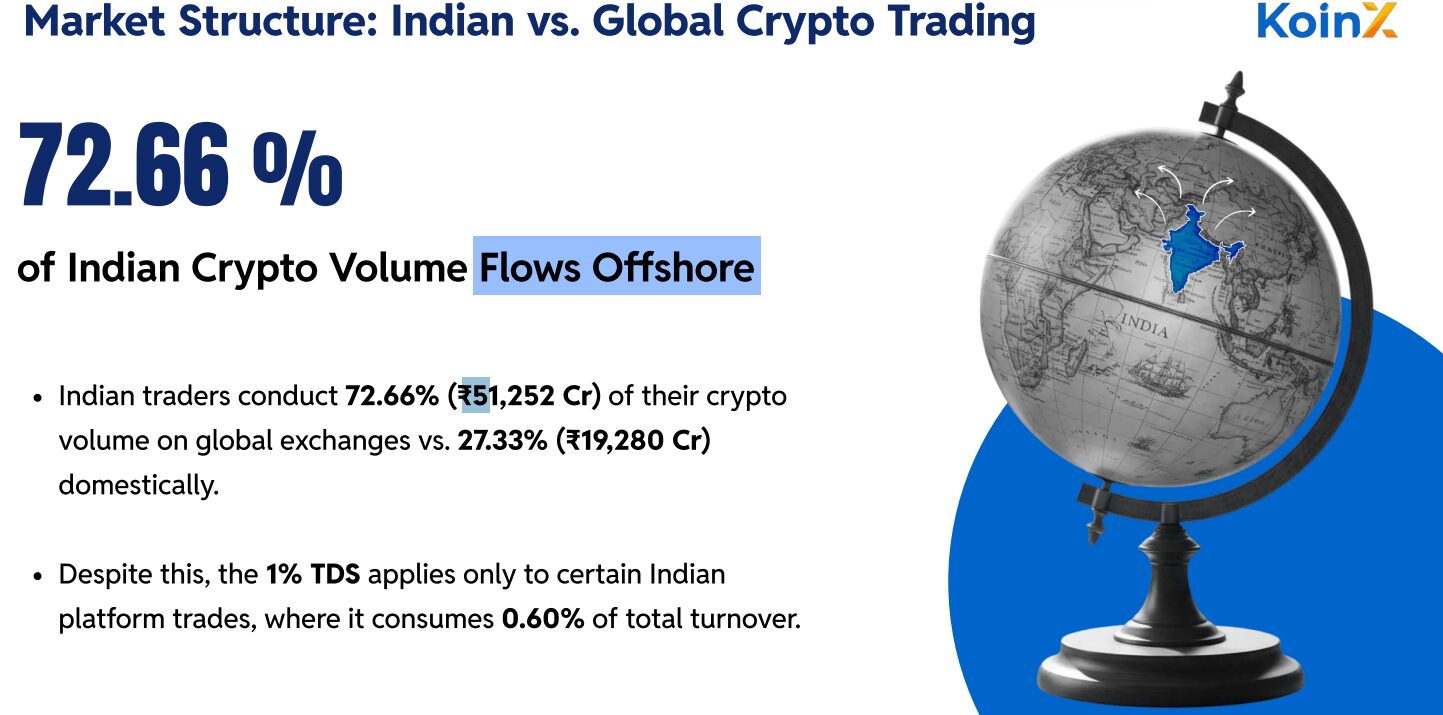
About 72.66% of India’s crypto trading volume that stood at Rs 51,252 crores in FY25 went to global offshore exchanges, revealed a survey by crypto tax compliance platform KoinX.
Use of global exchanges and offshore accounts by Indian users
Many Indian investors are moving their crypto activity to international platforms like Binance, Coinbase, Kraken, and Bitget, or leveraging cross-border OTC networks.
These channels give traders access to broader asset selections, higher liquidity, and more advanced trading tools that domestic platforms often cannot provide due to regulatory limits.
By operating through offshore accounts, users can trade around restrictions, avoid some of the reporting complexity, and participate in global DeFi protocols that are unavailable locally.
Implications for local innovation and fintech development
As Indian crypto users go offshore, the growth of local fintech ecosystems could become problematic. With fewer people actively using local exchanges, there will be fewer reasons for fintechs to innovate and introduce more advanced blockchain-based technology and innovative financial products.
Due to this brain drain, the development of local infrastructure for cryptocurrencies and fintechs may slow and hinder young companies’ ability to scale internationally.
Regulatory arbitrage and relocation
Many crypto businesses in the country have decided to restructure themselves or create offshore subsidiaries in order to optimize their tax position and comply with regulations that operate on an international level but not within the framework set by India.
Risk of long-term competitiveness
If the offshore trend gains more momentum, India might start falling behind other emerging markets in terms of crypto and blockchain innovation. The decline in trading volume and investment will not encourage institutions to operate in India.
As a result, India may end up at a disadvantage compared to other emerging markets that are actively adopting crypto and blockchain, which will negatively impact its long-term development.
Balancing Control and Growth
Now, India can easily be called one of the most restrictive countries for crypto trading on the planet. High taxes, crypto regulations, and uncertainty can become barriers for both users and exchanges. These restrictions are introduced for good reasons; however, they push crypto users offshore and limit its development in India.
For India to keep pace with the rest of the world in cryptocurrency trading, proper regulation and appropriate taxation are crucial. Good regulations, minimal reporting, and proper incentives for local innovation could go a long way in ensuring that India does not lose its competitiveness due to inadequate policy.
Disclaimer: This article is intended solely for informational purposes and should not be considered trading or investment advice. Nothing herein should be construed as financial, legal, or tax advice. Trading or investing in cryptocurrencies carries a considerable risk of financial loss. Always conduct due diligence.
Enjoyed this piece? Bookmark DeFi Planet, explore related topics, and follow us on Twitter, LinkedIn, Facebook, Instagram, Threads, and CoinMarketCap Community for seamless access to high-quality industry insights.
Take control of your crypto portfolio with DEFI PLANET PRO, DeFi Planet’s suite of analytics tools.”