















Quick Breakdown

- US Treasury yields approaching 5% make borrowing more expensive, prompting investors to shift from risk assets like Bitcoin to safer returns.
- Bitcoin price is hovering near key support levels around $68K, with projections suggesting potential drops toward $50K–$45K if macro and technical pressure persists.
- Higher yields reduce liquidity, extend institutional holding periods, strengthen crypto’s correlation with equities, and strain DeFi/leveraged positions, increasing volatility and risk.
Bond yields might sound like something only economists care about, but they quietly control how money moves across the entire financial system. Yields reflect the return investors earn from holding government debt like Treasury bonds. When yields rise, borrowing becomes more expensive, liquidity tightens, and investors start shifting away from risky assets.
At the time of writing, the 10-year US Treasury yield has climbed to around 4.4%, its highest level in months, while the 30-year yield is approaching the critical 5% mark. Rising oil prices and ongoing tensions tied to the US–Iran conflict are fueling inflation fears, which reduces the likelihood of interest rate cuts anytime soon.

If yields break above 5%, it signals tighter financial conditions ahead, and that could have a direct impact on risk assets like Bitcoin.
Why 5% Yields Could Trigger a Bitcoin Sell-Off
With the increase in yields, there is a shift in investor attitudes towards risk. Assets like Bitcoin will appear more appealing when yields are low, because their yields are high. With high yields that tend to approach or exceed 5%, safe assets can earn their yield without bearing any risk.
Opportunity costs arise from the risky investments that make the opportunity costs of buying bonds lower than purchasing stocks from the S&P 500 or Bitcoin. That’s why if the 10-year yield crosses 5%, we could see capital rotate out of crypto markets.
There’s also a broader ripple effect. Rising yields push mortgage rates higher (with fears already pointing toward 7%), tighten consumer spending, and slow down economic activity. All of this drains liquidity, the same liquidity that has always driven bitcoin rallies in the past.
If yields keep rising towards extreme highs above 6%, Bitcoin may find it difficult to sustain its rally going forward. It may act like a regular risk asset, with increased sell-offs as investors prefer stability over gains.
ALSO READ: Can AI Agents Become Liquidity Drivers for Stablecoins?
How Low Can Bitcoin’s Price Go?
Since the start of April, Bitcoin has slipped from $69,230 to around $67,740, showing early signs of weakness. While that drop may not look dramatic at first glance, it reflects a loss of momentum at a time when macro pressure, especially rising bond yields, is building.

According to CryptoQuant analyst Axel Adler Jr, “as long as Bitcoin’s price holds above $68K, the largest cohort remains near its cost basis and maintains a more resilient position.” It also lines up with the “realized price” of large holders (wallets holding 100–1,000 BTC), meaning this is roughly the average price where major investors accumulated their positions.
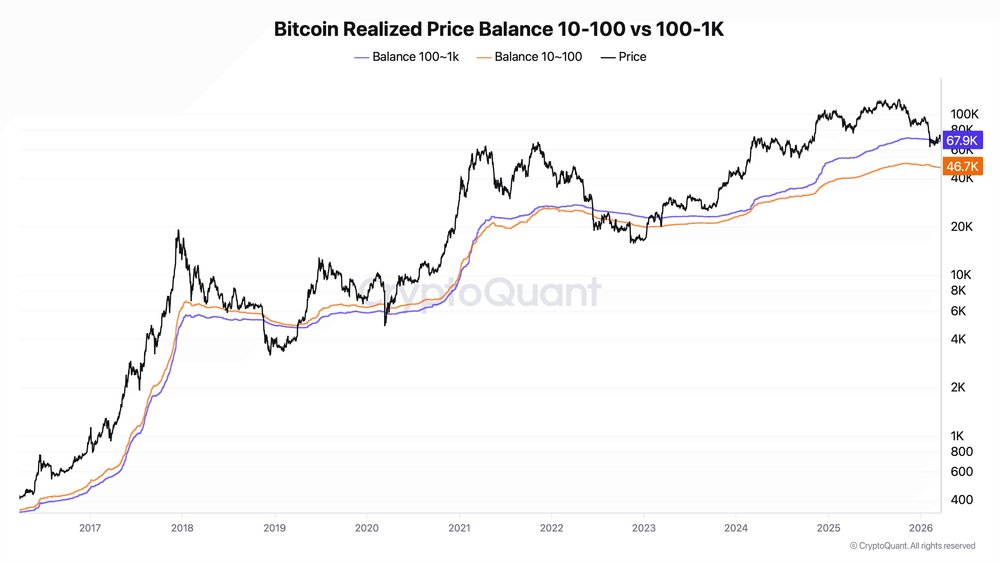
When price sits around this level, it becomes a key decision point: either buyers step in and defend it, or sellers take control.
From a technical standpoint, there’s also a more cautious outlook forming. Analyst Michael J. Kramer said
Bitcoin is getting close to taking that next leg lower into the mid-40ks. pic.twitter.com/xZR8qx6vcx
— Michael J. Kramer (@MichaelMOTTCM) March 22, 2026
If Bitcoin breaks below this structure, projections suggest a potential move toward $50,000 or even lower in the coming months.
That bearish outlook is also showing up in market expectations. On prediction platforms like Polymarket, traders are already pricing in a 66% chance that Bitcoin will drop below $55,000 by 2026, with nearly a 44% probability that it will fall below $45,000.

Taken together, this suggests that Bitcoin isn’t just reacting to short-term price movements; it’s sitting at a critical level where technical pressure and macro conditions could decide its next major move.
Impact on Crypto Market Structure
Rising US bond yields don’t just influence Bitcoin’s price; they reshape how the entire crypto market functions and how investors allocate capital.

Decreased liquidity across multiple exchanges
With interest rates on US Treasuries exceeding 5%, investors may seek investments with greater security and higher returns. Capital outflows from crypto exchanges will reduce the amount of money circulating on these platforms.
As for Bitcoin and Ethereum, reduced liquidity may make minor transactions create price surges or falls, thus making the market more susceptible to volatility. For altcoins, low crypto liquidity may lead to a crash when high order volumes meet thin order books.
Increased holding period for institutional investors
The actions of institutional investors to combat macroeconomic issues include reducing trading and holding onto positions longer to avoid exposure to high volatility.
As for Bitcoin, it will likely result in a decrease in the number of bitcoins traded actively, which may influence price spikes or drops due to the limited supply of Bitcoin.
The link to the traditional financial market grows stronger
Bitcoin traditionally tends to act as a risky financial instrument, and higher rates amplify this trend. The higher the rate, the more Bitcoin starts to correlate with equities because shocks in the equity market and macroeconomic news lead to movements in both markets at once.
DeFi and leverage operations
Yield growth leads to an increase in the costs of taking loans in crypto, which directly impacts margin trades and leverage operations in the crypto world. Defi projects that offer borrowing, lending, or yield farming experience tend to see lower user participation.
Macro Dominance Over Crypto
Investor sentiment is driven by the rising yields on US bonds, worries about rising inflation and geopolitical uncertainties. Given that the US Treasury 10-year yield is approaching or may cross the critical 5% level, crypto markets may see tighter liquidity, greater volatility, and limited upside potential, even in Bitcoin.
Going forward, BTC’s direction is expected to depend heavily on how these macro factors unfold. Should yields stabilize or geopolitical tensions decrease, Bitcoin may get back on track as a risky asset, whereas higher yields will limit upside and increase potential corrections.
For investors, all this confirms an important fact – it is necessary to understand the macro environment.
Disclaimer: This article is intended solely for informational purposes and should not be considered trading or investment advice. Nothing herein should be construed as financial, legal, or tax advice. Trading or investing in cryptocurrencies carries a considerable risk of financial loss. Always conduct due diligence.
Enjoyed this? Bookmark DeFi Planet, explore related topics, and follow us on Twitter, LinkedIn, Facebook, Instagram, Threads, and CoinMarketCap Community for seamless access to high-quality industry insights.
Take control of your crypto portfolio with DEFI PLANET PRO, DeFi Planet’s suite of analytics tools.






