















Quick Breakdown

- AI agents could increase blockchain activity, generating thousands or even millions of transactions per second through automated trading, microtransactions, and machine-to-machine interactions across DeFi, gaming, and Web3 applications.
- Future AI adoption may require blockchains to process up to 1 billion TPS, far exceeding the real-world capacity of today’s networks like Solana and Ethereum.
- Current scaling solutions may not be enough, pushing the industry toward new architectures, hybrid on-chain/off-chain systems, and innovative designs to support AI-driven blockchain ecosystems.
AI agents are now a key part of Web3 applications, gaming ecosystems, DeFi, and enterprise blockchain solutions. They can trade, manage digital assets, and interact with smart contracts or users on their own, all in real time. Because of this, AI agents can process thousands, or even millions, of transactions per second, far more than humans usually generate.
This increase in transactional load is pushing blockchains to rethink performance benchmarks. Networks that once measured success in tens of thousands of transactions per second (TPS) now face projections requiring billions of TPS to support AI-driven ecosystems.
As more AI systems are used, the pressure mounts to ensure blockchain scalability, low latency, and cost-effective processing, raising a crucial question for the blockchain industry: are today’s networks already obsolete in meeting the next generation of computational and transactional demands?
How Many TPS Do AI Agents Actually Need?
According to predictions from the co‑founders of Stripe, future AI adoption could push the demand for blockchain transaction throughput into uncharted territory.
Stripe’s founders argue that if AI agents become primary drivers of internet commerce and routine digital tasks, blockchains may need to scale beyond one million and up to one billion TPS to handle this surge, a scale far above what today’s public networks can achieve.
This projection reflects how AI interactions multiply transactional load: agents not only initiate rapid repeated actions but also communicate with multiple protocols, handle microtransactions, and interact at volumes far higher than any individual human user.
Today’s fastest public chains like Solana and Internet Computer Protocol only handle around 1,100 –1,250 TPS in real use, with theoretical peaks far below the projected AI demand.
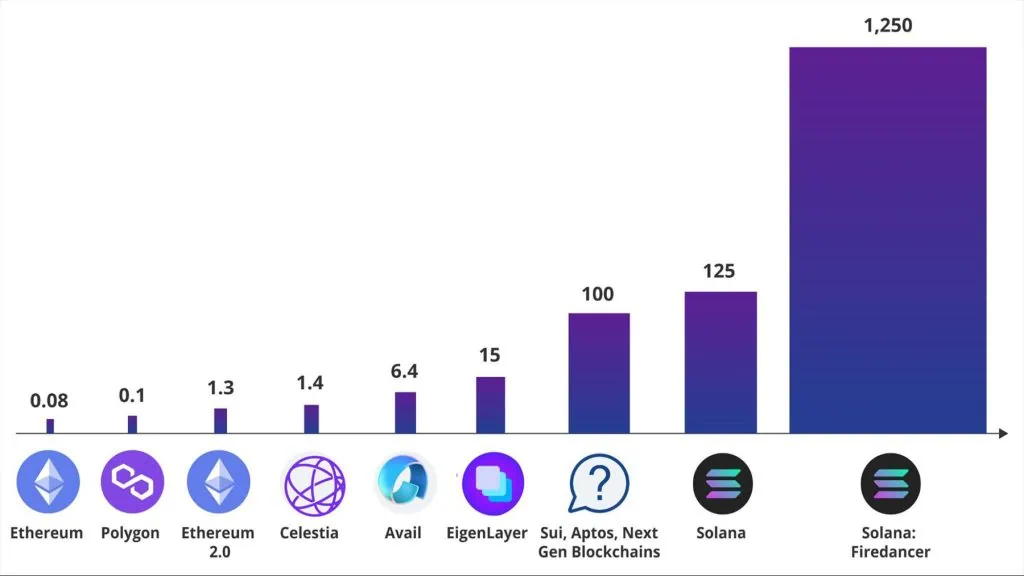
Even peak throughput figures, on the order of tens of thousands of TPS, remain orders of magnitude below future requirements if billions of autonomous agents are active simultaneously across applications.
Why traditional scaling may fall short
Traditional blockchain scaling approaches, such as Layer‑2 rollups, sharding, or throughput improvements, address parts of the problem but may not handle the exponential increase AI agents could bring. Most current designs still rely on consensus models that limit how many transactions can be processed in parallel without sacrificing decentralization or security.
Even advanced solutions typically target tens of thousands, sometimes hundreds of thousands, of TPS, which is only a starting point compared with the million‑plus TPS some forecasts suggest will be needed for widespread AI agent adoption.
While no fixed number of transactions is set in stone, expert voices in the tech community have made it clear that today’s blockchain capacity is far from sufficient for the level of agent‑driven activity envisioned for the future.
Meeting that demand will likely require entirely new architectures, protocols, and possibly radical rethinking of blockchain scalability beyond conventional TPS improvements.
Limitations of Current Scaling Solutions
Although blockchain scalability has improved through various technological innovations, many existing solutions may still struggle to meet the extreme throughput demands expected from large-scale AI agent activity.

Layer-1 upgrades (sharding, consensus changes)
Layer-1 scaling focuses on improving the core blockchain protocol itself. Techniques such as sharding divide the network into multiple smaller partitions that process transactions in parallel, potentially increasing throughput significantly.
Consensus upgrades, such as the shift from proof-of-work to proof-of-stake, also aim to reduce energy consumption and improve block finality times. For example, networks like Ethereum have explored sharding and other architectural changes to increase transaction capacity.
While these upgrades can raise performance limits, they often require complex coordination between nodes and can introduce new technical challenges, particularly when maintaining synchronization and security across shards.
Layer-2 solutions (rollups, sidechains)
Layer-2 solutions attempt to scale blockchain networks by processing transactions off the main chain while still relying on it for security and final settlement. Rollups bundle many transactions together and submit them as a single proof to the base layer, significantly reducing network congestion.
Sidechains operate as separate blockchains that connect to the main network and handle transactions independently. Ecosystems built around platforms like Polygon demonstrate how these approaches can expand capacity for decentralized finance, gaming, and Web3 applications.
However, layer-2 systems ultimately depend on the base blockchain’s throughput for final verification, which can still create bottlenecks during periods of extremely high activity.
Security, decentralization, and latency trade-offs
Blockchain scaling is constrained by the “blockchain trilemma,” a concept introduced by Vitalik Buterin, which describes the challenge of balancing blockchain scalability, security, and decentralization.
Improving throughput often requires compromises in at least one of these areas. For instance, increasing transaction speed might involve reducing the number of validating nodes, which can weaken decentralization.
Some scaling methods also introduce delays between transaction execution and final settlement, creating latency that may not be suitable for high-frequency machine-to-machine interactions.
Why incremental scaling alone may not suffice
Most current scaling approaches deliver incremental improvements rather than transformative increases in network capacity.
While tens of thousands of transactions per second may support today’s decentralized applications, AI-driven ecosystems could generate millions or even billions of automated interactions across DeFi, gaming, supply chains, and digital marketplaces.
In such scenarios, simply adding more shards or rollups may not keep pace with the exponential growth in machine-generated activity.
Addressing these demands may require fundamentally new blockchain architectures, advanced parallel processing systems, or hybrid infrastructures that combine on-chain security with high-throughput off-chain computation.
Are Today’s Blockchain Networks Already Obsolete?
The rapid rise of AI agents is exposing the limits of current blockchain performance, but it does not necessarily mean that today’s networks are already obsolete.

Ongoing network upgrades
Many major blockchains are still evolving and continue to introduce upgrades designed to improve scalability and efficiency. Networks such as Ethereum are developing technologies like sharding and rollups, while high-performance chains such as Solana are improving throughput and reducing transaction costs. These upgrades suggest that existing networks still have room to grow before reaching their true performance limits.
Hybrid on-chain and off-chain systems
Not every interaction generated by AI agents will need to occur directly on a blockchain. Many machine-to-machine activities can be processed off-chain through high-speed computing systems, with blockchains used mainly for settlement, verification, or record-keeping. This hybrid approach can significantly reduce network congestion while maintaining the security and transparency that blockchains provide.
New blockchain architectures are emerging
The pressure created by AI-driven demand is also encouraging the development of new blockchain designs. Future networks may rely on modular architectures, parallel processing, and specialized chains designed for high-frequency machine interactions. These innovations could dramatically increase transaction capacity without completely replacing existing blockchain ecosystems.
Incremental scaling still adds value
Even if current solutions cannot reach billions of transactions per second immediately, incremental scaling improvements still matter. Enhancements in layer-2 networks, data availability layers, and improved consensus mechanisms can collectively increase throughput over time, allowing current networks to gradually adapt to rising demand rather than becoming instantly outdated.
Practical Guidance for Developers and Investors
As AI agents begin interacting with blockchains more frequently, both developers and investors must start preparing for an environment where blockchain scalability, speed, and efficiency become critical to long-term success.
How developers can design AI-ready dApps and protocols
Developers building decentralized applications should begin designing systems that can handle high volumes of automated activity. AI-driven applications may generate continuous machine-to-machine interactions, microtransactions, and rapid decision-making processes.
To support this, developers can integrate layer-2 scaling solutions, modular blockchain architectures, and efficient smart contract designs that reduce unnecessary on-chain computations. Optimizing gas usage, minimizing transaction complexity, and using batching techniques can also help ensure that AI-powered dApps remain functional even when network demand increases significantly.
Key considerations for investing in scalable networks
For investors, scalability is becoming one of the most important metrics when evaluating blockchain projects. Instead of focusing only on short-term price performance, investors may benefit from assessing a network’s technical roadmap, throughput capacity, and long-term infrastructure plans.
Blockchains that support modular designs, parallel transaction processing, and strong developer ecosystems may be better positioned to handle AI-driven workloads. Evaluating factors such as real-world transaction capacity, network stability, and adoption by major developers can also provide insight into whether a project is prepared for future demand.
Balancing decentralization, security, and speed for long-term viability
One of the biggest challenges in blockchain design is maintaining the balance between decentralization, security, and scalability. Increasing transaction speed often requires compromises, such as reducing validator participation or increasing hardware requirements.
Developers and investors must therefore consider whether a network’s scaling strategy preserves long-term security and decentralization while improving performance. Sustainable blockchain ecosystems will likely be those that find ways to improve throughput without sacrificing the core principles that make decentralized networks trustworthy.
Future-Proofing Blockchain Networks for the AI Era
As AI agents become more integrated into digital economies, blockchain networks will need a clear strategy to scale far beyond current performance levels. Future-proofing blockchain infrastructure might require a long-term roadmap focused on extreme scalability, including modular architectures, improved data availability layers, and parallel transaction processing.
Interoperability will also play a crucial role in managing future demand. Cross-chain solutions can distribute activity across multiple networks rather than concentrating all transactions on a single chain, helping reduce congestion and improve overall system resilience.
At the same time, developers, investors, and network operators should closely monitor AI adoption trends to anticipate when automated activity could place new stress on blockchain infrastructure. Proactively adapting to these trends will be key to ensuring that blockchain networks remain capable of supporting the next generation of AI-driven applications.
Disclaimer: This article is intended solely for informational purposes and should not be considered trading or investment advice. Nothing herein should be construed as financial, legal, or tax advice. Trading or investing in cryptocurrencies carries a considerable risk of financial loss. Always conduct due diligence.
Enjoyed this piece? Bookmark DeFi Planet, explore related topics, and follow us on Twitter, LinkedIn, Facebook, Instagram, Threads, and CoinMarketCap Community for seamless access to high-quality industry insights.
Take control of your crypto portfolio with DEFI PLANET PRO, DeFi Planet’s suite of analytics tools.”






