



















































Quick Breakdown

- The bill protects blockchain developers who write and maintain open-source code from being wrongly labelled as financial intermediaries, reducing the fear of facing criminal charges.
- Boost to U.S. innovation. By setting clear legal boundaries, the bill encourages startups, investment, and open-source collaboration in blockchain technology.
- Regulators can focus on actors who actually control user funds or operate unlicensed financial services. This should improve oversight and help prevent misuse of the law.
Recently, blockchain developers have come under more legal scrutiny as governments try to regulate the fast-changing crypto industry. Regulators are now looking closely at tools for decentralized networks, like smart contracts, privacy protocols, and open-source code, because they worry these could be misused for illegal activities.
This growing pressure has led to a major debate: should developers be held legally responsible for how their code is used after it is released? The issue has become more urgent following past controversies involving creators of decentralized protocols who faced legal action despite claiming their work was simply open-source software.
In response, members of Congress have introduced a new pro-innovation bill aimed at clarifying whether writing and publishing code should be treated as protected activity.
Overview of The Pro-Innovation Bill
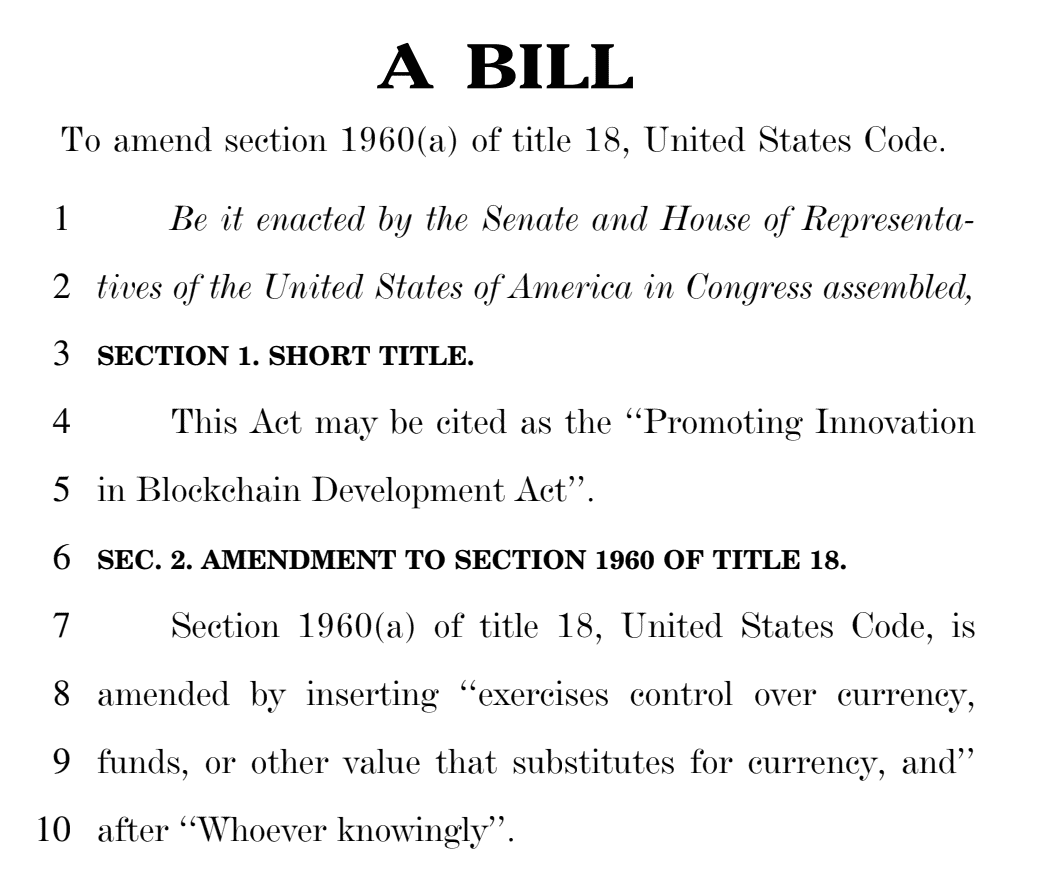
The proposed Promoting Innovation in Blockchain Development Act of 2026 was introduced in the United States Congress on February 26, 2026, to address growing legal uncertainty facing blockchain developers.
The bipartisan bill, sponsored by Scott Fitzgerald, Ben Cline, and Zoe Lofgren, aims to ensure that software developers who write code but do not handle users’ funds are not wrongly treated as financial intermediaries under current criminal laws.
Key provisions of the Pro-Innovation in Blockchain Development Act
A central part of the bill focuses on clarifying how 18 U.S.C. Section 1960 should apply to blockchain activity. Section 1960 is a U.S. criminal law that targets unlicensed money-transmitting businesses.
The new bill explains that the law should only apply to entities that actually control customer assets or transmit funds on behalf of users. This clarification aims to prevent developers from being misclassified as money transmitters simply for publishing or maintaining blockchain software.
How the bill aims to protect developers
The bill also makes it clear that writing and sharing open-source code should not count as running a financial service. Many blockchain developers create tools that anyone can use, without the developer having ongoing control. The bill says these developers should not face criminal charges if they do not manage customer funds or run a financial platform.
Supporters say the bill aligns existing law with the long-standing regulatory interpretation of the U.S. Department of the Treasury, which has generally focused enforcement on actors that actually move or control funds.
According to Rep. Ben Cline,
“For too long, federal overreach has blurred the line between bad actors and the innovators building next-generation technology. The Promoting Innovation in Blockchain Development Act restores needed clarity by protecting developers who don’t control customer funds, while ensuring law enforcement can continue to target real criminals. I’m proud to support this effort to keep America the global leader in blockchain innovation.”
Rep. Zoe Lofgren also noted that
“Blockchain technology has been quickly evolving, and regulations set by Congress have simply not kept up. Right now, we’re seeing misapplication of existing law harm innovation and push developers offshore. This bipartisan legislation provides clarity and protects software developers who don’t control customer funds from being wrongly exposed to criminal liability.”
By clarifying the legal boundaries, lawmakers hope to reduce fear among developers and encourage innovation in blockchain technology within the United States.
What Are The Rewards of The New Pro-Innovation Bill?
This new bill could strengthen the U.S. blockchain industry by giving developers clearer legal protections while encouraging innovation and responsible growth.
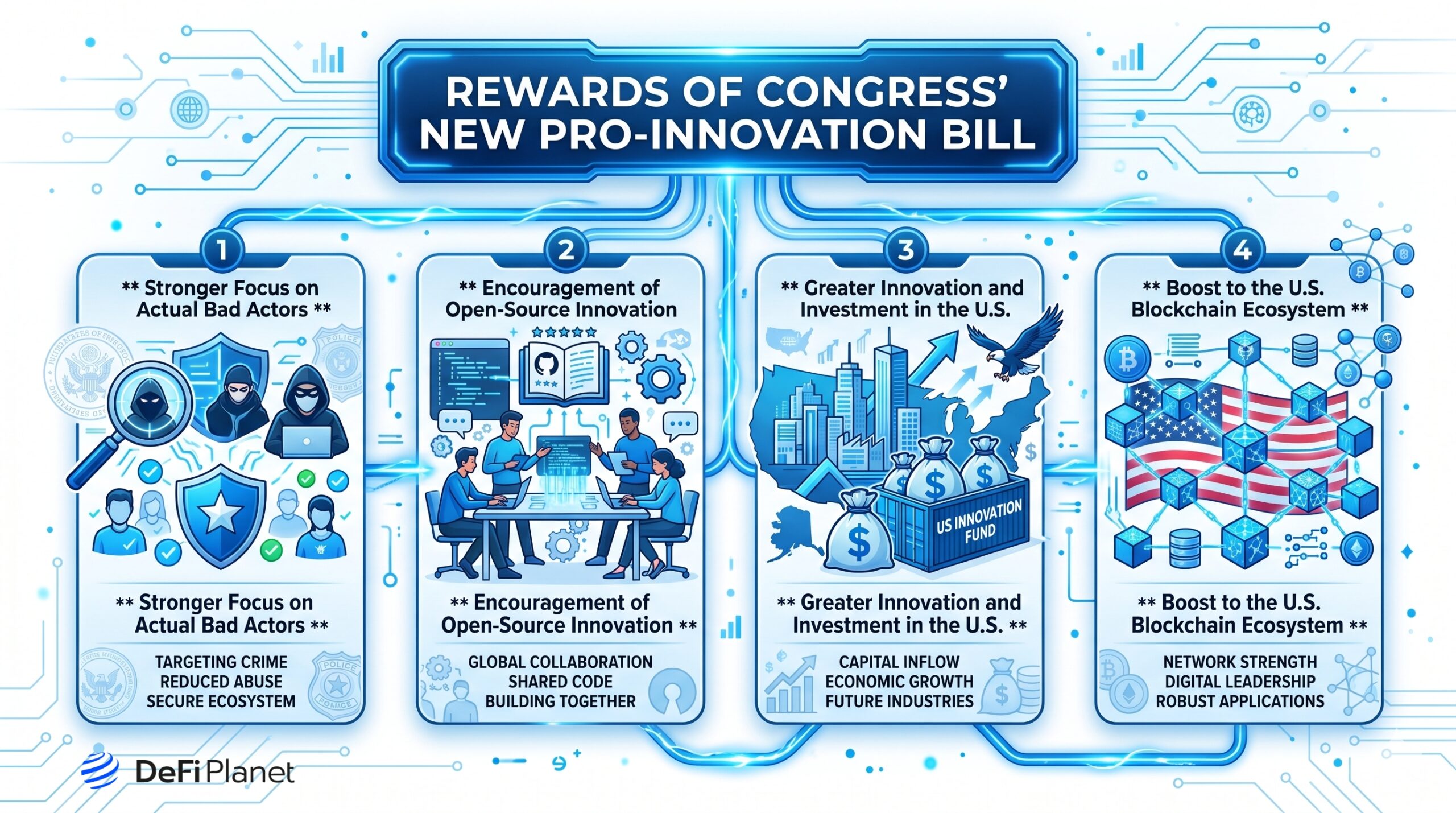
Stronger Focus on Actual Bad Actors
Another reward is that regulators can focus enforcement on individuals or companies that truly control user funds and operate unlicensed financial services. Instead of targeting software creators, authorities can concentrate on fraud, illegal money transmission, and financial misconduct, making enforcement more effective.
“The Promoting Innovation in Blockchain Development Act draws a clear line between those who develop and deploy blockchain software and those who actually move or manage funds. It provides long-overdue legal clarity, protects innovation here at home, and allows law enforcement to focus on genuine criminal activity.” – Rep. Scott Fitzgerald
Encouragement of Open-Source Innovation
Blockchain technology relies heavily on open-source collaboration. The bill supports this model by reinforcing the idea that publishing or maintaining open-source code should not expose developers to criminal liability. With stronger legal clarity, developers may feel more confident contributing to decentralized projects without fearing legal consequences.
Greater Innovation and Investment in the U.S.
Supporters argue that legal uncertainty has pushed some blockchain developers and startups to move their projects outside the United States. By creating a more predictable legal environment, the bill could encourage entrepreneurs to build and launch blockchain platforms domestically, potentially strengthening the country’s position in emerging technologies.
Boost to the U.S. Blockchain Ecosystem
Clearer legal boundaries could help grow the broader blockchain ecosystem, including startups, research labs, and open-source communities. If developers feel protected while experimenting with decentralized technologies, it may accelerate innovation in areas such as DeFi, digital identity systems, and blockchain infrastructure.
Risks of The New Pro-Innovation Bill?
While the pro-Innovation bill aims to protect developers and support innovation, the policy could also introduce new legal and regulatory risks if not carefully enforced.
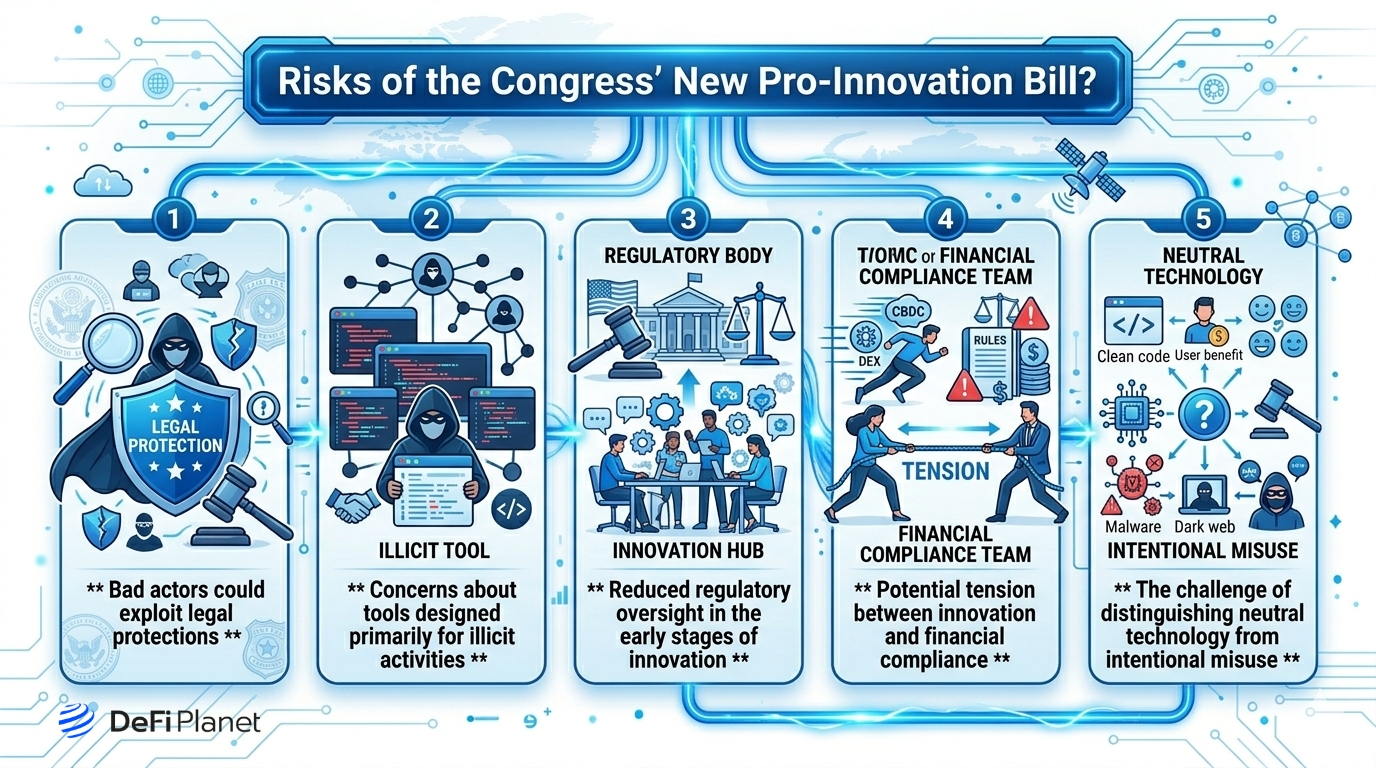
Bad actors could exploit legal protections
One concern is that individuals involved in questionable activities may claim they are simply “developers” to avoid legal responsibility. If the law strongly shields those who write code, some bad actors could try to hide behind these protections while enabling illegal financial activity.
Concerns about tools designed primarily for illicit activities
Some blockchain tools, such as anonymous transaction services or automated financial systems, could be used to move or hide funds from illegal operations. Critics worry that if developers of such tools are broadly protected, it may become harder for authorities to act against software intentionally designed to support crime.
Reduced regulatory oversight in early stages of innovation
Stronger protections for developers could unintentionally reduce oversight during the early development of financial technologies. Without proper safeguards, risky or poorly designed systems could enter the market before regulators fully understand their impact.
Potential tension between innovation and financial compliance
The bill may also create friction between innovation and existing financial rules. Regulators could struggle to balance encouraging new technology while still enforcing anti-money-laundering laws and protecting the broader financial system.
The challenge of distinguishing neutral technology from intentional misuse
A major challenge is deciding whether a piece of code is a neutral technology or something built specifically to facilitate illegal activity. Many blockchain tools are dual-use, meaning they can serve both legitimate and harmful purposes, making enforcement and regulation complex.
Recommendations for Balanced Developer Regulation
Policymakers will need to design frameworks that protect innovation while still maintaining clear accountability. This could include defining when developers are responsible for a platform’s activity and when they are simply publishing open-source code.
Clear legal definitions and fair compliance rules can help make sure developers are not unfairly targeted, while still stopping misuse of blockchain technologies. At the same time, more transparency—like voluntary audits, security reviews, and disclosure standards—can help build trust in decentralized tools.
By combining legal clarity with practical oversight, regulators can support technological progress while protecting users and the broader financial system.
Disclaimer: This article is intended solely for informational purposes and should not be considered trading or investment advice. Nothing herein should be construed as financial, legal, or tax advice. Trading or investing in cryptocurrencies carries a considerable risk of financial loss. Always conduct due diligence.
Enjoyed this piece? Bookmark DeFi Planet, explore related topics, and follow us on Twitter, LinkedIn, Facebook, Instagram, Threads, and CoinMarketCap Community for seamless access to high-quality industry insights.
Take control of your crypto portfolio with MARKETS PRO, DeFi Planet’s suite of analytics tools.”