











Everyone watching crypto in 2025 saw the headlines about Bitcoin prices and market cap milestones, but the real story was the quiet transformation of yield itself. After years of speculation and regulatory uncertainty, crypto started building real bridges to traditional finance (TradFi) as yield returned to digital assets—not through risky token farms, but through real-world financial instruments like government bonds and regulated stablecoin frameworks.

What Changed in 2025?
The catalyst for this transformation was U.S. legislation known as the Guiding and Establishing National Innovation for U.S. Stablecoins Act of 2025, widely referred to as the GENIUS Act. On July 18, 2025, President Trump signed the GENIUS Act into federal law, creating the first comprehensive U.S. regulatory framework for payment stablecoins. This law set rules requiring U.S.‑dollar‑pegged stablecoins to be backed 100% by liquid assets such as dollars or short‑term Treasuries and to provide regular public disclosures of those reserves.
:max_bytes(150000):strip_icc():format(webp)/GettyImages-2225858033-d920095771fa45feb8a8fa2815d712e9.jpg "Yield Is Back: RWAs, Tokenized Treasuries and Interest‑Bearing Stablecoins After the GENIUS Act")
This was a game‑changer in crypto regulation because it replaced uncertainty with clear guardrails, which are precisely what institutional money has been asking for. The GENIUS Act gave stablecoins a legal definition and status in the U.S., marking a massive shift for an asset class that had for years operated in regulatory grey zones.
READ ALSO: Is The GENIUS Act a Game Changer For US Regulation?
The law did not make stablecoins perfect or risk‑free; it did not allow interest payments directly to holders, a deliberate choice by legislators intended to avoid turning stablecoins into bank deposit substitutes. What it did was to create a fertile environment for innovation, particularly around how yield could be earned without violating the law.
The GENIUS Act changed the incentives for innovation in stablecoins and DeFi by requiring full reserve backing and transparent audits. The law effectively forced issuers to adopt professional-grade financial controls, similar to those used by banks and money market funds.
Also, the law accelerated the development of compliant yield products, and since direct interest on stablecoins was prohibited, crypto innovators had to pivot toward alternative ways to generate returns. This led to a surge in tokenized real-world assets (RWAs) like short-term Treasuries, money market instruments, and structured debt products on blockchain networks.
The GENIUS Act also standardized disclosure and auditing requirements, which allowed regulators, investors, and market participants to track stablecoin reserves in real time. This transparency reduced systemic risk and made stablecoins more trustworthy as tools for payments, settlements, and collateral.
In practice, this meant that stablecoins could now serve as institutional-grade digital cash, usable for trading, lending, and collateralization, while simultaneously integrating with tokenized Treasuries and other yield-bearing RWAs.
Finally, the law signalled to the broader financial markets that the U.S. was serious about fostering regulated innovation in digital assets. Other jurisdictions began looking to the GENIUS Act as a model for creating legal certainty for stablecoins, marking 2025 as the start of a more globally coordinated approach to bridging TradFi and DeFi.
Why Yield Matters in Crypto
Yield has always been the lifeblood of financial markets, and in TradFi, investors expect returns on their capital, whether through interest, dividends, or yield curves. For years, crypto struggled to offer a trustworthy yield system. The early DeFi era was defined by high‑APR farming and temporary liquidity incentives, which were exciting but not sustainable or deeply trusted by institutions.
In 2025, that changed, and crypto began to offer yield that looked more like TradFi but with blockchain advantages. Instead of chasing short‑term token incentives, investors and institutions started allocating to tokenized government debt, regulated RWA products, and interest‑aligned yield instruments that fit into broader financial portfolios.
Institutional players began participating more actively, deploying capital into these tokenized products alongside traditional portfolios. They were attracted to features such as real-time settlement, on-chain collateralization, and the ability to programmatically integrate assets into DeFi lending, borrowing, and structured strategies. Even sophisticated retail investors began to take advantage of these products, accessing yields that were previously restricted to banks or money market funds.
2025 also saw the emergence of interest-aligned yield instruments that bridged the gap between DeFi and TradFi. These products delivered predictable, regulated returns without the extreme volatility of typical DeFi farming. Examples included tokenized money market instruments, Treasury-backed tokens, and structured RWA pools that generated yield while remaining compliant under U.S. stablecoin law.
Tokenized Treasuries: Real Yield on Chain
Perhaps the biggest story of 2025 in this space was the explosive growth in tokenized U.S. Treasury assets.
According to CoinGecko’s 2025 RWA Report, the market cap of tokenized Treasury assets climbed from virtually nothing to $5.6 billion by April 2025, representing a 544% increase year-over-year. This made tokenized treasuries the fastest-growing class of RWA assets in crypto during that period.

BlackRock’s BUIDL fund emerged as the dominant player, holding roughly 44% of the tokenized Treasuries market cap by April 2025 after growing significantly within the year. Other major players, including Ondo Finance, Franklin Templeton, and Superstate, also helped expand the category, bringing greater variety and depth to these on-chain financial instruments.
Why does this matter? U.S. Treasuries are the bedrock of global finance. Tokenizing them means you can:
- Hold, trade, and settle Treasury exposure directly on blockchains
- Use them as collateral in DeFi applications
- Integrate them into smart contracts for lending, borrowing, and liquidity provisioning
That gives crypto users real yield that is tied to the very core of global markets.
READ ALSO: 5 Powerful Charts, 25 Sector Drivers That Defined Crypto’s $4Trillion Year
Yield Without Yield‑Bearing Stablecoins

The GENIUS Act prohibited stablecoins from paying interest directly to holders under its payment rules. In practice, the restriction redirected creativity rather than suppressing it, pushing builders toward alternative yield paths that were both law-abiding and institutionally credible.
Instead of yield-bearing stablecoins, the market began to embrace yield-linked instruments that sit adjacent to stablecoins rather than inside the payment stablecoin category:
- Tokenized Treasury bills and short-term debt tokens
- Tokenized money market funds
- Structured RWA products that generate return outside the stablecoin payment framework
These instruments function like yield-bearing stablecoins in effect, but they are structured differently so they comply with the new regulatory framework.
Tokenized Treasury bills and short-term debt tokens became one of the most important substitutes. These tokens represent claims on government securities that already pay yield in traditional markets, and by bringing them onchain, users could earn returns tied to risk-free or low-risk instruments while still benefiting from blockchain settlement, programmability, and composability.
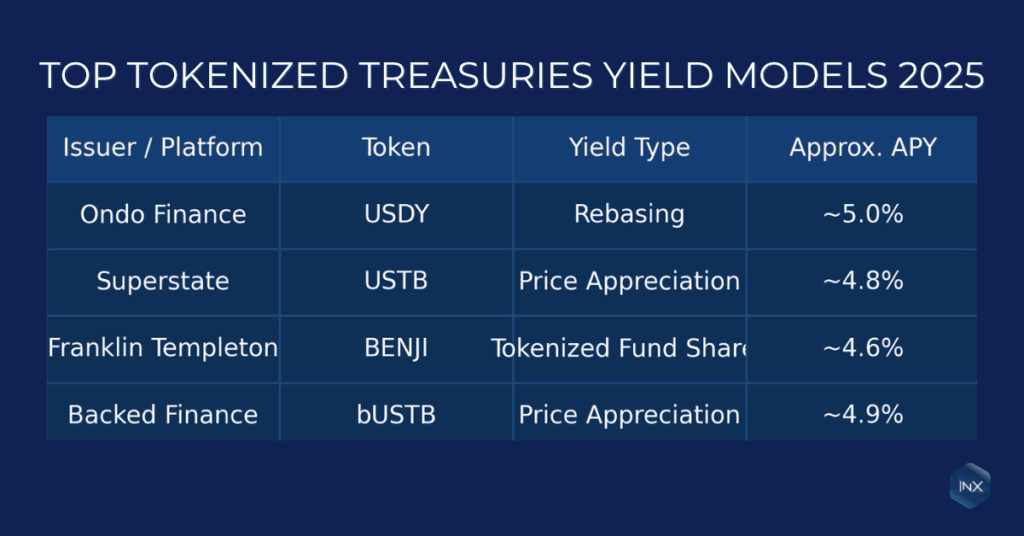
Tokenized money market funds also gained traction; these products pool capital into diversified short-duration assets like Treasury bills and repurchase agreements, then issue on-chain tokens representing ownership in the fund. For the main reason that they are structured as investment products rather than payment stablecoins, they fall outside the GENIUS Act’s interest prohibition while still delivering a predictable yield.
Structured RWA products expanded alongside these developments, including on-chain vehicles that bundle Treasuries, cash-like instruments, or private credit into transparent pools designed to generate yield without functioning as circulating money.
Data shows that these yield-linked RWA instruments grew rapidly throughout 2025 as users and institutions adjusted to the new regulatory environment. This allowed DeFi to tap into macroeconomic yield without relying on speculative token incentives.
More importantly, this shift helped separate money from yield in crypto, while stablecoins became what regulators wanted them to be: reliable, boring, payment-focused digital cash. Yield moved into clearly defined investment products built on top of that cash layer. This separation mirrors TradFi, where checking accounts do not pay yield, but money market funds and Treasury products do.
The result is a more mature financial stack, where regulators get clearer boundaries, and builders gain room to innovate responsibly.
Stablecoins as Treasury Demand Engines
The regulatory requirement for stablecoins to hold high-quality liquid assets to back their tokens has turned stablecoin reserves into significant holders of U.S. Treasuries.
A market analysis in 2025 estimated that stablecoins collectively processed more than $33 trillion in transaction volume globally. The same analysis pointed out that stablecoin issuers already held tens of billions of dollars in U.S. Treasuries as part of their reserve backing.
This dynamic turns stablecoin issuers into major institutional buyers of government debt, with implications beyond crypto:
- More demand for Treasuries can influence yields and liquidity in global bond markets.
- It ties digital money issuance to sovereign debt, which deepens the relationship between crypto and macroeconomics.
- It signals that stablecoins have matured from niche payment tokens into core financial infrastructure that can drive global capital markets.
RWA Growth Across Crypto
Tokenized Treasuries were only the beginning, and the broader real-world asset tokenization market, i.e. assets beyond stablecoins, also saw strong demand and rapid expansion.
Excluding stablecoins, the RWA market grew from approximately $5.5 billion at the end of 2024 to roughly $18.1 billion by late 2025, according to a Cointelegraph report, a 229% rise in less than a year. This includes tokenized Treasuries but also private credit, structured finance instruments, and other yield-related tokens.
CoinShares and other analysts expect 2026 to be another breakout year for tokenized RWA growth, with U.S. Treasury products once again leading the charge as blockchain settlement and issuance technology matures.
Institutional and Regulatory Momentum
The GENIUS Act is not the only sign that authorities are taking crypto yield markets seriously. A recent policy report reviewing global developments in 2025 found that over 70% of jurisdictions with major crypto exposure were advancing stablecoin regulation, which in turn created incentives for institutional market entry.
This broader regulatory emphasis has helped de‑risk certain parts of the blockchain economy, making yield‑linked products more attractive to banks, asset managers, and institutional investors.
At the same time, financial industry groups such as SIFMA have formally weighed in on how regulators should implement the GENIUS Act in a way that protects investors while allowing innovation in tokenized assets and stablecoin markets. The result is a market‑friendly environment where compliance and capital can coexist.
Actionable Insights for 2026 and Beyond
Here’s how traders, builders, and policy watchers can act on this story:
For traders
- Watch the yield curves of tokenized RWA products, not just token prices.
- Use Treasury‑backed tokens as collateral in diversified strategies.
- Monitor regulatory developments that affect how stablecoin reserves are managed.
For builders
- Focus on compliant yield products that align with regulatory frameworks like the GENIUS Act.
- Build interoperability layers between tokenized assets and TradFi systems.
- Educate users on yield mechanisms and risk profiles to deepen trust and adoption.
For Policy Watchers
- Study how stablecoin reserve requirements influence Treasury markets and monetary policy.
- Encourage harmonized global frameworks to support institutional participation.
- Track how innovations like tokenized debt reshape financial markets.
READ ALSO: 5 Powerful Charts, 25 Sector Drivers That Defined Crypto’s $4Trillion Year
Disclaimer: This article is intended solely for informational purposes and should not be considered trading or investment advice. Nothing herein should be construed as financial, legal, or tax advice. Trading or investing in cryptocurrencies carries a considerable risk of financial loss. Always conduct due diligence.
If you want to read more market analyses like this one, visit DeFi Planet and follow us on Twitter, LinkedIn, Facebook, Instagram, and CoinMarketCap Community.
Take control of your crypto portfolio with MARKETS PRO, DeFi Planet’s suite of analytics tools.”