














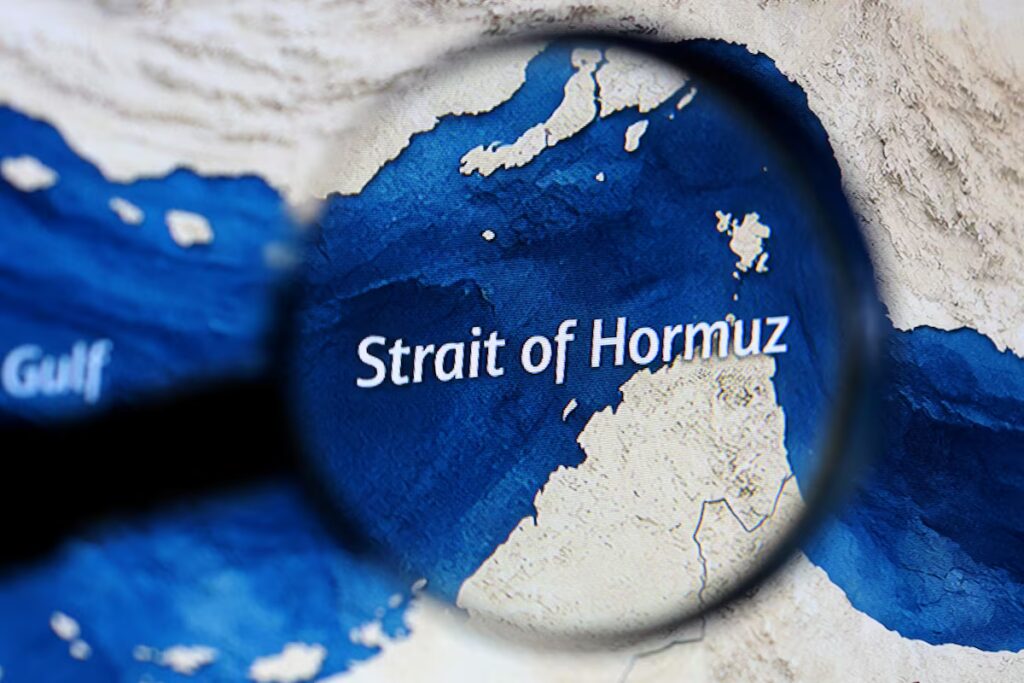
Fraudulent actors are reportedly demanding cryptocurrency payments from shipping companies stuck near the Strait of Hormuz, offering safe passage in exchange for Bitcoin or USDT, according to warnings from maritime risk firm MARISKS.

The scheme emerges as shipping routes remain heavily disrupted by escalating regional tensions and competing naval restrictions, with vessels unable to safely transit one of the world’s most critical energy corridors.
Impersonation scams emerge in high-risk shipping corridor
MARISKS said unidentified groups are posing as Iranian authorities and contacting shipping operators with instructions to submit documentation for “security clearance” before paying transit fees in crypto.
The messages reportedly promise unimpeded passage once payments are made, with fees demanded in digital assets including Bitcoin and Tether (USDT). One case cited by the firm described a staged process where vessels are first assessed before being assigned a cryptocurrency payment requirement.
The advisory warned that at least one vessel recently attempting to exit the strait may have been caught in the fraudulent operation, highlighting growing risks for maritime operators in the region.
Also Read: Coinbase CEO Calls for Changes to Accredited Investor Rules in the US
Rising crypto payments intersect with geopolitical shipping tensions
The scam surfaces alongside broader discussions around tolls and transit payments in the region, where reports have previously suggested proposals for multi-million-dollar fees per tanker, potentially payable in cryptocurrency.
The Strait of Hormuz, which handles around one-fifth of global oil and LNG flows, remains under significant pressure following renewed restrictions and military activity affecting navigation. Maritime security experts say the overlap between geopolitical instability and crypto-based payments is creating new opportunities for fraud, particularly as shipping firms seek urgent passage through restricted waters.
Reports suggest a controversial plan linked to Iran involving proposed tolls on ships passing through the Strait of Hormuz during ongoing ceasefire discussions. According to the Financial Times on April 8, Iran is considering charging up to $2 million per oil tanker for safe passage, with payments reportedly allowed in cryptocurrency, including Bitcoin.
A spokesperson for Iran’s Oil, Gas and Petrochemical Products Exporters’ Union, Hamid Hosseini, said the charge is around $1 per barrel of oil. At the same time, U.S. President Donald Trump stated that the United States will maintain its blockade on Iranian ports until an agreement is reached with Tehran, according to the BBC. The current temporary ceasefire between the two countries is set to expire on April 23, and it remains unclear whether further peace talks will take place in Pakistan.
Meanwhile, a new report from Tiger Research shows crypto-related hacks accelerating in 2026, with at least 12 incidents recorded in April alone.
Enjoyed this? Bookmark DeFi Planet, explore related topics, and follow us on Twitter, LinkedIn, Facebook, Instagram, Threads, and CoinMarketCap Community for seamless access to high-quality industry insights
Take control of your crypto portfolio with DEFI PLANET PRO, DeFi Planet’s suite of analytics tools.






