












As the crypto world evolves, the race between crypto mining and crypto staking continues to intensify. These two validation mechanisms underpin some of the largest blockchain networks in existence. But as concerns around energy, decentralization, and ROI grow, one big question looms: What’s the difference between staking and mining? And more importantly, is staking more profitable than mining?

Let’s break down the difference between crypto mining vs. staking, analyze their environmental and economic impact, and explore which one is set to thrive in the years ahead.
The Basics: What Is Mining vs. Staking?
Mining and staking are two methods used to validate transactions and secure blockchain networks, but they operate on fundamentally different principles.
Mining (Proof of Work – PoW)
Crypto mining is the original way blockchain networks reached consensus, first introduced by Bitcoin in 2009. At its core, it’s a competition of computational strength. Miners around the world race to solve complex mathematical puzzles, problems so difficult they require significant computing power. The first to crack the code earns the right to add the next block to the blockchain and, in return, receives a reward. As of 2024, that reward is 6.25 BTC per block, though this amount halves roughly every four years through a process known as the “halving.”
But mining isn’t as simple as plugging in a computer. It demands specialized equipment like ASICs (Application-Specific Integrated Circuits) or high-performance GPUs. Miners also need a reliable, often massive supply of electricity…think megawatts for industrial-scale operations. On top of that, running and maintaining a mining setup takes serious technical know-how.
Despite the challenges, many still find PoW mining worthwhile. It’s the mechanism behind several well-known cryptocurrencies, including Bitcoin (BTC), Litecoin (LTC), Dogecoin (DOGE), and Monero (XMR).
RELATED: Everything You Need to Know About Proof-of-Work in Blockchain
Staking (Proof of Stake – PoS)
In contrast, crypto staking is like the greener, more efficient cousin of mining. Instead of relying on raw computing power, Proof of Stake networks depend on ownership and commitment. Validators are chosen to confirm transactions and secure the network based on how much cryptocurrency they’re willing to “stake” or lock up. The more you stake, the higher your chances of being selected and rewarded.
For example, becoming a solo validator on Ethereum requires locking up a minimum of 32 ETH. However, many users join staking pools to participate without meeting that high threshold. Running a validator node also means maintaining consistent uptime, because if your node misbehaves or goes offline, you could face “slashing”—a penalty that reduces your staked funds.
Staking is gaining popularity for its lower energy demands and more accessible entry points. Major blockchains that use Proof of Stake include Ethereum (ETH), Cardano (ADA), Solana (SOL), and Polkadot (DOT).
Environmental Debate: Energy Consumption vs. Sustainability
One of the most pressing conversations in the crypto space revolves around the environmental impact of mining compared to staking.
On the one hand, mining, particularly Bitcoin mining, has come under intense scrutiny for its massive energy consumption. According to the Cambridge Centre for Alternative Finance, in 2023, Bitcoin alone consumed about 121 terawatt-hours (TWh) of electricity.
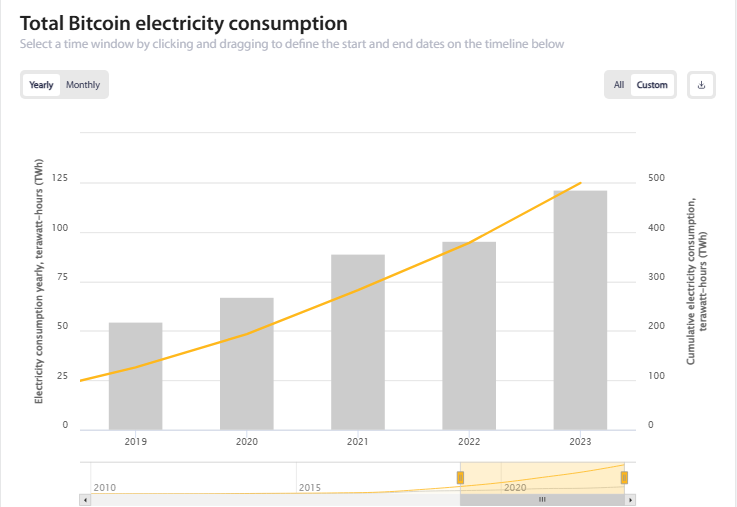
A significant portion of this energy comes from fossil fuels, raising concerns about the long-term environmental impact of Proof of Work (PoW) systems.
Critics of mining argue that it contributes to growing e-waste, as specialised hardware becomes quickly obsolete. The energy-intensive nature of mining operations also raises alarms about their carbon footprint and their tendency to flourish in areas with cheap, and often non-renewable, energy sources.
Crypto staking, in contrast, represents a greener alternative. Because it doesn’t require energy-hungry hardware or continuous power consumption, staking is vastly more efficient. When Ethereum transitioned to Proof-of-Stake in 2022, it slashed its energy usage by more than 99.95%—a move that highlighted staking’s potential as a sustainable path forward for blockchain technology.
From an environmental perspective, staking is the clear frontrunner. As investors and institutions increasingly prioritize sustainability and ESG (Environmental, Social, and Governance) standards, the pressure to move away from traditional mining methods continues to grow. Staking offers a way to support blockchain innovation without compromising the planet.
Profitability & ROI: Which Is More Lucrative for Investors?
When investors weigh their options, a key question often arises: Is staking more profitable than mining? The answer depends on goals, risk tolerance, and capital.
Mining has the potential for high rewards, particularly during bullish market cycles. However, this profitability doesn’t come easy. It’s heavily influenced by several factors: the cost of hardware, electricity prices, market volatility, and the increasing difficulty of mining over time—not to mention the impact of Bitcoin’s halving cycles.
The cost to mine a single Bitcoin varies based on several factors, including electricity rates and hardware efficiency. For example, CoinShares estimated the average production cost at approximately $37,856 per Bitcoin post-halving.
Staking, on the other hand, provides a more accessible and steady way to earn. Instead of investing in physical equipment, participants lock up their crypto to help secure the network and, in return, receive regular rewards. Staking yields from 2% to over 18% across different cryptocurrencies.
What makes staking especially appealing is its low barrier to entry and the ability to reinvest (or compound) rewards over time. There are no massive hardware costs, and it’s generally less hands-on than mining. Still, it isn’t risk-free. Token price fluctuations can impact overall returns, and validators who fail to meet network requirements may face penalties, such as slashing.
In essence, mining is a high-risk, high-capital endeavour with potentially large rewards, while staking offers a more stable, lower-risk route to earning, ideal for those seeking passive income with fewer upfront demands. In many cases, staking is more profitable than mining for the average investor because it avoids the complexities and volatility of hardware-based operations.
Side-by-Side Comparison: Crypto Mining vs. Staking
Criteria |
Crypto Mining |
Crypto Staking |
| Initial Investment | High (equipment + electricity) | Low (tokens only) |
| Energy Efficiency | Very low (high power usage) | High (minimal energy) |
| Profit Potential | High risk, high reward | Steady, passive income |
| Risk Exposure | Equipment failure, price swings | Token volatility, slashing |
| Environmental Impact | Significant carbon footprint | Eco-friendly |
| Accessibility | Limited to tech-savvy users | Open to anyone with tokens |
Decentralization Concerns: Is Staking Just Making the Rich Richer?
Decentralization is one of blockchain’s founding ideals—yet both mining and staking have drawn criticism for gradually drifting away from that vision.
In the early days, mining was a grassroots activity that anyone with a decent computer could participate in. Today, it’s a different story. The rise of industrial-scale mining operations has concentrated power in the hands of a few dominant players. By 2024, more than 60% of Bitcoin’s total hash rate was controlled by the top five mining pools. This centralization raises alarm bells, as it increases the risk of collusion among major players. In the worst-case scenario, a coordinated group could launch a 51% attack, potentially compromising the integrity of the network. Meanwhile, smaller miners find it nearly impossible to compete due to the high costs of equipment and electricity.
Staking, while more energy-efficient, isn’t immune to similar concerns. In Proof of Stake systems, the more tokens you hold, the greater your influence. Validators with large stakes are more likely to be chosen to validate blocks and earn rewards, creating a feedback loop where wealth compounds and power becomes increasingly concentrated. This dynamic has led to concerns that staking may simply be favouring the wealthy.
Ultimately, both consensus mechanisms face challenges in living up to the decentralized ethos of blockchain. The debate continues over how to balance efficiency, security, and true democratic participation in the networks of the future.
Which Model Will Dominate the Future?
The debate of crypto mining vs. staking isn’t about good vs. bad—it’s about choosing the right tool for different network goals.
Staking appears poised to lead the charge in newer blockchain projects and decentralized applications. Its advantages are hard to ignore: it scales more efficiently without the computational bottlenecks of mining, it aligns with growing environmental and ESG (Environmental, Social, and Governance) concerns, and it’s far more accessible to the average user.
Ethereum’s landmark shift from PoW to PoS in 2022 signalled that even the biggest players recognize the long-term benefits of staking. With governments and regulatory bodies increasingly spotlighting crypto’s environmental impact, staking is emerging as the more sustainable and compliant model for the future.
That said, mining isn’t disappearing anytime soon. Bitcoin, the original and most valuable blockchain, still relies on PoW, and its security model remains unmatched in the eyes of many. Supporters argue that PoW offers unparalleled decentralization and censorship resistance, making it the gold standard for truly trustless systems.
Innovation within the mining sector is striding toward sustainability. Green mining initiatives powered by renewable sources, such as hydroelectric and solar energy, are working to reduce the ecological footprint traditionally associated with PoW.
In the end, both models may continue to coexist—staking as the dominant choice for scalable, eco-conscious networks, and mining as the bedrock of robust, battle-tested systems like Bitcoin. The future of consensus isn’t about one model winning over the other; it’s about choosing the right tool for the right job.
Disclaimer: This piece is intended solely for informational purposes and should not be considered trading or investment advice. Nothing herein should be construed as financial, legal, or tax advice. Trading or investing in cryptocurrencies carries a considerable risk of financial loss. Always conduct due diligence.
If you would like to read more articles like this, visit DeFi Planet and follow us on Twitter, LinkedIn, Facebook, Instagram, and CoinMarketCap Community.






