











Quick Breakdown
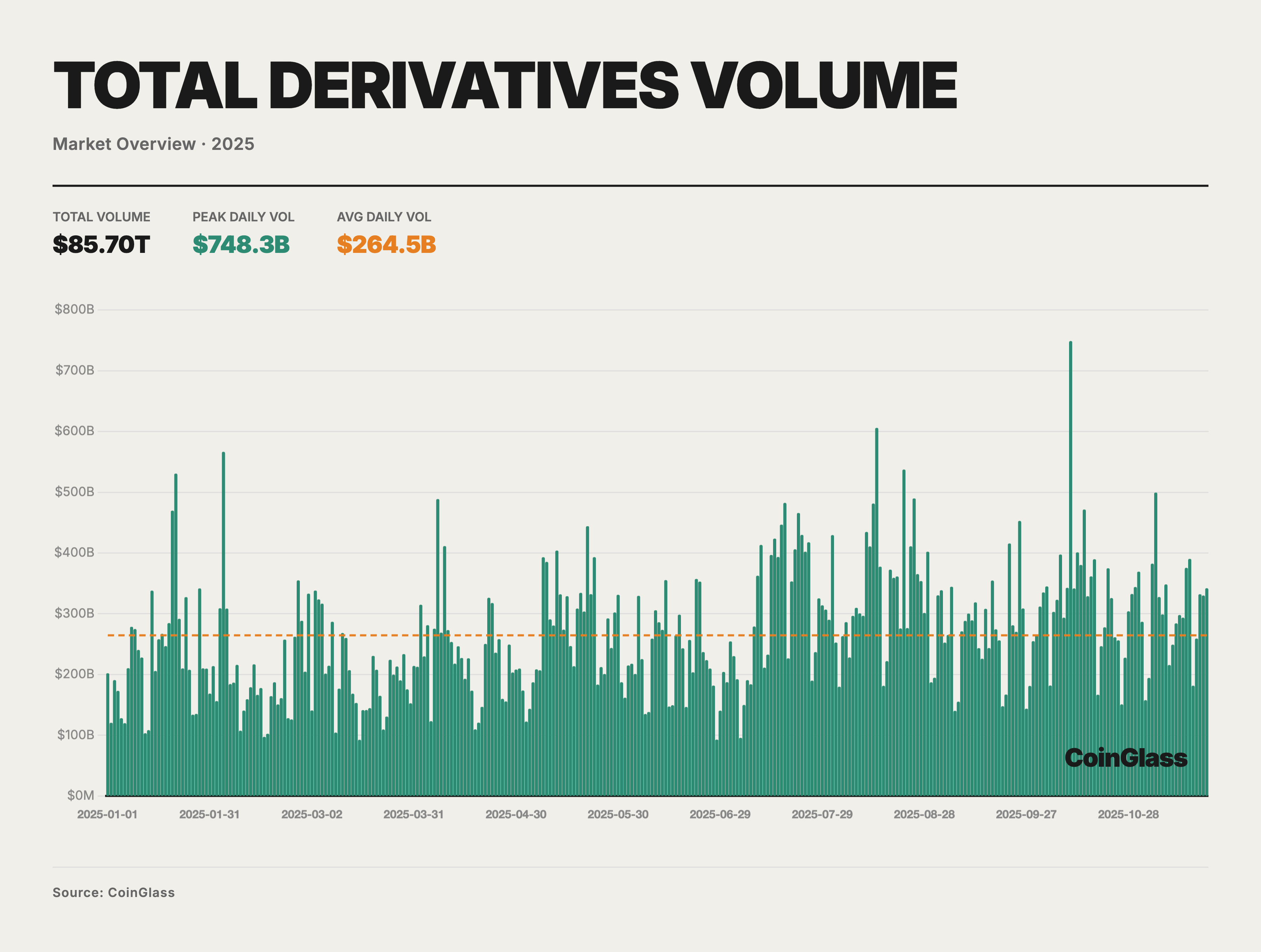
- In 2025, crypto derivatives hit $86 trillion, fueled by institutional adoption, concentrated liquidity hubs, advanced trading strategies, and high volatility, dwarfing spot market activity.
- Growth was driven by easier institutional access through ETFs and regulated futures, more complex products and strategies, major global events, and active open interest cycles that kept daily trading volumes high.
- Risks and future outlook center on leverage-induced volatility, regulatory gaps, counterparty and liquidity risks, and market concentration, highlighting the need for robust risk management as derivatives continue shaping the crypto ecosystem.

Crypto derivatives volume jumped to almost $86 trillion in 2025, making derivatives a major part of digital asset markets. This amount is much higher than spot market volumes and continues a trend where futures and leveraged products play a bigger role in shaping the market.
The $86 trillion mark is more than just a big number for the headlines. It shows the market is maturing, with deeper liquidity and more active investors. High derivatives volumes mean that professionals, institutions, and even regular traders are using leveraged crypto markets for hedging, speculation, and earning yields.
Understanding why derivatives have grown so rapidly provides insight into how the crypto ecosystem has evolved from a primarily spot-focused market into a sophisticated, multi-layered financial environment.
Key Factors Driving Crypto Derivatives Growth
1. Expansion of institutional access
The main reason for growth is that more institutions are joining the market. In the past, retail traders looking for leverage dominated crypto derivatives. But in 2025, regulated products like spot ETFs, options, and compliant futures made it safer for institutions to get involved.
For example, spot ETFs, options, and compliant futures gave institutions more ways to enter the market. This shift means trading is no longer just about hype—now, banks and hedge funds are involved. The rise in CME’s volume shows that traditional finance is taking part, which helps stabilize and legitimize the market.
2. Market concentration and liquidity hubs
Most derivatives trading happens on a few major exchanges, creating liquidity hubs. For example, Binance handles 29% of global volume; the top four exchanges control 62.3% of total market share.
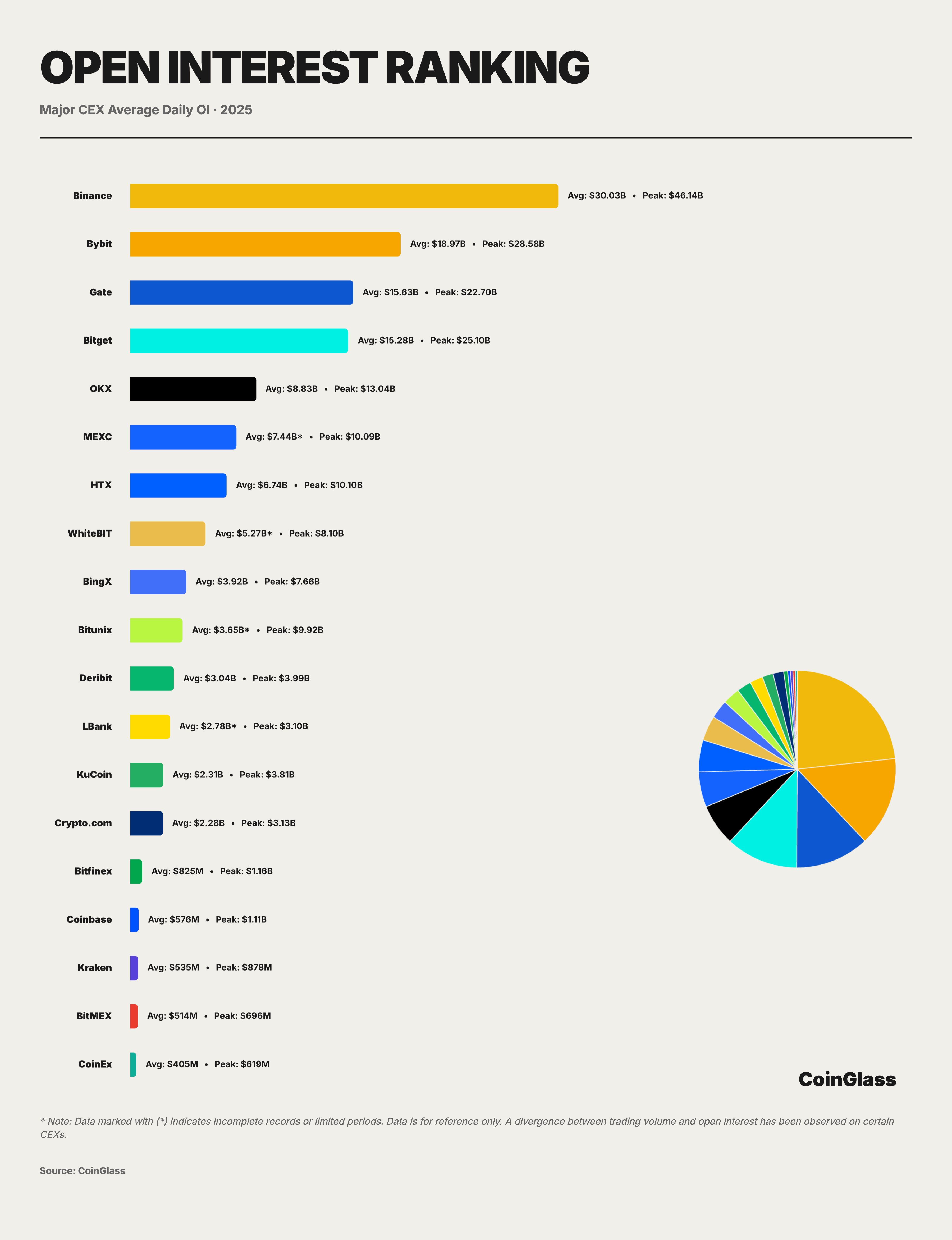
Why this matters: high liquidity attracts even larger trades, reduces slippage (the extra cost caused by big orders moving the price), and encourages more frequent trading. These hubs create a flywheel effect, as volume grows, it attracts more participants, which drives even higher volume.
3. Shift in trader behaviour
Trader behaviour in 2025 changed dramatically. Instead of retail-led, high-leverage speculation, markets saw a mix of institutional hedging, basis trading, and ETF activity.
The market moved away from a retail-led, high-leverage boom-and-bust model toward a mix of institutional hedging, basis trading and ETFs. This shift explains why volumes stayed high even during deleveraging and why derivatives are increasingly used as risk management tools rather than pure speculation. Daily turnover remained elevated because participants were trading for strategy, not just thrill.
4. Product complexity and strategy diversification
The growth in derivatives isn’t just about more trades, but also about more complex types of trades. In 2025, derivatives became more sophisticated.
More strategies, like options spreads, calendar trades, and basis trades, mean each participant executes more transactions, driving total notional volume higher without a corresponding increase in spot market activity. Even if crypto prices are stable, these complex strategies inflate trading volume.
5. Volatility and macro-driven events
Real-world events fueled spikes in derivatives activity. For example, the October liquidation shock, Trump’s tariff announcement triggering “risk-off,” $150B in forced liquidations over the year.
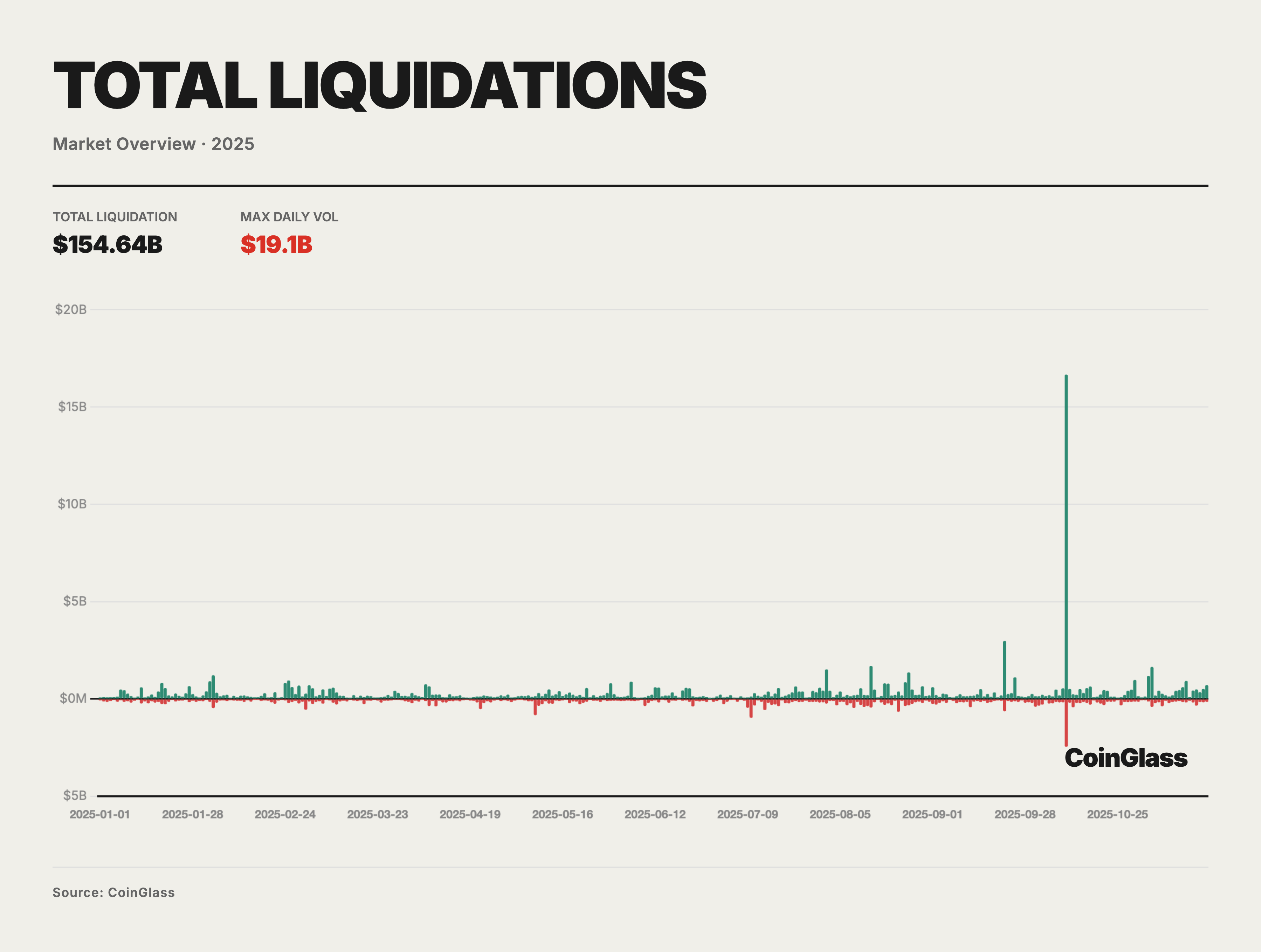
Volatility draws traders into the market, and forced liquidations temporarily inflate notional turnover, acting as a natural accelerator for volume. These stress events aren’t anomalies; they’re part of what makes derivatives markets reactive and high-volume.
6. Open interest cycles and leverage resets
Even when traders delivered, derivatives growth continued. Q1 open interest reset, surge to $235.9B in October, and year-end OI still +17% YoY.
This means that money is staying in the market and being reused, not leaving. While leverage resets carry risk, they highlight a healthier, more dynamic derivatives ecosystem, where traders keep adjusting their positions instead of leaving the market entirely.
Risks and Market Considerations
Despite crypto derivatives’ impressive run, this growth introduces unique risks:
Leverage-induced volatility and systemic risk
High leverage amplifies gains but also magnifies losses. In derivatives markets:
- Flash liquidations, like the $150B forced liquidation event in October 2025, can cascade across exchanges.
- Tail-risk events are more pronounced because positions are interconnected globally.
- Even relatively small price moves can trigger outsized volatility in leveraged products.
Traders and institutions need robust risk controls, including margin buffers, hedging strategies, and position monitoring.
Regulatory scrutiny and global compliance gaps
Derivatives trading exists in a patchwork of regulatory regimes. Some jurisdictions allow fully regulated futures and ETFs (e.g., CME, US ETFs). Others remain largely unregulated, with limited investor protections (e.g., offshore platforms)
Risks:
- Non-compliance can trigger sudden account freezes, asset seizures, or fines.
- Diverging rules across borders make cross-border trading challenging.
Counterparty, settlement, and liquidity risks
As derivatives dominate trading:
- Counterparty risk rises, especially on smaller platforms or highly leveraged products.
- Settlement risk emerges when liquidations, cross-platform transfers, and margin calls fail to execute smoothly.
- Liquidity risk becomes critical in stress periods; high open interest and concentrated positions can exacerbate price swings.
Future Implications for Crypto Markets
Derivatives are not just a trading tool; they shape the broader crypto ecosystem by affecting price discovery, Capital efficiency, and adoption in the following ways:
- Price discovery: Futures and options provide reference points beyond spot prices, helping institutions assess fair value.
- Capital efficiency: Leverage allows exposure to larger positions with smaller capital, attracting institutional inflows.
- Adoption: Structured products and ETFs linked to derivatives enable conservative investors to participate without direct crypto custody.
Well-functioning derivatives markets can stabilize, rather than destabilize, mature crypto ecosystems, but only with strong risk management.
Potential for market concentration or further institutionalization
Top exchanges (Binance, Bybit, OKX, CME) account for over 60% of derivatives volume, creating potential risks:
- Market dominance may amplify systemic shocks if a single platform fails.
- Institutional flows could consolidate market influence, shifting power away from retail traders.
The trend toward institutionalization may improve liquidity and adoption, but also introduces concentration risk, which needs monitoring.
Outlook for 2026 and Beyond: Sustainability, Risk Management, and Growth Areas
Looking ahead, derivatives trading is likely to keep growing as long as institutions stay interested. Exchanges and traders will need to come up with new ways to manage risk, like updating margin rules, monitoring across platforms, and improving how liquidations are handled.
Emerging products, such as tokenized derivatives, options on real-world assets, and regulated ETFs, could further expand institutional participation and market sophistication. Ultimately, derivatives will remain a backbone of crypto markets, but their long-term impact will depend on regulatory clarity, robust risk management, and responsible leverage practices.
Disclaimer: This article is intended solely for informational purposes and should not be considered trading or investment advice. Nothing herein should be construed as financial, legal, or tax advice. Trading or investing in cryptocurrencies carries a considerable risk of financial loss. Always conduct due diligence.
If you would like to read more articles like this, visit DeFi Planet and follow us on Twitter, LinkedIn, Facebook, Instagram, and CoinMarketCap Community.
Take control of your crypto portfolio with MARKETS PRO, DeFi Planet’s suite of analytics tools.”