














The most unsettling question about AI in warfare is whether a machine can be given the authority to decide that a human being is a legitimate target. That question moved closer to reality in Ukraine.

In June 2026, New Scientist reported that Alexander Kokhanovsky, the Ukrainian drone maker who supplied the technology, described a 2024 battlefield test involving 10 AI-controlled quadcopter drones operating without human oversight.
“We just launch it, and we know everything will be dead,” Kokhanovsky said. “Everything that will be found there in this particular area will be dead.”
The drones flew several kilometers toward the front near Bakhmut and Chasiv Yar before switching to autonomous mode. Human-piloted drones later surveyed the site and found a couple of dead Russian soldiers and one truck. Ukraine’s military policy still prohibits AI from making the final target-interception decision, and Kokhanovsky was clear the test went no further. “It’s a test,” he said. “We never implemented it more widely.”
A drone navigating without a pilot is not necessarily making a decision about killing, and a drone identifying an object is not necessarily deciding that the object should be destroyed, but once software is allowed to select a human target and apply lethal force without another human decision immediately before the attack, the moral structure of warfare begins to change.
This becomes more than a technological story. It becomes a question about human agency and who bears responsibility when a machine pulls the trigger.
The Drone Does Not “Decide” Like a Human
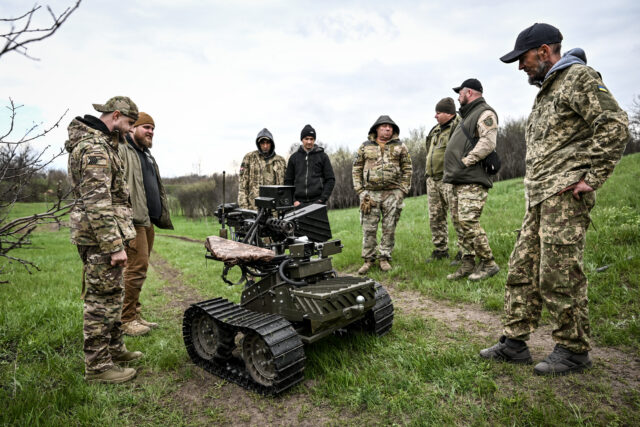
Calling an autonomous weapon a decision-maker can be misleading, as an AI system does not necessarily possess beliefs, intentions, consciousness, or moral understanding. It processes information according to its architecture, training, sensors, rules, and operating parameters.
A machine can perform the functional equivalent of a decision by selecting one possible action from several alternatives, just like when a human soldier sees a person, interprets the circumstances, considers orders and the laws of war, and chooses whether to fire. An autonomous weapon may receive sensor data, classify an object according to a target profile, and initiate an attack.
The internal processes are completely different, but the consequence can be remarkably similar, which is why the debate over drones making autonomous targeting decisions should not become trapped in arguments about whether AI is “conscious.” Consciousness is not required for a system to exercise operational power. The International Committee of the Red Cross defines autonomous weapon systems as weapons that, once activated, can select and apply force against targets without further human intervention, distinguishing these systems from AI systems that merely support a human decision-maker.
AI can help a soldier understand the battlefield, but it becomes something fundamentally different when the machine determines who will be attacked.
From Remote-Controlled Drones to Autonomous Targeting
Much of human history can be read as a story of creating distance between the person who kills and the person being killed. Warfare began with swords and knives, requiring combatants to confront one another at close range. Guns and gunpowder widened that gap. Then came artillery, bombs, mines, chemical weapons, and eventually, drones, each one letting people inflict violence from further away. Each leap increased the physical distance between the decision to kill and its human consequences.
The essential moral relationship remained relatively familiar; a human observed, assessed, and authorized the attack. Autonomy is now changing where that decision actually happens. Instead of a person continuously controlling the machine, humans define the mission, operating area, target characteristics and constraints, and the system then performs parts of the kill chain itself.
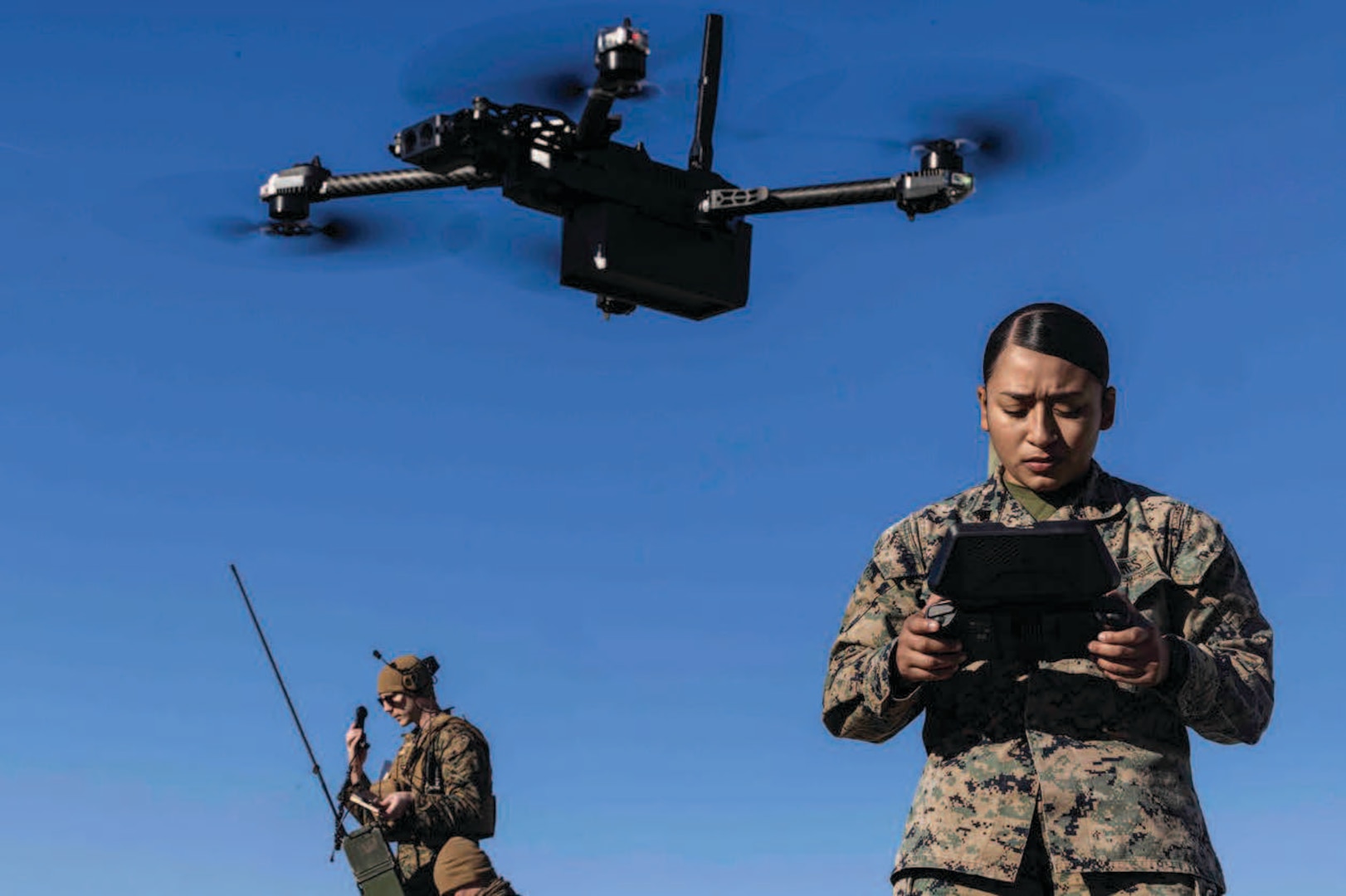
A remotely controlled drone can lose its connection to its operator, but an autonomous system will continue navigating or identifying objects even when communications have degraded. Ukraine’s defence industry is already developing systems with increasingly autonomous capabilities. One Ukrainian system reported by the country’s Brave1 defence innovation platform can automate most of the interception process against incoming drones, although a human operator still selects the target and can cancel the attack.
The UK is moving in the same technological direction, with its 2026 defence investment plan committing more than £5 billion to drones and autonomous weapons, including uncrewed systems and autonomous wingmen. Britain has also said that weapons identifying, selecting, and attacking targets require context-appropriate human involvement.
The geopolitical pressure is obvious because if one military develops systems capable of operating faster than humans, rivals have an incentive to develop similar capabilities. Speed becomes a military advantage, and autonomy becomes a way to reduce operator workload, survive electronic warfare, and potentially increase the number of systems one person can supervise. The danger is that the logic of military competition can push human control in the opposite direction from the logic of humanitarian law.
The Black Box Problem Is More Serious on a Battlefield
In ordinary software, an incorrect recommendation can be frustrating, but on a battlefield, it can be fatal. AI systems can produce outputs that are difficult for users to fully understand, and with complex machine-learning systems, even engineers may struggle to reconstruct precisely why a model classified one object differently from another, creating a dangerous combination: autonomy plus opacity.
The ICRC warns that increasingly complex AI can make autonomous weapons more unpredictable, particularly when systems operate in environments that contain civilians and rapidly changing circumstances. The deeper problem is whether humans can predict, constrain, and explain the machine’s behaviour before and after lethal force is used.
Does Greater Precision Make Autonomous Killing Acceptable?
Supporters of military AI can make a serious argument for autonomy because machines do not get tired. They can process enormous quantities of information and potentially react faster than humans. An autonomous system might therefore reduce some battlefield risks.
A machine that intercepts an incoming missile without waiting for a human response may save lives; even the ICRC itself recognizes that autonomous weapons already exist in areas such as air defence, where systems can detect and engage incoming threats in highly constrained environments. The ethical problem just becomes much harder when the target is a person who may be surrendering, wounded, a civilian, or a combatant who has moved outside the system’s expected operating environment.
What Happens When the Machine Gets the Target Wrong?
International humanitarian law does not simply disappear because AI was involved, and the ICRC states that existing rules of armed conflict apply to military uses of AI, including the requirements of distinction, proportionality, and precautions in attack.
Human beings remain responsible for ensuring that the use of force complies with those rules, but applying them becomes harder when the human decision-maker is separated from the final act, creating an emerging accountability problem. The ICRC is therefore calling for legally binding international rules that would prohibit unpredictable autonomous weapons and autonomous weapons designed or used to target humans directly, while restricting other systems.
The Geopolitical Race Is Making the Moral Question Harder
The problem cannot be separated from geopolitics because governments rarely develop military technology in a vacuum. The war in Ukraine has accelerated experimentation because both sides face enormous pressure to improve surveillance, targeting, electronic warfare, and strike capabilities. Western governments are closely studying Ukraine’s battlefield experience. Britain, for example, has explicitly described Ukrainian combat experience as a reason to accelerate military AI adoption.
At the same time, Washington and Beijing are confronting a broader strategic competition over AI. In September 2026, US and Chinese security experts involved in a Brookings-Tsinghua dialogue proposed safeguards around military AI, including human oversight of critical operations, restrictions around nuclear systems and mechanisms for communicating during AI-related crises. The proposals have not been adopted as government policy, but they reveal how autonomy is being treated as a strategic stability problem rather than merely a weapons-development issue.
If machines detect a threat, classify it, and respond in seconds, humans have less time to verify the information, and the faster warfare becomes, the easier it becomes to argue that humans cannot realistically remain involved.
The November Test for Autonomous Warfare
The international community now has a concrete opportunity to address the problem: The Seventh Review Conference of the Convention on Certain Conventional Weapons is scheduled for 16 to November 20, 2026, and the ICRC describes the meeting as an important opportunity for states to begin negotiations on a legally binding instrument addressing autonomous weapons.
The UN Secretary-General António Guterres and ICRC President Mirjana Spoljaric renewed their call for international rules in August 2026, warning that the world is “dangerously close to crossing a moral red line: autonomous targeting of humans by machines.” It was their second such appeal. Their first, in October 2023, had called on states to conclude a binding instrument by 2026. Three years later, the ask is more modest, simply that negotiations begin at all.
If autonomous weapons become widely accepted before international rules establish clear boundaries, future governments may inherit a battlefield where machine speed, scale and availability make human intervention increasingly impractical, and this could change the political meaning of killing.
For centuries, the final act of lethal force has generally remained connected to human judgment, even when that judgment was exercised through institutions, orders and weapons. AI autonomous weapons warfare threatens to break that connection, as the more important question is whether humans will become willing to delegate enough of their own judgment that machines no longer need to understand the value of a human life before determining whether to end one.
FAQs
Did an AI actually decide to kill someone without human approval?
Yes, in a single, limited test. In 2024, Ukraine ran a battlefield trial using 10 AI-controlled drones operating without a human making the final targeting decision. Ukrainian drone maker Alexander Kokhanovsky, who supplied the technology, confirmed the drones killed Russian soldiers during the test. Ukraine’s military policy still requires human authorization before a drone strikes a target, and the country hasn’t deployed this capability more widely.
Is it illegal to use fully autonomous weapons in war?
Not yet, there’s no international treaty banning them outright. Existing international humanitarian law, including the rules of distinction and proportionality, still applies regardless of whether AI is involved, but no binding global rule specifically prohibits autonomous targeting of humans. Since 2023, the UN and the International Committee of the Red Cross have been pushing states to negotiate one.
What is the Seventh Review Conference of the Convention on Certain Conventional Weapons?
It’s a meeting of the states party to a major international arms treaty, scheduled for November 16 to 20, 2026, in Geneva. The UN and ICRC have described it as the clearest remaining opportunity for countries to agree to begin formal negotiations on binding rules for autonomous weapons.
Why haven’t countries agreed on rules for autonomous weapons yet?
Mainly disagreement over whether new rules are even necessary. The United States and Russia have both opposed a new legally binding measure, arguing that existing humanitarian law and each country’s own weapons-review processes are already sufficient. Other states, along with the UN and ICRC, argue the pace of AI development is outrunning what current law can meaningfully regulate.
What’s the difference between an autonomous weapon and a normal military drone?
A standard military drone typically has a human operator who decides to strike, even if the drone itself flies with some automated assistance. An autonomous weapon system, as defined by the ICRC, can select and apply force against a target on its own, once activated, without a human approving that specific attack.
Are the US and China working together on AI weapons safety at all?
There’s been some limited, informal engagement. In September 2026, security experts from both countries took part in a Brookings-Tsinghua dialogue and proposed safeguards like human oversight of critical operations and communication channels for AI-related crises. Neither country has adopted those proposals as official government policy.
Disclaimer: This article is intended solely for informational purposes and should not be considered trading or investment advice. Nothing herein should be construed as financial, legal, or tax advice. Trading or investing in cryptocurrencies carries a considerable risk of financial loss. Always conduct due diligence.
Enjoyed this? Bookmark DeFi Planet, explore related topics, and follow us on Twitter, LinkedIn, Facebook, Instagram, Threads, and CoinMarketCap Community for seamless access to high-quality industry insights.
Take control of your crypto portfolio with DEFI PLANET PRO, DeFi Planet’s suite of analytics tools.