












On June 1, 2026, South Korean crypto exchange Korbit officially announced a new “Send to Contacts” feature that lets users transfer crypto using a phone number and real name instead of a long wallet address. The goal is to make sending digital assets simpler and reduce the costly mistakes that come with mistyped addresses during transfers.

The move fits efforts to make crypto payments feel more like using everyday mobile banking. But replacing wallet addresses with phone numbers and names raises an obvious question: what has to give to make crypto that convenient?
How Phone Number Crypto Transfers Work
Korbit’s “Send to Contacts” feature lets users send crypto using a phone number and real name instead of a wallet address. It’s available to verified South Korean nationals aged 19 and older who have completed KYC and CARF (cross-border tax reporting) requirements, so it operates within a fully verified, domestic system. Transfers are capped at 1,000,000 KRW per transaction and 10,000,000 KRW per day.
A user opens the Korbit app and selects the crypto they want to send, for example, Bitcoin or USDT. Instead of pasting a wallet address, they tap “Send to Contacts,” choose a saved contact or enter the recipient’s phone number, and type the recipient’s full name. After confirming the details, they approve the transfer. The crypto is then sent directly through Korbit’s internal system without blockchain address entry.
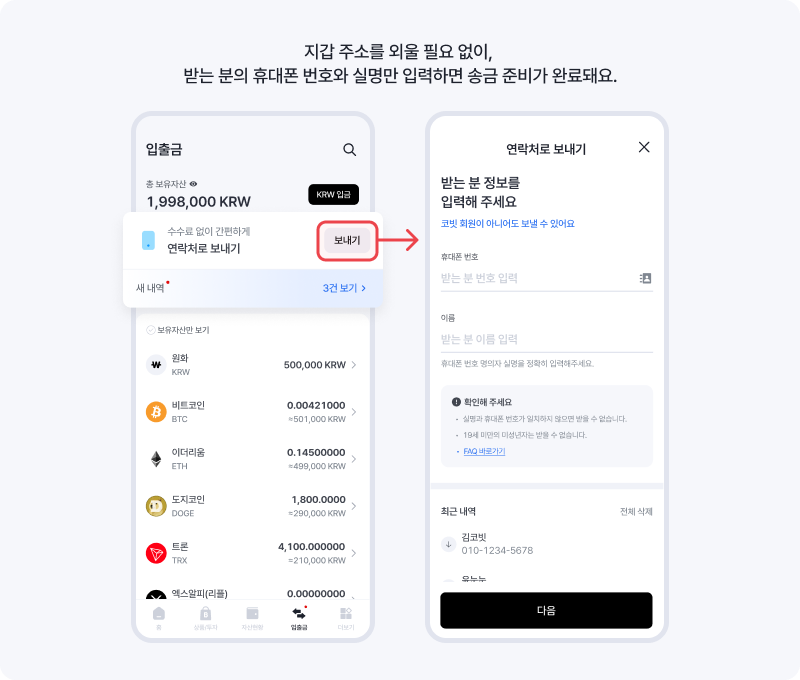
Korbit designed this to feel similar to sending money through a mobile banking app. For example, instead of sending crypto to a long string like “bc1q…,” a user can simply send it to “James Allen” using his phone number. This reduces errors like sending funds to the wrong address, which is one of the most common mistakes in crypto transfers.
If the recipient is not a Korbit user, they receive a notification through apps like KakaoTalk. They then have 72 hours to sign up on Korbit and complete verification to claim the funds. If they do nothing within that time, the crypto is automatically returned to the sender.
Korbit also removed transfer fees for this feature. Since the transfer happens inside its system, users avoid blockchain gas fees and waiting times. The platform also runs extra security checks to make sure the phone number and real name match before approving any transaction, helping reduce fraud and mistaken transfers.
Why Removing Wallet Addresses Makes Crypto Easier to Use
Removing wallet addresses reduces friction in crypto usage in several key ways.

Eliminating long and error-prone wallet addresses
Wallet addresses are long strings of random letters and numbers that are difficult to read and easy to miscopy. For example, a Bitcoin address like “bc1q…” must be entered or pasted exactly, or the transfer may fail or go to the wrong place. Replacing this with a phone number or contact name removes that complexity entirely.
Reducing user mistakes and failed transactions
Even a small typing error in a wallet address can lead to lost funds or irreversible transactions. For instance, sending crypto to the wrong address cannot usually be undone. Using a contact-based system works more like sending a message to “David” on your phone, which reduces the chance of mistakes.
Making crypto transfers more familiar to non-technical users
Most users already understand contact-based payments from apps like mobile banking, PayPal, or WhatsApp transfers. For example, instead of copying wallet details, a user simply selects a saved contact and sends funds instantly. This makes crypto feel less like a technical system and more like a normal payment app.
Enabling safer saved contacts and trusted recipient lists
Wallet addresses don’t naturally show who you are sending money to, which can make trust harder to build over time. With a contact-based system, users can build a “trusted list” of verified recipients, similar to saved beneficiaries in mobile banking.
For example, a user can quickly send crypto to “Mom” or “Freelancer A” without re-checking addresses each time, reducing hesitation and improving repeat payments.
Lowering onboarding barriers for first-time users
New users often struggle with wallet setup, network selection, and address formats. For example, a beginner might hesitate or abandon a transfer because they are unsure if they chose the correct network (like ERC-20 vs. TRC-20). Removing wallet addresses simplifies the first experience and makes it easier to start using crypto.
Could Phone Number Transfers Drive Mainstream Crypto Adoption?
Phone number-based transfer solutions would make cryptocurrency seem less technical and could be necessary for mass adoption.
Could simpler transfers pull in retail users?
Complexity and perceived risk are two of the biggest reasons retail users avoid crypto. Removing wallet addresses cuts directly into that complexity. A complete newcomer is far more likely to complete a transfer when the process is just “select a contact and send” than when it requires understanding blockchain networks and address formats.
Potential for integration into exchanges, wallets, and payment apps
The model could extend beyond Korbit’s current implementation to become a standard feature across crypto wallets and fintech apps. If more exchanges and platforms adopt identifier-based transfers, that shift matters more for crypto’s overall usability than any single platform’s version of it.
Does easier usability lead to lasting growth?
While user experience enhancements may facilitate the initial adoption of the technology, further growth relies on sustaining user activity within the platform.
Therefore, while a user may attempt to use the phone-based transfer due to its simplicity, the repeated usage of the system is necessary for further growth.
The Risks of Phone Number-Based Transfers
While phone number-based transfers make crypto easier to use, they also introduce new risks around privacy, security, and how much control users and platforms actually have.

Privacy concerns from linking identity to wallet activity
Tying a real name and phone number to transfers strengthens the link between a user’s identity and their transaction history. Once a phone number appears across enough transactions, it becomes easier to reconstruct someone’s spending patterns into a financial profile.
Risk of centralized databases becoming targets for attacks
These systems depend on centralized databases linking phone numbers to verified identities and transaction histories. A single breach of that database could expose millions of users’ identity and transaction data at once, a very different risk profile than a compromised individual wallet.
Both sides need to be on the same platform
Identifier-based transfers only work if both parties are on the same platform. If the recipient hasn’t completed onboarding, they can’t access the funds right away, which is why Korbit’s version relies on a 72-hour claim window with an automatic refund as a fallback.
Identity-linked transfers invite more regulation
Because phone number transfers require identification, they’re more likely to fall under existing financial regulations than standard wallet-to-wallet transfers. That makes oversight easier for regulators, but it comes at a cost for users: less pseudonymity than a standard crypto wallet provides.
SIM swaps become a bigger threat
As phone numbers are used to trace crypto transactions, the hackers can employ SIM swap techniques. For instance, if hackers succeed in taking over the user’s phone number, they can then gain access to transfer alerts and even account recovery methods.
Loss of pseudonymity that traditional crypto wallets provide
Traditional crypto wallets are pseudonymous, not anonymous. A person can hold and transact using a wallet address without directly linking it to their legal name, but the address itself is public and every transaction tied to it is visible on-chain. Phone number transfers remove even that layer of separation by attaching a verified name and number to the activity from the start.
How Korbit’s New Feature Compares With Traditional Fintech Payment
Crypto transactions based on phone numbers may seem straightforward, but they remain quite different from any conventional methods used by regular payment systems.
Familiar interface, different infrastructure
Sending crypto by phone number feels like using any modern payment app: pick a contact, confirm, done. But the infrastructure underneath is different. Traditional payment systems move money through banking rails; crypto transfers like this one settle through an exchange’s internal system or, ultimately, the blockchain itself. Touch-based delivery, instant confirmations, and streamlined flows reduce the need to think about wallets or blockchains directly, but that’s a usability layer sitting on top of a more fragmented settlement system, not a replacement for it.
Easier to use, but not yet universal
Though crypto transfers are more simplified, they are far from universally adopted. The bank rails and card network are accepted almost anywhere, whereas the phone number crypto transfers require certain platforms or users’ registration with a particular service. It means the convenience feels like sending money through text message, but only when the sender and the recipient are using the same ecosystem.
From Wallet Addresses to Identity-Based Transfers: What Comes Next
The existence of phone-number transfers proves that crypto is gradually moving from using technical information to adopting something more natural for end-users, such as identity. The evolution implies that the next stage may not require knowledge about blockchains, rather, the ability of the technology to smoothly integrate with users’ digital identities on financial platforms.
Furthermore, the very idea of crypto transfer implies that, in order to make the process smoother, crypto is becoming more platform-centric. The real question going forward is not just whether crypto can feel like texting money, but whether that simplicity can exist without changing what made crypto distinct in the first place.
FAQs
Do phone number crypto transfers still use blockchain technology?
Not for the transfer itself. When both the sender and recipient are Korbit users, the transfer is processed entirely within Korbit’s internal system, which is why there’s no blockchain gas fee and no confirmation wait. The crypto only touches the blockchain if a user later withdraws it to an external wallet. So the asset is still a real cryptocurrency, but this specific transfer step bypasses on-chain settlement rather than speeding it up.
Can you send crypto to someone who is not on the same platform?
Not directly. You can initiate a transfer to anyone’s phone number, but the recipient has to sign up for Korbit and complete verification before they can claim the funds. If they don’t onboard within the set window, the transfer automatically reverses to the sender. So in practice, this only works within Korbit’s user base, it doesn’t let you send crypto to someone on a different exchange or in a self-custody wallet using just their phone number.
Are phone number-based transfers replacing wallet addresses completely?
Not yet. Wallet addresses are still required for most blockchain-native transactions, especially in DeFi and self-custody wallets. Phone number systems are currently an added layer of simplicity, not a full replacement.
What happens if someone changes or loses their phone number?
Korbit hasn’t published specifics on this scenario, but based on how the system works, phone numbers are tied to verified accounts, not to the crypto itself. So losing access to a number would likely require standard account recovery and re-verification through Korbit, rather than anything blockchain-based. This is a meaningful difference from self-custody wallets, where recovery depends on a private key or seed phrase, not a platform’s identity system.
Could this system work for global crypto payments across different countries?
In the long term, yes, but it depends on regulatory alignment and platform integration. Right now, Korbit’s version is limited to verified South Korean nationals, and most phone-based crypto transfer systems elsewhere are similarly restricted to specific regions or exchanges. Global use is still a work in progress.
Disclaimer: This article is intended solely for informational purposes and should not be considered trading or investment advice. Nothing herein should be construed as financial, legal, or tax advice. Trading or investing in cryptocurrencies carries a considerable risk of financial loss. Always conduct due diligence.
Enjoyed this? Bookmark DeFi Planet, explore related topics, and follow us on Twitter, LinkedIn, Facebook, Instagram, Threads, and CoinMarketCap Community for seamless access to high-quality industry insights.
Take control of your crypto portfolio with DEFI PLANET PRO, DeFi Planet’s suite of analytics tools.






