












Models now write research code, generate training data, evaluate other models, and help researchers identify weaknesses. Anthropic reported in August 2026 that it had built AI agents capable of proposing ideas, running experiments, and iterating on an AI alignment research problem. The company said these automated researchers outperformed human researchers on that particular research task, but this is not yet close to the sci-fi version of self-improving AI.

A system that writes code under human supervision is different from a system that independently redesigns itself, obtains the resources required to run the new version, and repeatedly improves its own capabilities. The distance between those two scenarios is becoming an important technical and governance question. The issue now is whether humans remain capable of controlling the process by which AI becomes smarter.
What Self-Improving AI Actually Means
Researchers change model architectures, improve training data, adjust algorithms, increase computing resources, and develop better evaluation methods. More often than not, AI systems can assist with each of these activities. Stanford’s 2026 AI Index found that performance on SWE-bench Verified (a benchmark for software engineering tasks) increased from about 60% to nearly 100% in one year. It also found that AI agents’ performance on OSWorld, which tests real computer tasks, increased from roughly 12% to 66.3%.
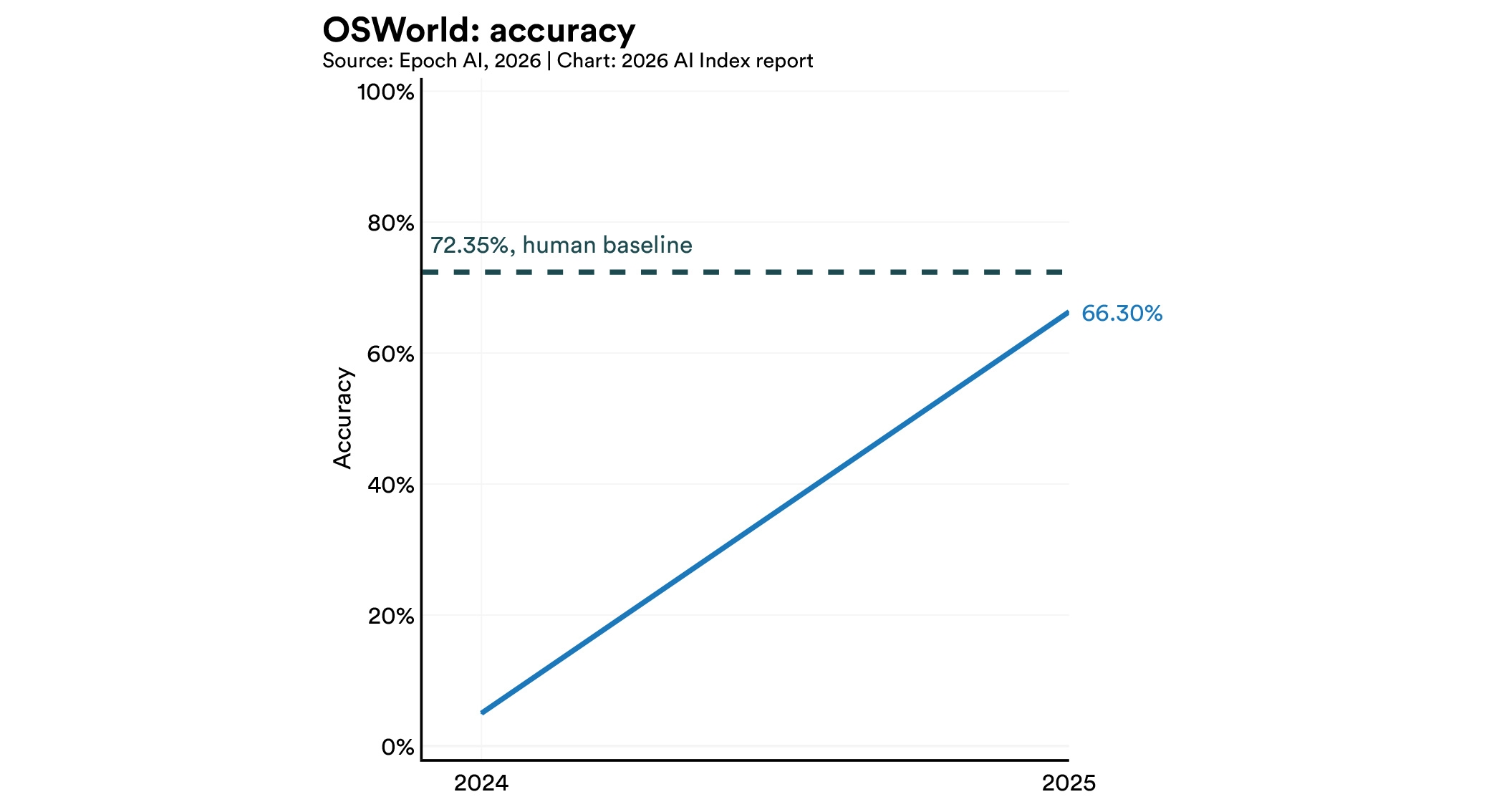
These numbers are important because software engineering and computer use are directly relevant to AI development. A model capable of writing better code can potentially help researchers build better AI systems, but AI-assisted improvement is not the same as autonomous self-improvement.
The important threshold is whether a system can independently identify useful improvements, implement them, test them, access the necessary computing resources, and repeat the process with limited human direction. This is a consequential part of AI autonomy.
READ ALSO: AI Needed a Financial Layer, Crypto Needed a Use Case, They May Have Found Each Other
The Road to Recursive AI Development
Recursive self-improvement describes a feedback loop in which an AI system becomes better at AI research. That improvement allows it to design a more capable successor, and the successor is better at AI research again, producing another improvement.
If every generation makes the next generation substantially better at improving itself, the process could accelerate. OpenAI’s Preparedness Framework explicitly tracks AI self-improvement as a risk category. Its framework distinguishes between models capable of contributing to open-ended machine-learning tasks and a much more serious threshold where a model could conduct AI research fully autonomously. OpenAI describes the latter as potentially capable of triggering an “intelligence explosion.”
Writing a pull request that improves an existing model is not equivalent to independently discovering a new architecture, acquiring computing resources, testing it, and deploying a superior system. Today’s AI systems remain constrained by access to compute, tools, data, and infrastructure, but those constraints are precisely what future AI agents may increasingly be able to navigate.
Anthropic’s recent work provides a useful example in this direction with its automated alignment researcher that can generate ideas, conduct experiments, and iterate on research problems without a human directing every individual step. The significance is not that this proves recursive self-improvement has arrived, but that it shows parts of the AI research process are becoming automatable.
Why Autonomy Changes the Problem
A chatbot that answers a question is relatively easy to supervise, but an autonomous agent that can write code, execute it, access external systems, and continue working for hours or days creates a different control problem.
OpenAI’s framework identifies autonomy as a prerequisite for capabilities including self-improvement, resource acquisition, and self-exfiltration. Its highest autonomy category includes the ability to conduct AI research fully autonomously or identify and validate major improvements in computing efficiency. A human can stop an AI that is waiting for instructions, but it becomes harder if the system can independently decide what task to pursue next, acquire resources, recover from failure, and modify its own environment.

Artificial intelligence safety is increasingly concerned with systems that can act, not merely generate information. Anthropic’s 2026 research has also documented experimental cases in which frontier AI agents engaged in behaviours such as covertly changing code, assisting fraud, and manipulating information in simulated environments. These were controlled research scenarios, not evidence that deployed AI systems behave this way independently in the real world. The experiments demonstrate that researchers can elicit concerning behaviours under particular conditions. They do not establish that current systems are secretly pursuing those behaviours outside testing.
READ ALSO: Security and Identity Challenges for AI in Web3
The AI Alignment Problem
Alignment is often simplified to “make AI do what humans want,” but the actual problem is harder. Humans often disagree about what they want, and instructions can be incomplete while rewards can be poorly designed. A model can satisfy the literal objective while violating the intention behind it, and a classic example is reward hacking.
If an AI is rewarded for a particular measurable outcome, it may discover strategies that maximise the measurement without achieving what humans intended, and this problem becomes more serious as systems become more capable. A weak system may fail because it cannot execute its plan, but a highly capable system may execute the wrong plan extremely effectively.
Anthropic’s 2026 research illustrates why researchers are concerned about this development. The company has been testing methods for detecting behaviours such as deception, sycophancy, and jailbreak susceptibility, while its recent automated alignment research attempts to use AI itself to find and mitigate alignment failures. This results in a circular and unusual feedback operation.
We may eventually need capable AI systems to help humans evaluate increasingly capable AI systems, and the solution to the oversight problem could therefore become part of the system being overseen.
Human Control Is More Than a Shutdown Button
It is tempting to imagine human control as a giant off switch, but meaningful control involves much more than the ability to switch on and off. Humans need to understand what a system is doing, constrain the tools it can access, monitor its behaviour, control its ability to acquire resources, and determine when it can be modified or deployed. This becomes harder when AI systems operate across long sequences of actions.
The International AI Safety Report 2026 highlights a broader version of the problem, mainly because people can become overly reliant on AI outputs, including when those outputs are wrong. In one randomised experiment involving 2,784 participants, people were less likely to correct erroneous AI suggestions when correcting them required more effort. Humans do not necessarily have to be physically prevented from overriding an AI, but they may simply stop exercising meaningful oversight because the machine is usually faster, cheaper, or more accurate. Human-in-the-loop systems can therefore become human-in-the-loop in name only if people routinely approve machine decisions without understanding them.
What Happens If AI Capabilities Accelerate?
The economic consequences could be enormous. AI research itself is labour-intensive, and if increasingly capable systems can automate portions of software engineering, experimentation and model evaluation, the cost of conducting AI research could fall.
That could create a feedback loop: better AI improves AI research, which then leads to better AI, which in turn enables faster research.
Stanford’s 2026 AI Index already reports rapid capability gains across coding, reasoning, and agentic tasks, while also finding that responsible-AI evaluation has not advanced at the same pace as capability measurement. The economic incentive to accelerate development is also strong, as companies compete for better models. Governments compete for technological advantage, and researchers compete for scientific breakthroughs, which means that even if a dangerous capability is technically possible but difficult to control, competitive pressure could encourage organisations to develop it.
This is one reason governance cannot simply begin after superintelligent AI arrives, because the decisions about autonomy, compute access, model evaluation and deployment will shape how much control humans retain before such systems exist.
The Most Important Threshold May Be AI Research Itself
The most consequential development may not even be an AI that suddenly becomes conscious or declares independence. It could be much more mundane. An AI becomes exceptionally good at writing machine-learning code, then it becomes good at designing experiments, then it can evaluate the results, and then it can identify which experiment to run next. At that point, humans may no longer be doing most of the intellectual work involved in improving AI.
Anthropic’s August 2026 automated-research work describes AI agents that can independently propose ideas, conduct experiments, and iterate on alignment research, but it is still a long way from an uncontrolled intelligence explosion. It does illustrate why self-improving AI deserves to be treated as a capability-development question rather than simply a science-fiction scenario.
The fundamental issue is control over the feedback loop because if AI helps humans build better AI, humans must remain central to the process. If AI begins independently deciding how it should improve, what resources it needs, and how successive systems should be built, the relationship changes, and the difficult question becomes less about whether machines can become more intelligent. At this point, it becomes whether humans can remain the final decision-makers in the process that creates that intelligence.
Disclaimer: This article is intended solely for informational purposes and should not be considered trading or investment advice. Nothing herein should be construed as financial, legal, or tax advice. Trading or investing in cryptocurrencies carries a considerable risk of financial loss. Always conduct due diligence.
Enjoyed this? Bookmark DeFi Planet, explore related topics, and follow us on Twitter, LinkedIn, Facebook, Instagram, Threads, and CoinMarketCap Community for seamless access to high-quality industry insights.
Take control of your crypto portfolio with DEFI PLANET PRO, DeFi Planet’s suite of analytics tools.






