








More than $200 billion in crypto has flowed through Africa, yet the infrastructure supporting that activity is surprisingly difficult to see. Unlike North America, Europe, and parts of Asia, where crypto exchanges, payment networks, custodians, and blockchain companies have become more visible parts of the financial system, Africa’s crypto activity often runs through a less obvious mix of exchanges, informal markets, and cross-border services.

So where does all the African crypto activity actually happen? And what infrastructure moves, stores, converts, and settles these assets across the continent? The question isn’t whether Africans use crypto. The activity is already there. The bigger question is why the systems supporting hundreds of billions of dollars in crypto flows remain so fragmented and difficult to see.
What Does the $200 Billion+ Figure Actually Represent?
The $205 billion figure does not represent money invested in African crypto markets. It is the estimated value of crypto received by addresses in Sub-Saharan Africa between July 2024 and June 2025.
This figure focuses on Sub-Saharan Africa because the vast majority of cryptocurrency activity on the continent takes place within Sub-Saharan Africa. For North African countries (like Egypt, Morocco, and Algeria), transaction volumes are tracked globally under the Middle East and North Africa (MENA) regional umbrella.
Those flows include cryptocurrency bought, sold, or transferred through centralized exchanges and other platforms, as well as transactions involving stablecoins. Stablecoins made up a substantial share of crypto activity in the region.
At the country level, Nigeria continues to lead the region by a wide margin. Chainalysis estimated that Nigerian addresses received more than $92.1 billion in cryptocurrency between July 2024 and June 2025, nearly three times what South Africa, the next-largest market, received. Ethiopia, Kenya, and Ghana completed the top five.

Chainalysis also found that more than 8% of all value transferred in Sub-Saharan Africa during the 12-month period was in transfers below $10,000, compared with 6% elsewhere.
Where Is All That Crypto Actually Flowing?
The $205 billion recorded by Chainalysis between July 2024 and June 2025 passed through the following:
Centralized Exchanges
Centralized exchanges such as Binance, Bybit, KuCoin, and OKX are one of the clearest routes for crypto entering and leaving African markets. Sub-Saharan Africa saw a sharp surge in activity in March 2025, with monthly on-chain volume reaching nearly $25 billion, making it a clear outlier as most other regions recorded declines.
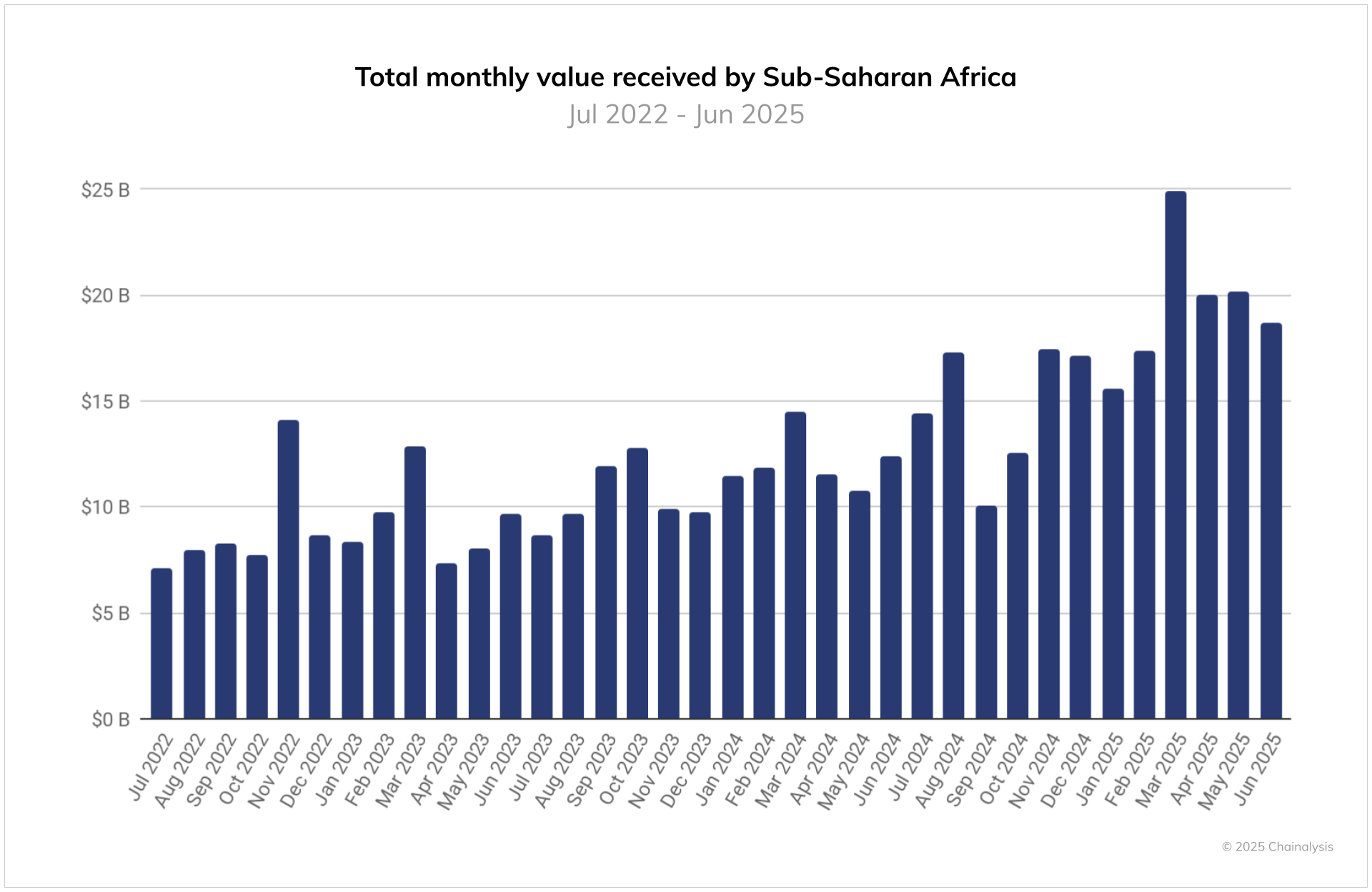
The increase was driven largely by centralized exchange activity in Nigeria, where the naira came under renewed currency pressure.
Currency devaluation can boost crypto activity in two ways: users may turn to crypto to protect their savings from a weakening local currency, and existing crypto purchases become more valuable when measured in naira.
Stablecoin payment networks
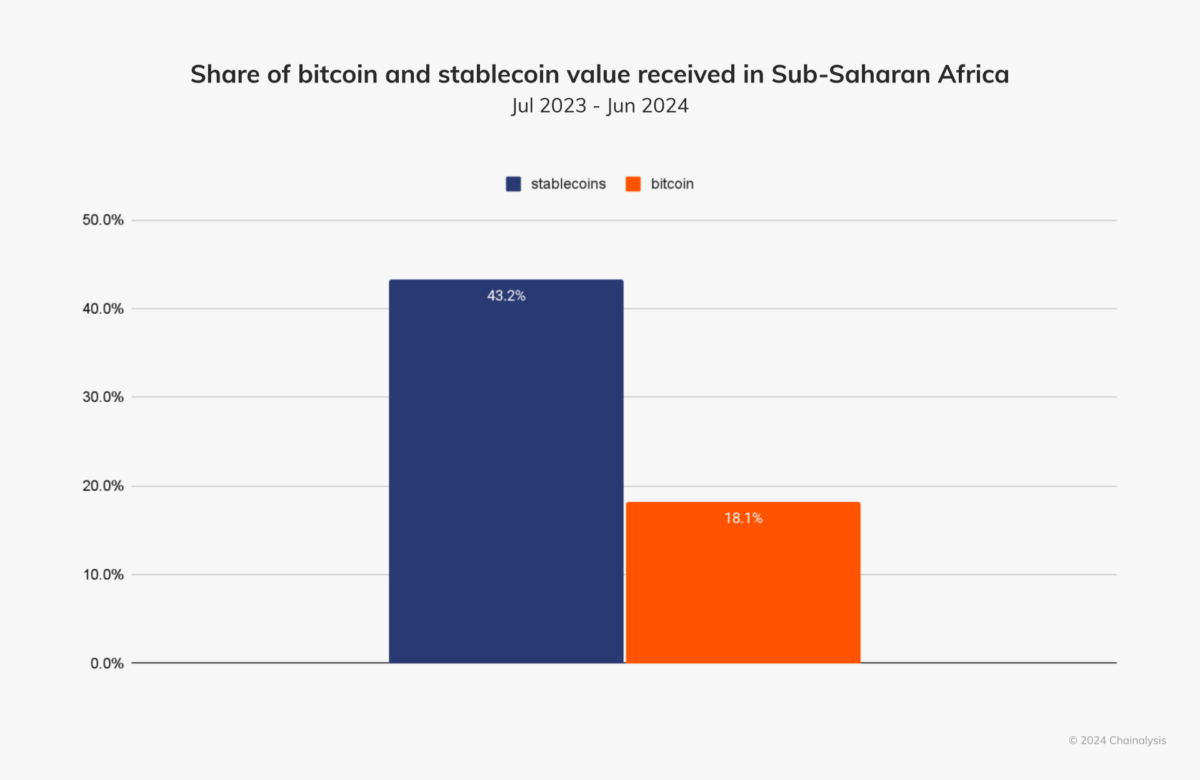
Stablecoins are another major route for crypto to move across the continent. Data shows that stablecoins accounted for 43% of Sub-Saharan Africa’s total transaction volume in 2024.
The flow doesn’t necessarily end in another crypto wallet. A business or individual can receive USDT or USDC and then convert it into local currency. This creates an infrastructure layer between the blockchain and the local financial system.
For example, Yellow Card says its payment infrastructure lets businesses receive local fiat, convert it to or from stablecoins, and send funds via bank transfers or mobile money across 20 African countries.
Peer-to-peer markets
Peer-to-peer markets provide another route, particularly where access to centralized exchanges or international payment systems is limited. P2P exchanges accounted for 6% of cryptocurrency transaction volume in Africa in 2022, more than twice the share recorded in the next-highest region in that analysis.

The basic model is straightforward. One person wants to buy crypto, another wants to sell it, and the platform or payment arrangement connects them. The crypto can move between wallets while the corresponding local-currency payment happens through a bank transfer, mobile-money service, or another local payment method.
Remittances and cross-border transfers
Cross-border movement is another important route. Stablecoins can let someone outside Africa send dollar-denominated value to a recipient on the continent without routing the entire transaction through traditional correspondent banking channels.
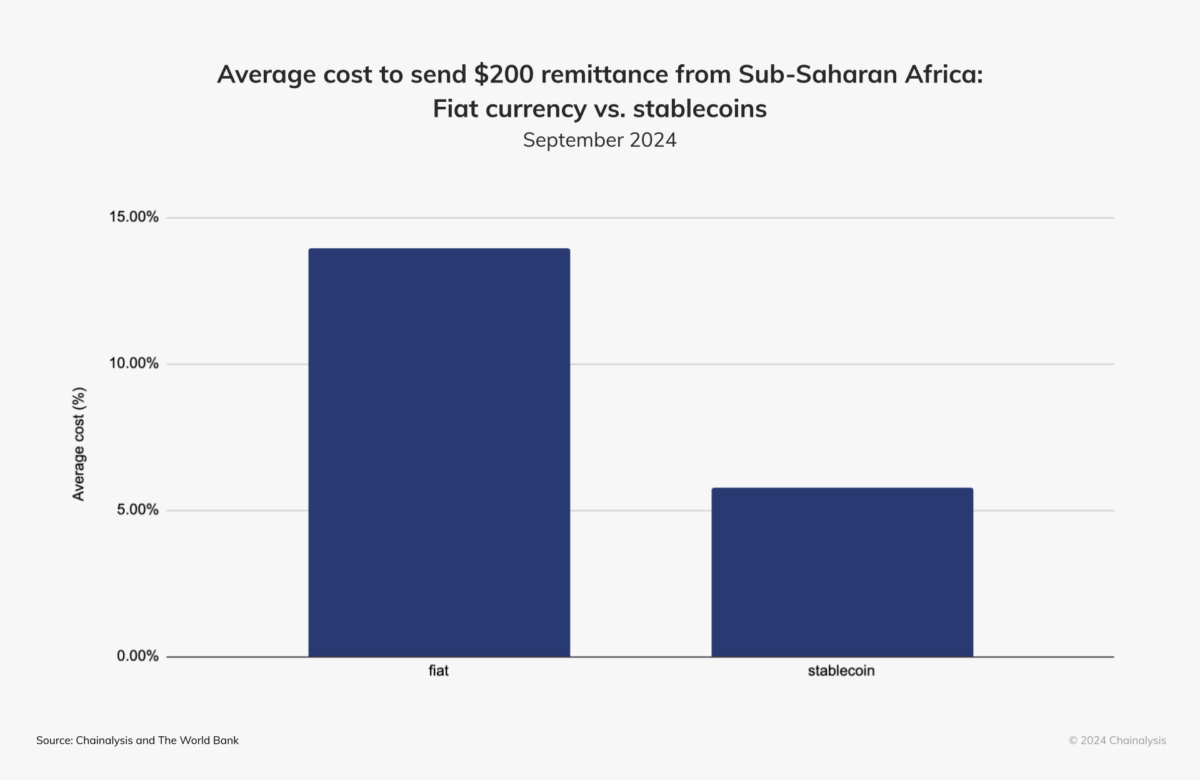
In 2024, the average cost of sending a $200 remittance from Sub-Saharan Africa was about 60% lower using stablecoins than traditional fiat-based methods.
The money usually takes a relatively simple path: a sender acquires a dollar-pegged stablecoin, sends it to a recipient or intermediary in Africa, and the recipient converts it into local currency. The final step can involve a bank account, a mobile-money wallet, or a local crypto off-ramp.
Why Africa’s Crypto Infrastructure Is So Difficult to See
The first reason this infrastructure is hard to identify is that African crypto activity generally doesn’t require an African blockchain.
A user in Nigeria can hold USDT on Tron, receive USDC through another public blockchain, trade Bitcoin on a global exchange, or send an asset to a wallet operated by an international company. The underlying blockchain infrastructure is global. The African component may appear only when the user converts the asset to naira, pays someone through a local payment method, or withdraws funds to a Nigerian bank account.
This creates a system in which different companies handle different parts of the transaction. The blockchain provides the settlement layer, a global company may provide the crypto service, and an African company may connect the transaction to local money. As a result, no single company or network always provides the infrastructure behind African crypto activity.
For example, Coinbase integrated Yellow Card’s payment network into Coinbase Wallet, giving users access to local payment methods. Coinbase provides the consumer-facing crypto service, while Yellow Card connects to local payment infrastructure.
Crypto activity often looks like ordinary financial activity
A second reason the infrastructure is difficult to identify is that the crypto component can disappear once a transaction reaches the user’s local financial system.
Consider a freelancer or business in Kenya that receives USDC from an overseas client. The client sends the stablecoin to a wallet or payment provider, which converts it into Kenyan shillings and sends the money to the recipient’s bank account or mobile-money wallet. From their perspective, the end result is simply money received through a familiar financial channel. Once the conversion is complete, there’s little reason to think about the blockchain behind the transaction.
This is because mobile money and other digital payment systems are already deeply embedded in everyday financial activity in Africa. A bank branch is visible. A card network has a recognizable brand. A mobile-money agent has a physical presence. By contrast, a crypto payment can pass through a blockchain, wallet, exchange API, liquidity provider, and local bank account without the user seeing most of those layers.
The infrastructure may therefore become visible only when something goes wrong, when a company markets the service behind it, or when researchers trace the transaction on-chain.
Africa’s market is fragmented
Africa is not one financial market. The continent has dozens of currencies, separate banking systems, different payment networks, and different regulatory frameworks. A company that wants to move stablecoins into local money cannot simply build one connection and treat the entire continent as a single market.
The World Bank made a similar point in its 2026 report on African economic integration, noting that payment, financial, digital and other systems frequently remain fragmented across national borders. It specifically calls for more interoperable payment and digital systems to make African markets work more closely together.
Crypto companies face this fragmentation directly.
A company supporting users in Nigeria may need a naira payment connection and to comply with Nigerian regulations. Expanding into Kenya can require a different banking relationship, liquidity in Kenyan shillings, and mobile-money connectivity. Ghana brings the cedi and its own regulatory environment. South Africa has a more developed virtual-asset regulatory framework and a different institutional market.
Why Traditional Banking Infrastructure Hasn’t Captured More of This Activity
Traditional banks already process a large share of Africa’s financial activity, but much of the crypto economy sits outside the systems they were built to operate. A cross-border payment can pass through several banks, correspondent institutions, currencies, and settlement systems before reaching the recipient. For some users, stablecoins offer a simpler alternative by letting dollar-denominated value move directly between wallets, without following the same path as a conventional international bank transfer.
Banks also face regulatory, compliance, and risk considerations when dealing with crypto. Depending on the market, they may offer limited support for crypto businesses, restrict digital-asset transactions, or require additional monitoring of transactions and customers. This has pushed activity toward crypto exchanges, fintechs, P2P markets, and stablecoin payment providers rather than directly through bank infrastructure.
The result is a gap between where financial activity is happening and where traditional financial infrastructure is built to capture it. Banks remain central to the final movement between crypto and local currency, but they may not control the digital rails where much of the activity takes place.
The Companies Trying to Build Around the Gap
The infrastructure gap has created opportunities for companies building between blockchains and Africa’s existing financial systems.
Stablecoin payment infrastructure
Flutterwave is moving into stablecoin payments from the traditional fintech side. The company has been developing stablecoin payment flows using Polygon. This will allow users to send and receive stablecoins while connecting those transactions to existing payment infrastructure.
The problem is the gap between digital-dollar transactions and local payment systems. A business may receive USDC from an international customer but still need to settle the transaction in a local bank account or another familiar payment method.
Crypto-to-fiat conversion
Platforms such as Bitnob provide infrastructure that connects African businesses and users to Bitcoin, stablecoins, and local financial systems. Its business products support payments, wallets, and API integrations, including moving funds between crypto and local bank or mobile-money systems.
Remittance infrastructure
Platforms like Paycrest focus on the cross-border payment problem from a liquidity perspective. The Nigerian company describes its platform as a decentralized liquidity network connecting local currency providers with stablecoin-based payments. This allows stablecoin transactions to reach local-currency markets without requiring every participant to build direct banking connections.
Custody and institutional infrastructure
As institutions hold more digital assets, they need infrastructure to control and secure them. VALR, a South African digital-asset platform, has expanded beyond retail trading into institutional services. Its institutional offering includes custody, OTC trading, API integration, multi-account management, and governance controls. The company says it serves more than 2,000 corporate and institutional clients.
Blockchain-based financial services
Blockradar is building another layer of this infrastructure by providing wallet and stablecoin technology to fintechs. Its platform lets businesses integrate non-custodial wallets and stablecoin functionality without building the underlying blockchain infrastructure themselves.
The significance is that the customer does not necessarily need to know that blockchain is involved. A fintech can build stablecoin functionality into an existing financial product while Blockradar handles much of the underlying infrastructure.
The Infrastructure Gaps That Still Need to Be Solved
Africa’s crypto market has grown faster than the infrastructure needed to make digital assets work seamlessly across countries, financial systems, and businesses.
Cross-border connectivity
Moving value between African countries remains fragmented. A solution that works in Nigeria may not automatically work in Ghana, Kenya, or South Africa because each market has different currencies, payment networks, financial institutions, and regulations.
Infrastructure providers need interoperable networks that can connect these markets and make cross-border crypto and stablecoin transactions easier to settle in local currencies.
Banking connections
Crypto companies still depend on banks and payment providers to move money between digital assets and the traditional financial system. Limited account access or weak banking relationships can make it harder to process local payments, settle transactions, and expand into new markets.
More reliable banking and payment connections can give crypto companies consistent access to local financial rails without forcing them to build separate arrangements for every market.
Regulation
Different rules across African countries make regional expansion difficult. Requirements for stablecoins, exchanges, custody, and crypto payments can vary widely, leaving businesses to navigate multiple licensing and compliance systems.
Clearer regulatory frameworks and greater consistency across markets can give infrastructure providers more certainty when building cross-border services.
Security and trust
Users and businesses need confidence in the companies that hold, convert, or move their funds. Questions around reserves, custody, transaction security, and what happens when a provider fails can limit adoption even when the underlying technology works.
Stronger custody controls, transparent reserve practices, secure transaction systems, and clearer accountability can make crypto infrastructure more trustworthy for both individuals and businesses.
Infrastructure for businesses
Businesses need more than basic crypto payment functionality. They need APIs, treasury tools, accounting systems, and compliance infrastructure that can connect digital assets with their existing operations.
Providers need to build business-focused systems that make crypto easier to manage alongside bank accounts, local currencies, payroll, payments, and financial reporting.
The Real Question Behind Africa’s $200 Billion Crypto Flow
Africa’s crypto economy is harder to see because its infrastructure is spread across global blockchains, exchanges, fintechs, mobile-money networks, banks, and liquidity providers. There is no single African network handling these flows. The $205 billion in crypto value received by addresses in Sub-Saharan Africa between July 2024 and June 2025 shows that significant demand already exists.
The bigger question is who will build the infrastructure to capture and connect that activity. Companies working on stablecoin payments, crypto-to-fiat conversion, liquidity, custody, and business tools are already addressing parts of the gap. The companies that can connect fragmented markets to reliable local financial systems may capture the greatest value as Africa’s crypto economy develops.
Disclaimer: This article is intended solely for informational purposes and should not be considered trading or investment advice. Nothing herein should be construed as financial, legal, or tax advice. Trading or investing in cryptocurrencies carries a considerable risk of financial loss. Always conduct due diligence.
Enjoyed this? Bookmark DeFi Planet, explore related topics, and follow us on Twitter, LinkedIn, Facebook, Instagram, Threads, and CoinMarketCap Community for seamless access to high-quality industry insights.
Take control of your crypto portfolio with DEFI PLANET PRO, DeFi Planet’s suite of analytics tools.