



























































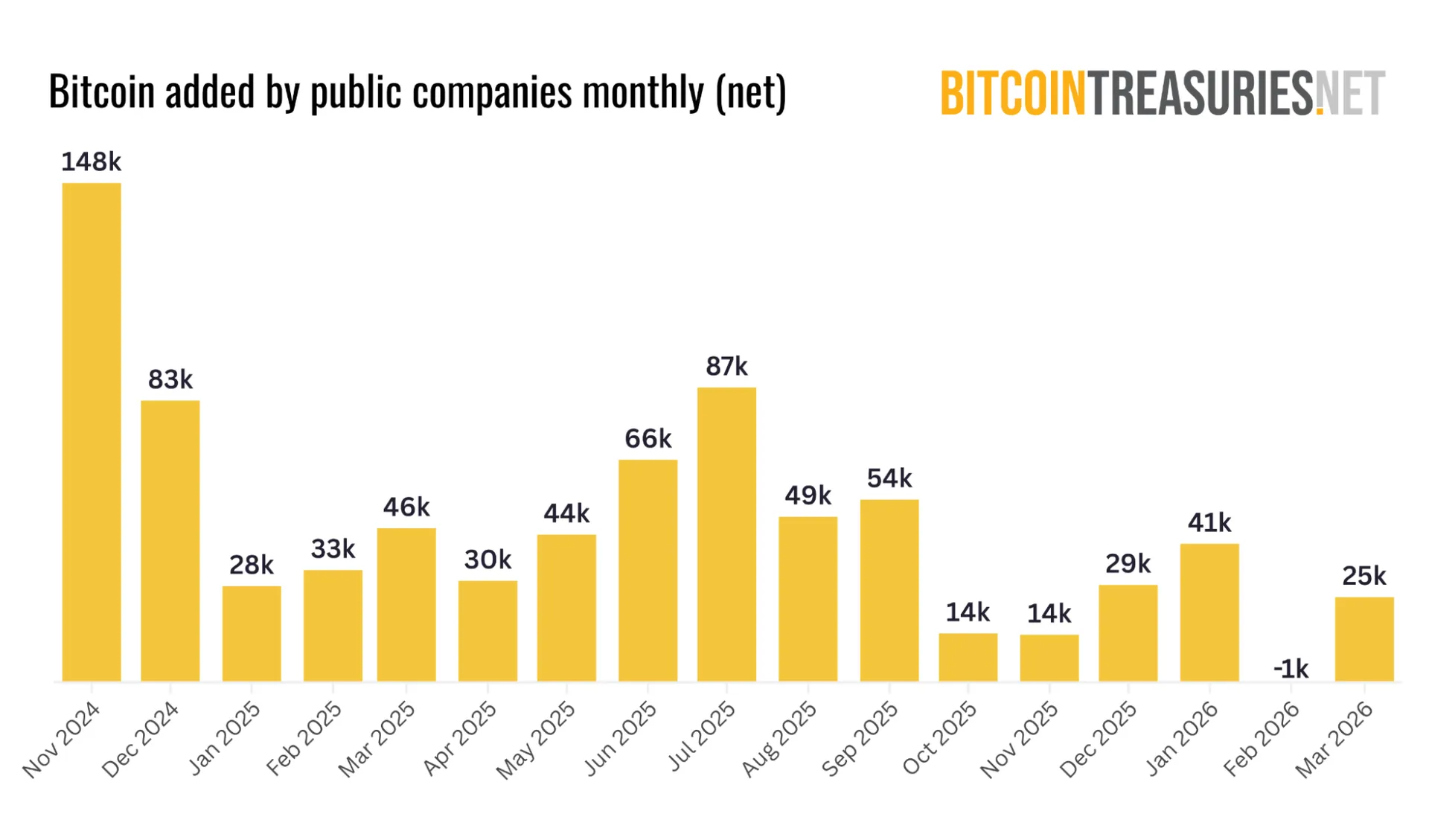
Public companies added more than 47,000 BTC in March, with most of the accumulation driven almost entirely by Strategy, according to industry treasury data.

The firm accounted for 44,377 BTC of total monthly inflows, representing roughly 94% of all corporate Bitcoin purchases during the period. Its buying was funded through a mix of capital raised from at-the-market share sales, including more than $1 billion from STRC offerings and additional proceeds from MSTR equity sales.
Corporate demand for Bitcoin as a treasury asset has fallen sharply, with most recent buying now coming almost entirely from Strategy (MicroStrategy). Data shows that companies outside Strategy bought only about 1,000 BTC in the past month, while Strategy bought around 45,000 BTC, making up about 98% of corporate purchases.
Overall, corporate Bitcoin buying has dropped 99% since its peak in August 2025, even though Strategy continues to accumulate heavily. Despite concerns about concentration risk, Michael Saylor argues that Bitcoin is too large and liquid for any single company to control its price.
JUST IN: Strategy $MSTR accounted for 94% of all 47,000 #Bitcoin bought by public companies in March.
After 9 companies reduced their holdings by 22,000 BTC, net monthly additions shrank to 25,000 BTC.
Read more: https://t.co/IuZZxINfYi pic.twitter.com/E9zggk5Mxn
— BitcoinTreasuries.NET (@BTCtreasuries) April 1, 2026
Corporate bitcoin demand weakens outside strategy
Excluding Strategy, corporate Bitcoin accumulation remained weak. Around 15 companies collectively added just 3,000 BTC, one of the lowest monthly totals recorded in recent periods.
At the same time, several firms reduced exposure, with nine public companies selling or cutting holdings by roughly 22,000 BTC. This left net corporate inflows at around 25,000 BTC for the month.
Large sellers included mining and digital asset firms that adjusted treasury positions amid market volatility and liquidity needs. Notable reductions came from companies such as MARA Holdings and other listed digital asset operators that trimmed reserves significantly.
Mixed movements reshape corporate rankings
Despite overall weak demand, treasury reshuffling led to notable ranking changes across corporate holders. Smaller acquisitions allowed several firms to climb the leaderboard as positions shifted across the sector. New entrants and incremental buyers, including firms like American Bitcoin, Strive, and DDC Enterprise, increased holdings through modest but steady accumulation strategies.
Meanwhile, large treasury holders such as Exodus Movement and other digital asset firms reduced holdings, contributing to a more uneven distribution of corporate Bitcoin exposure. Data trackers note that Strategy’s continued accumulation remains the dominant force shaping institutional Bitcoin flows, with its purchasing activity far outweighing combined activity from the rest of the corporate sector.
Notably, Strategy increased its bitcoin exposure after raising capital through equity sales, according to a newly released filing with the U.S. Securities and Exchange Commission.
Enjoyed this piece? Bookmark DeFi Planet, explore related topics, and follow us on Twitter, LinkedIn, Facebook, Instagram, Threads, and Coin MarketCap Community for seamless access to high-quality industry insights.
“Take control of your crypto portfolio with DeFi Planet PRO, DeFi Planet’s suite of analytics tools.”