












In 2025, stablecoins became more than just a crypto tool; they filled critical gaps where local currencies were fast-failing, areas where banking systems were slow, and remittances were necessary. They were used by people to save, receive income, perform cross-border transfers, run businesses and hedge against inflation. Stablecoins, with their overall transaction volume rising 83% between July 2024 and July 2025 to reach over $4 trillion in total. They now account for 30% of all crypto transaction volume, with USDT and USDC handling hundreds of billions monthly.


The increase in the use of stablecoins was so enormous that the policymakers of multiple nations started to prepare a Stablecoins bill, which is going to direct their use and protect consumers, which demonstrates the rising necessity of regulating stablecoins.
As the global adoption increased, five nations outperformed the rest, not by the volume of crypto, but by the degree of dependency, sparked by inflation, liquidity requirements, cross-border trade, restricted dollar access, or by geopolitical pressures.
1. Nigeria — The World’s Most Stablecoin-Dependent Consumer Market
Nigeria became the clearest illustration of a nation where stablecoins turned into an item of daily use. As the naira suffered unprecedented devaluations and authorities restricted access to FX, the concept of stablecoins became the surest way of earning, and for ordinary people to protect their income and operate.
In 2025, Nigerians used USDT at even higher rates compared to residents of fully dollarized economies. Roughly 7% of all user purchases went into USDT, a striking metric that reflects how digital dollars replaced traditional savings for millions. Stablecoins became easier to access than physical dollars, cheaper to move than bank-mediated FX, and more trustworthy than a currency losing value week by week.
Between July 2023 and June 2024, Nigeria processed nearly $22 billion in stablecoin flows, accounting for almost 40% of Sub-Saharan Africa’s stablecoin activity.
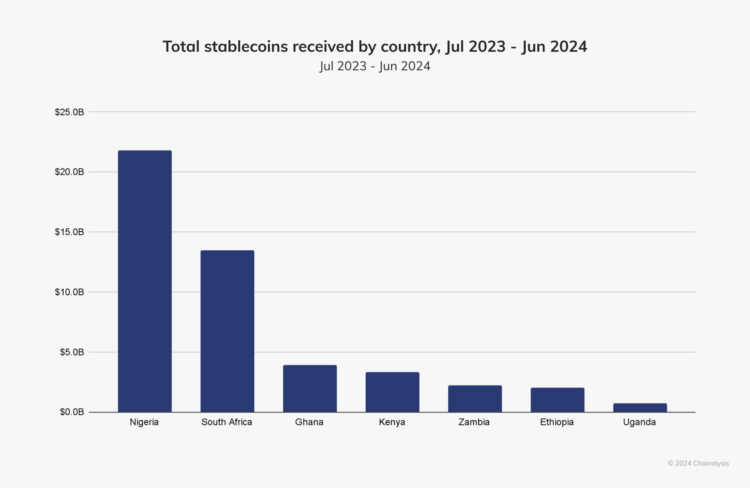
That reliance only deepened into 2025. People used stablecoins to save, freelance, trade, receive remittances, and hedge against inflation.
2. Argentina — Stablecoins as a Parallel Financial System
Argentina’s history with stablecoins was shaped by decades of inflation, currency controls, and peso hypervolatility. As of 2024, stablecoins already made up 61.8% of the country’s crypto transaction volume. This dependency continued up to 2025 as inflationary pressure persisted.
Between July 2024 and June 2025, more than half of all peso-denominated exchange purchases went directly into stablecoins. For many Argentines, converting income into USDT or USDC on payday became standard practice, reflecting widespread stablecoin adoption as a parallel financial system.
In Argentina, the use of stablecoins was not as a speculative instrument; rather, it was the unofficial savings system in the country, safeguarding value in an environment where the local currency could not.
3. Brazil — A Modern Fintech Giant Turning to Digital Dollars
Brazil emerged in 2025 as one of the world’s most active stablecoin markets, driven by a mix of inflation concerns, cross-border commerce, and remittances.
Although inflation had cooled to around 5%, years of volatility left Brazilians wary of relying solely on the real. Officials noted that more than 90% of all crypto flows in Brazil in 2025 involved stablecoins, an extraordinary figure for a country with a robust financial ecosystem.
Between July 2024 and June 2025, over half of all BRL exchange purchases went straight into stablecoins. While Pix already made domestic BRL transfers instant and free, it could not handle global transfers or offer protection against inflation. Stablecoins filled this gap seamlessly: fast settlement, global reach, and dollar-linked value.
For Brazilians trading abroad, running international businesses, or receiving foreign payments, stablecoins offered a level of efficiency and stability unmatched by local rails.
4. South Korea — A Trading Powerhouse Driving a Different Kind of Stablecoin Boom
South Korea’s rise was surprising for an entirely different reason: the stablecoin boom was fueled by one of the world’s most active trading communities.
When Korean exchanges like Coinone introduced USDT/KRW pairs in late 2023, traders instantly recognized their value. Stablecoins became the preferred bridge asset for liquidity management, arbitrage, hedging, and fast rotations between volatile tokens.
By June 2025, KRW purchases of stablecoins reached roughly $64 billion in a single year. This surge pushed Korea to the top of the Asia-Pacific region for local-currency stablecoin activity.

The demand was so strong that policymakers began exploring frameworks for a fully regulated KRW-backed stablecoin, as part of broader stablecoins regulation.
5. Russia — Stablecoins as a Geopolitical Workaround
Russia’s position as a 2025 stablecoin hotspot was driven less by consumer demand and more by geopolitics and sanctions.
The breakout story was the A7A5 stablecoin. By July 2025, its transaction volume hit $41.2 billion, with a market cap doubling from $521 million to $1 billion in just two weeks. More than $1 billion moved through it daily. TRM Labs traced A7A5 to a crypto network operating through Kyrgyzstan that enabled trade in dual-use goods from China to Russia.
This activity highlighted how stablecoins were becoming the backbone of alternative payment networks outside Western banking rails. Meanwhile, Russian demand for USDT intensified. A7A5’s developers added $100 million worth of USDT to their DEX liquidity pool just to meet the inflows.
In Russia, stablecoins served three key roles:
- enabling cross-border payments amid sanctions,
- acting as substitutes for USD in trade,
- and forming a resilient settlement layer resistant to geopolitical pressure.
Russia’s stablecoin adoption was not just financial; it was strategic.
Also Read: Russia Trades Through The Back Door And Crypto Holds It Open
Why These Countries Stand Out
These five countries stand out because each relied on stablecoins in ways shaped by unique local pressures rather than global trends.
In Nigeria, stablecoins became a lifeline, offering a reliable store of value and access to dollars amid a rapidly depreciating naira and restrictive foreign exchange controls.
South Korea’s adoption, by contrast, was driven by liquidity and speed, as high-frequency traders used stablecoins to move quickly between assets, hedge risk, and optimize market opportunities.
In Brazil, stablecoins served as both a hedge against persistent inflation and a tool for global payments that domestic systems like Pix could not fully support.
Argentina’s reliance reflected long-term inflationary pressures, with households and businesses using stablecoins as an unofficial savings system to preserve wealth and transact internationally without losing value to the peso.
Russia, meanwhile, leaned on stablecoins for geopolitical resilience, using them to maintain trade flows, circumvent sanctions, and create alternative payment channels outside traditional banking rails.
Across all five countries, stablecoins solved real, practical financial problems that conventional systems could not address efficiently, proving their role as both a financial necessity and a strategic tool in diverse economic environments.
The Stablecoin Map No Longer Follows GDP; It Follows Need
By the end of 2025, one truth became unmistakable: stablecoin adoption no longer aligned with economic size, global influence, or technological sophistication. It aligned with the need. The countries that embraced stablecoins most intensely were not the biggest economies; they were the ones where people were under the most pressure or where financial systems had the widest gaps. Stablecoins rose where currencies were unstable, where inflation was corrosive, where remittances were critical, where banking access was limited, or where geopolitical constraints made traditional payment networks unreliable.
What emerged was a new global map of digital money, one that cut across continents, income levels, and political systems. All five countries demonstrated that stablecoins succeed not because they are trendy, but because they solve problems that no other financial technology solves as effectively.
The lesson of 2025 is simple but profound: stablecoins grow where they are needed most. And as long as economic volatility, cross-border work, and global tensions continue to shape people’s financial lives, the demand for digital dollars will not be slowing down. The future of stablecoins will not be determined by the richest nations, but by the ones whose people need them the most.
Disclaimer: This article is intended solely for informational purposes and should not be considered trading or investment advice. Nothing herein should be construed as financial, legal, or tax advice. Trading or investing in cryptocurrencies carries a considerable risk of financial loss. Always conduct due diligence.
If you want to read more market analyses like this one, visit DeFi Planet and follow us on Twitter, LinkedIn, Facebook, Instagram, and CoinMarketCap Community.
Take control of your crypto portfolio with MARKETS PRO, DeFi Planet’s suite of analytics tools.”






