















Quick Breakdown
- Russia is facing a barrage of sanctions that have further isolated it from global finance. As a result, crypto, once disregarded, has become a practical lifeline for cross-border payments.
- Blockchain payment rails have helped Moscow keep exports moving without relying on Western banks.
- Strict state oversight still clouds the outlook for decentralization and future innovation inside the country.
- The surge of cross-border crypto payments in Russia, and indeed across Europe, clearly signals a shift to strategic adoption.
- Could this be the start of a new financial era for Russia, or just a stopgap under pressure?

Russia’s Crypto Gambit in a Sanctioned World
For years, Russia kept crypto at arm’s length. Officials dismissed it as a risky, speculative fad that could weaken the ruble and enable shady financial activity. The Central Bank of Russia (CBR) especially viewed cryptocurrencies with suspicion, warning that they could destabilize the economy and leave retail investors trapped in volatile swings.
In 2020, the government reinforced this cautious view with the “On Digital Financial Assets” law, which officially recognized cryptocurrencies but banned their use for everyday payments.
Then sanctions hit.
Western countries imposed sweeping financial restrictions after the Ukraine conflict snowballed into full-on war in 2022. Russia suddenly found itself locked out of global systems like SWIFT. Access to U.S. dollars and euros, the backbones of international trade, was cut off. Faced with an economy gasping for liquidity, the Kremlin began to view crypto less as a threat and more as a possible lifeline.
Crypto payments became a way to move money across borders when traditional routes were blocked.
By 2024, the government began opening the door carefully. New legislation allowed companies to use crypto for international trade, a major shift from its previous hardline stance. However, the state made sure to keep a tight grip: while businesses could transact globally, ordinary Russians still faced restrictions on trading and holding crypto. The message was clear: crypto was for strategy, not speculation.
The real turning point came when Finance Minister Anton Siluanov announced that the Finance Ministry and the CBR had agreed to legalize crypto for foreign trade. He called it a “necessary adaptation”— a way to keep trade alive despite heavy sanctions.
This was more than policy. It was survival. Russia has since been using blockchain solutions for cross-border payments to stay plugged into global trade, bypassing sanctions.
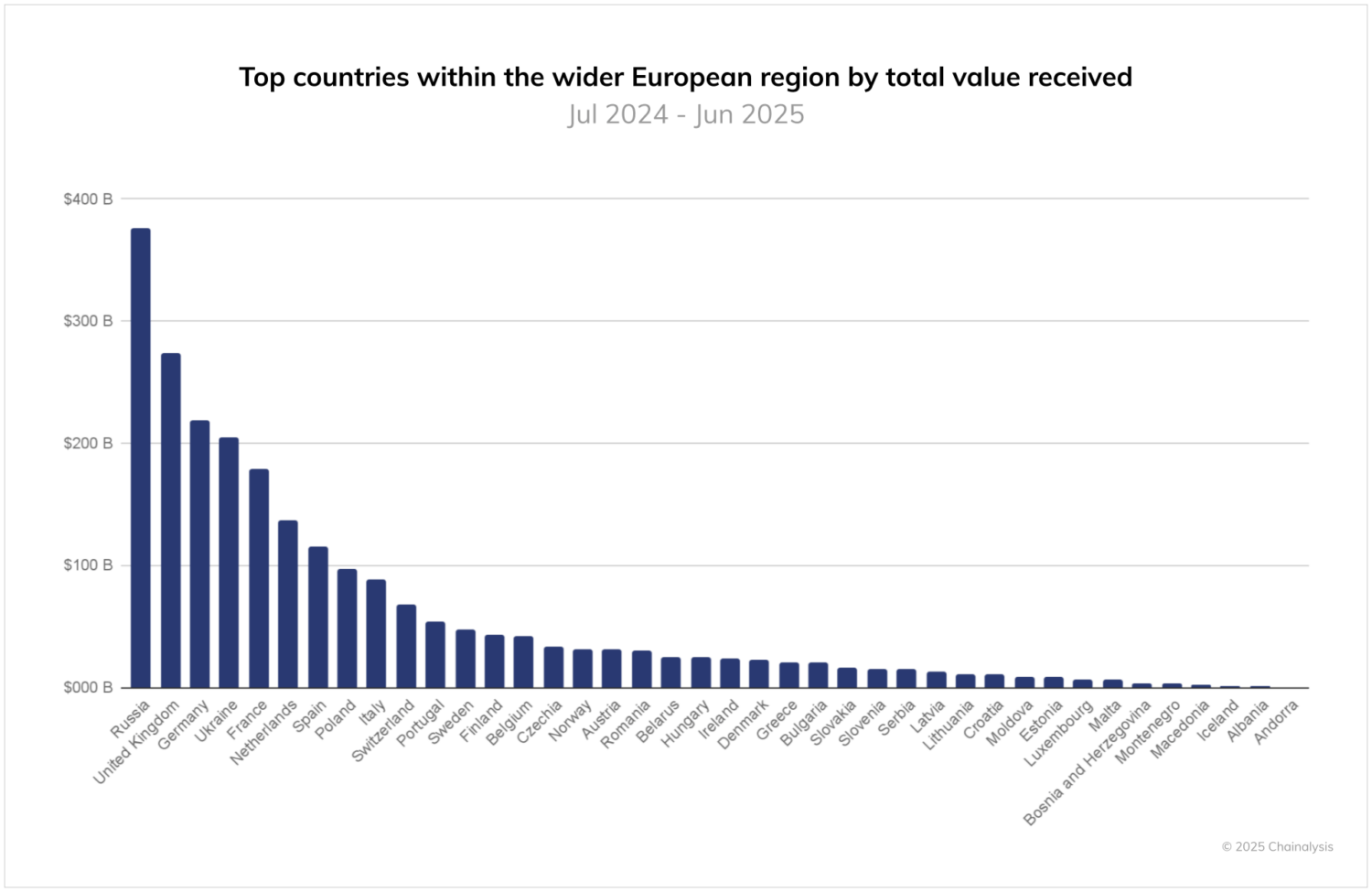
And available data backs this up. According to Chainalysis, between July 2024 and June 2025, Russia became Europe’s largest crypto market, receiving $376.3 billion, far surpassing the United Kingdom’s $273.2 billion.
Will Crypto Redefine Trade or Reinforce Economic Isolation?
Russia’s crypto experiment sits at a fascinating crossroads. On one hand, it shows how blockchain and crypto cross-border payments can help countries bypass traditional bottlenecks and gain financial independence. On the other hand, it raises an uncomfortable question: can innovation really thrive under a government that insists on total control?
A permissioned, state-run blockchain where every transaction requires approval risks becoming just another centralized system in disguise. That’s the irony. The same government that once feared decentralization is now trying to use blockchain without actually embracing the freedom that makes it useful.
There’s also the matter of trust. For crypto-based trade to work at scale, partners abroad have to believe the rules are fair, the records are reliable, and the system will not change on a whim. Without that confidence, the technology won’t open doors. It will close them.
How Russia’s Crypto Strategy Impacts Global Sanctions Enforcement
Russia’s shift toward blockchain-based payments doesn’t just reshape its own trade; it also tests how far sanctions can reach in a digital world. Crypto rails create new paths for moving value, but they don’t automatically guarantee invisibility or protection from oversight.
For one, the rise of crypto does not mean sanctions suddenly lose their power. While digital assets can bypass some traditional banking checks, most large transactions still interact with exchanges, OTC brokers, or service providers that regulators monitor closely. Agencies like OFAC and the EU have upgraded their tools to track on-chain activity, identify patterns, and flag suspicious wallets. What once looked like an escape route is now becoming another space for surveillance.
It’s also important to understand the role of mixers, OTC desks, and sanctioned banks. These entities can help obscure payment trails, but they also leave digital fingerprints. Blockchain transparency means every transfer is permanently recorded. Ironically, Russia’s move toward more transparent blockchain rails can make it easier for analysts to trace flows, map networks, and identify counterparties, something far harder to do in opaque cash systems.
So, the question is whether crypto gives Russia enough flexibility to keep trading while regulators race to close the gaps. The answer sits somewhere in the middle: crypto complicates enforcement, but it also creates new data points for tracking compliance.
A New Trade Blueprint or a Temporary Escape Route?
Russia’s move toward blockchain-based settlements reflects another truth: pressure speeds up innovation. When access to traditional rails tightens, countries look for workarounds. By testing new digital finance tools like crypto, Moscow is asking a simple question: Can technical self-reliance reduce financial dependence?
If it works, Russia could set a precedent for other countries shut out of traditional systems, showing that blockchain-powered cross-border payments can offer workable alternatives to dollar-centric trade. But there are obvious risks. A network with heavy oversight and limited connections to the wider world can turn into a closed loop. It may be digital, yet still confined and hard to scale.
The honest view is that this is not a clean break with the past. It is a practical response to today’s mix of money, power, and technology. Whether it matures into a durable trade option or remains a temporary workaround will come down to one factor: trust.
Without it, even the most advanced form of crypto cross-border payments remains just another walled garden in an already divided global economy.
Disclaimer: This article is intended solely for informational purposes and should not be considered trading or investment advice. Nothing herein should be construed as financial, legal, or tax advice. Trading or investing in cryptocurrencies carries a considerable risk of financial loss. Always conduct due diligence.
If you want to read more market analyses like this one, visit DeFi Planet and follow us on Twitter, LinkedIn, Facebook, Instagram, and CoinMarketCap Community.
Take control of your crypto portfolio with MARKETS PRO, DeFi Planet’s suite of analytics tools.”






