






















































For most of the internet era, the biggest technological revolutions have followed a familiar pattern; breakthroughs appear, innovation explodes, and startups emerge everywhere, and then, over time, power concentrates around a small group of dominant companies.

Search became synonymous with Google, social media consolidated around a handful of giant platforms and cloud infrastructure became concentrated among major players like Amazon, Microsoft, and Google. Mobile computing eventually narrowed around Apple’s iOS and Google’s Android ecosystems, but now the same question is being asked about artificial intelligence.
Will AI become another industry controlled by a small group of technology giants? Or can a new generation of decentralized networks create a more open future?
Supporters of decentralized AI networks believe AI should not be controlled by a handful of corporations. They argue that blockchain technology, token incentives, and open-source development can create meaningful alternatives to today’s AI leaders, but critics are less convinced. They point out that modern AI development requires enormous financial resources, specialized hardware, proprietary datasets, and infrastructure on a global scale and from their perspective, decentralization sounds attractive but struggles against the economic realities of building frontier AI systems.
The stakes could hardly be higher as the organizations that control advanced AI may influence education, healthcare, scientific discovery, software development, finance, and productivity across entire economies, necessitating the question of whether decentralized AI can compete with OpenAI, Google, or Meta, which has become much bigger than a crypto debate. It is increasingly becoming a debate about who controls the future of intelligence itself.
TL;DR:
- AI is dominated by a handful of giants — OpenAI, Google, Meta, Microsoft — because building cutting-edge AI requires enormous money, computing power, and data.
- Decentralized AI networks are trying to change this using open-source models, shared computing, and blockchain incentives. But they face real obstacles: compute is expensive, proprietary data is hard to replicate, and big tech has unbeatable distribution through products that billions of people already use.
- Decentralized AI probably can’t beat the giants head-on anytime soon. But it doesn’t have to. The bigger opportunity is in the gaps the giants ignore: niche tools, open research, community platforms, and privacy-first alternatives.
- Open-source models are improving fast, and the gap between open and proprietary AI is narrowing, though it hasn’t closed.
- The future likely isn’t one side winning; it’s both coexisting, each serving different needs. The real debate isn’t just about technology, it’s about who controls one of the most powerful inventions humanity has ever built, and that question is still wide open.
Why AI Became Centralized
To understand the future, we first need to understand the past and the present. AI did not become centralized by accident. It became centralized because scale matters, and training state-of-the-art AI systems requires enormous computational resources.
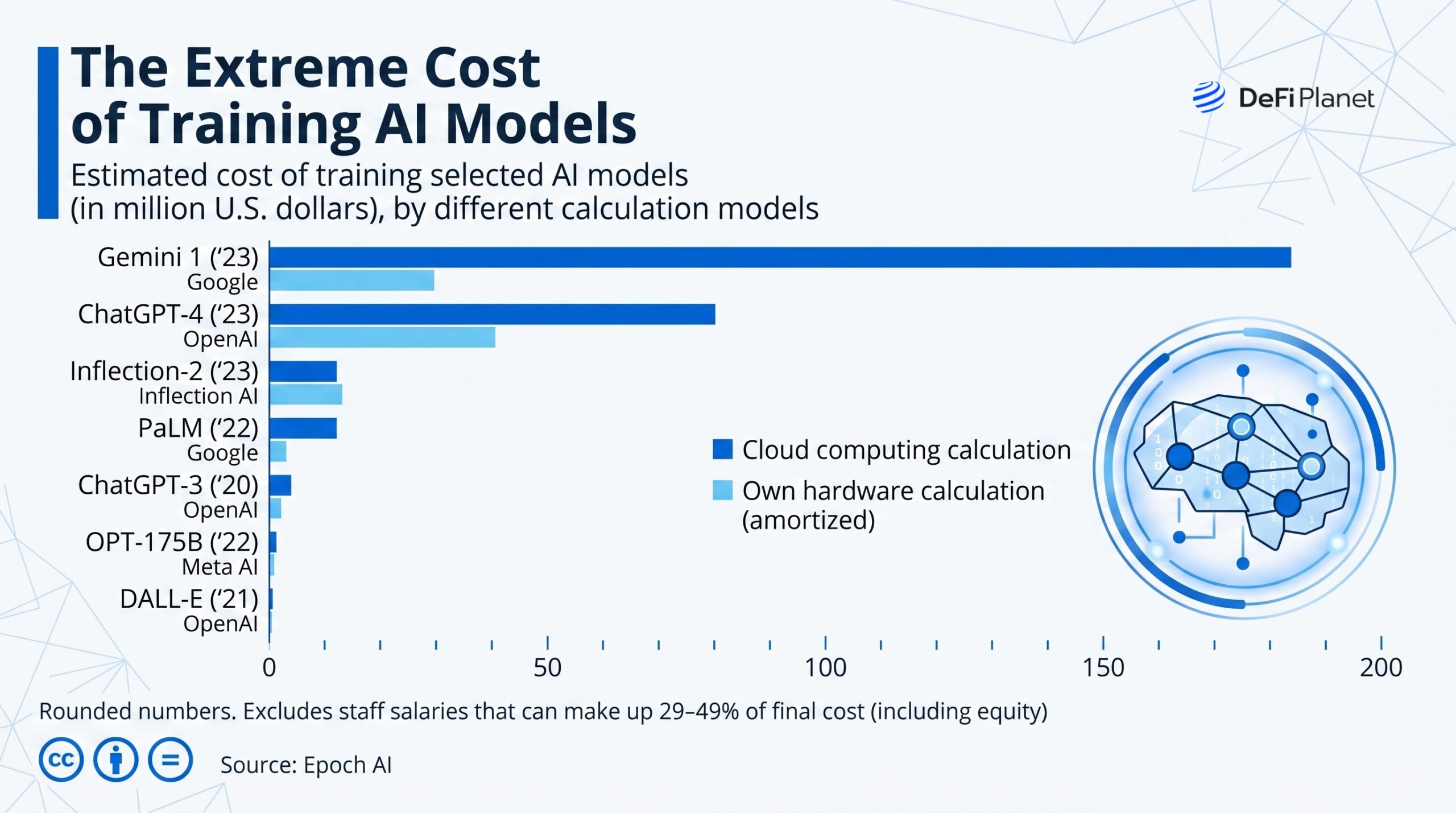
Modern frontier models are trained on massive GPU clusters running continuously for weeks and even months. The cost of these training runs has risen dramatically over the past decade, with research from Epoch AI estimating that frontier model training costs have been increasing rapidly.
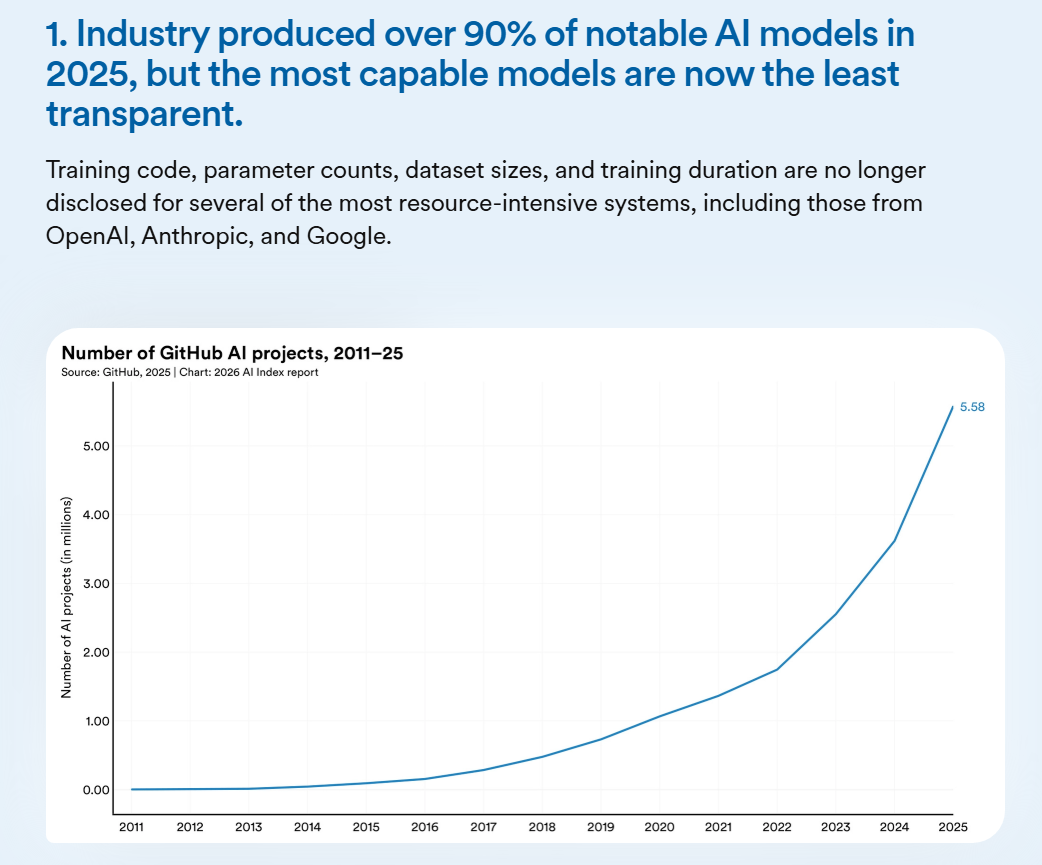
According to Stanford’s 2026 AI Index, industry giants produced more than 90% of notable AI models in 2025, but the most capable models are now the least transparent.
That concentration creates a powerful advantage because companies like OpenAI, Google, Meta, and Anthropic can spend billions on infrastructure, talent, research, and deployment, and only a few organizations can match that level of investment. As a result, AI development naturally concentrates among firms with access to enormous pools of capital.
This concentration is one reason concerns about Big Tech’s dominance in AI continue to grow, because when you have a small number of organizations that control the most advanced models, they gain significant influence over pricing, access, deployment policies, and future innovation.
For many observers, that concentration raises important questions about competition and technological power. What makes this dynamic especially important is that AI benefits from powerful network effects, and success in AI is not simply about building a good model. It is about creating a system that continuously improves faster than competitors.
Large AI companies can invest more money into training models, and better models will attract more users. More users generate more feedback and usage data, which helps improve future models, attracting even more users and, over time, creating a cycle that reinforces itself.
The result is that leadership in AI can compound, and a company that is ahead today may find it easier to stay ahead tomorrow. This is very different from earlier eras of software development, where a small startup could once challenge a large incumbent with a clever product and a handful of engineers. In frontier AI, even gaining access to the necessary computing resources can require hundreds of millions of dollars, making the barrier to entry really high.
Another factor is talent concentration because the world’s leading AI researchers, engineers, and infrastructure specialists are increasingly drawn toward organizations that can offer access to massive compute resources and ambitious research programs. This creates another feedback loop. The best talent often wants to work where the most advanced research is happening, which can make the leaders even stronger.
Infrastructure ownership adds yet another layer, as training a frontier model is only the beginning. Deploying AI at a global scale requires data centers, networking capacity, cloud infrastructure, cybersecurity systems, and operational expertise. The organizations that already control these resources can move faster and more efficiently than newcomers trying to build them from scratch.
Some analysts compare the current AI landscape to the early days of electricity or railroads because, in those industries, the companies that controlled the underlying infrastructure often accumulated enormous influence, as everyone else depended on their networks. AI may be developing similar characteristics, and the most valuable asset may not simply be the model itself, but the ecosystem surrounding it.
If advanced AI becomes a foundational layer of the global economy, similar to cloud computing or the internet itself, should so much capability be concentrated in the hands of a relatively small number of organizations?
Supporters of decentralization argue that concentration creates risks, and a handful of companies could shape which AI systems people can access, how information is filtered, what applications are prioritized, and who benefits economically from AI-driven productivity gains.
Critics of decentralization respond that concentration is not necessarily a flaw but a consequence of the enormous resources required to push the technology forward. In their view, frontier AI is centralized for the same reason semiconductor manufacturing is concentrated: the economics naturally favour scale.
The challenge is not simply whether AI should be decentralized but whether decentralized systems can realistically match the advantages that scale, capital, infrastructure, talent, and data have already given to the industry’s largest players, and that question may ultimately determine the future structure of the AI economy.
How Decentralized AI Networks Work
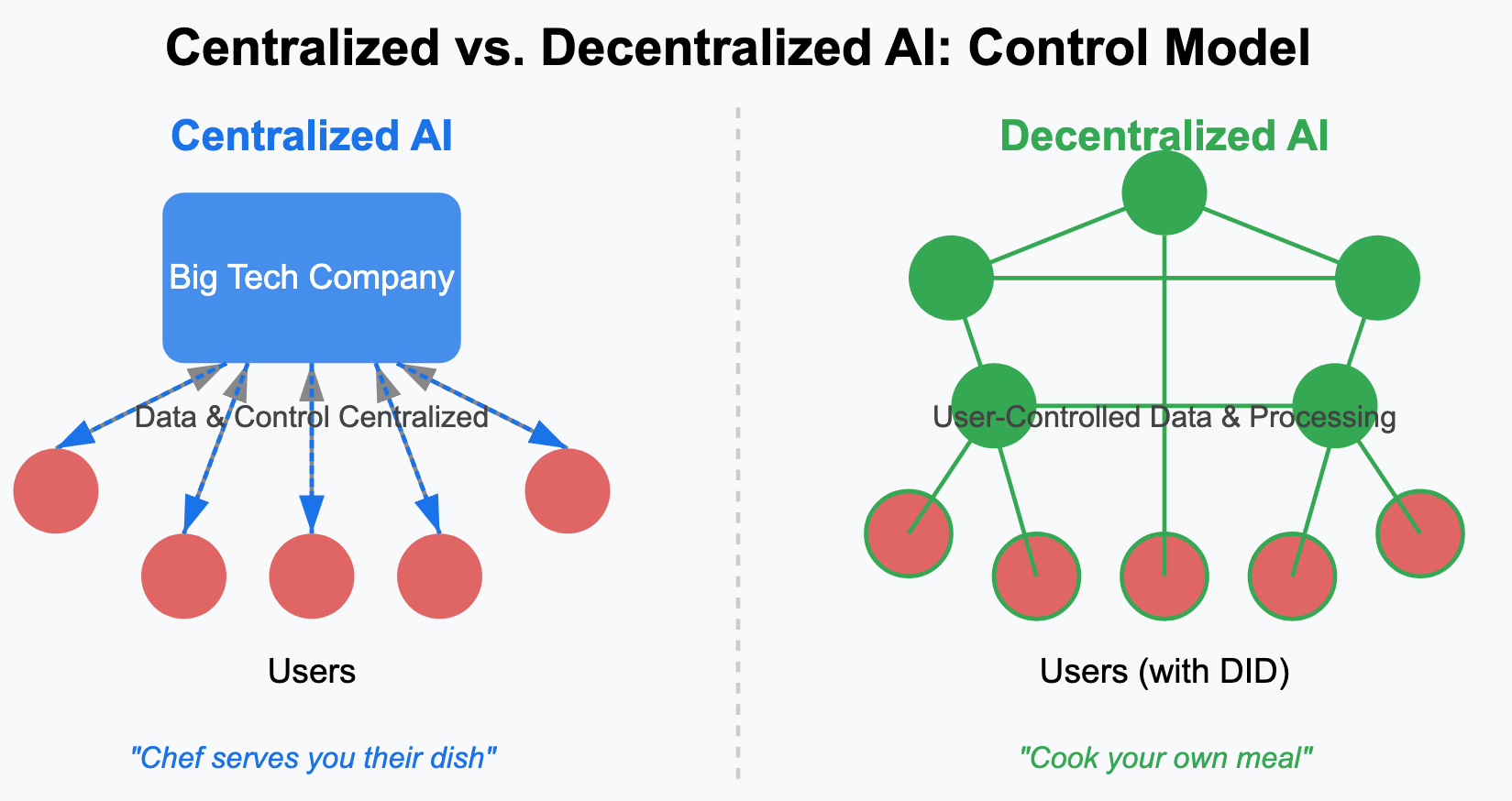
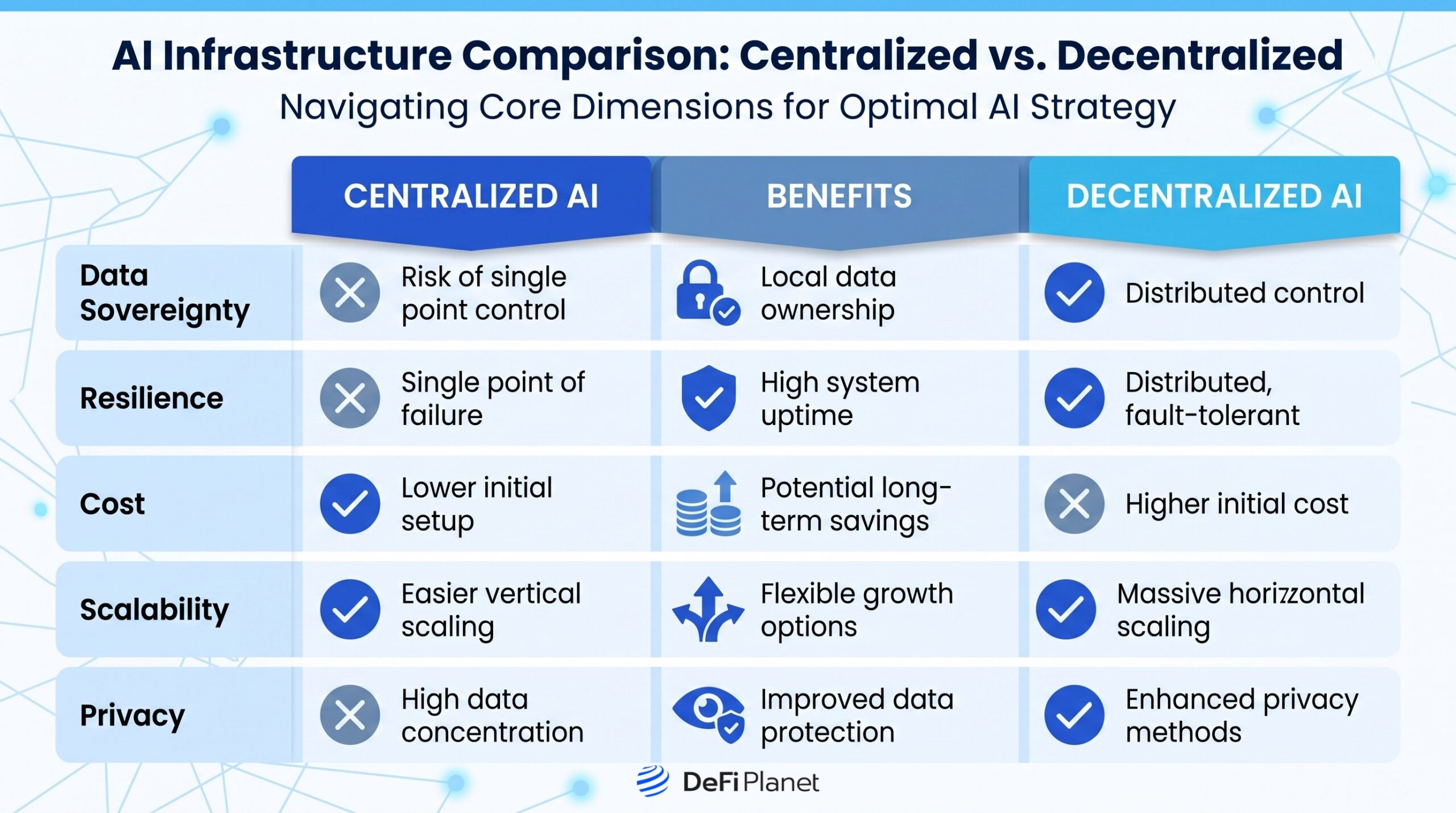
Before evaluating whether decentralized systems can compete, it helps to understand how decentralized AI networks work. Traditional AI companies control nearly every part of the stack: they own the infrastructure, train the models, manage deployment and control governance.
Decentralized AI projects attempt to distribute some or all of these functions across networks of participants, with different projects approaching this challenge differently. Some focus on decentralized compute markets where individuals contribute unused GPU resources. Others focus on open-source model development. Some use blockchain systems to coordinate incentives among researchers, developers, and infrastructure providers; the core idea remains consistent.
Instead of one corporation controlling everything, decentralized systems attempt to spread ownership and participation across broader communities. Projects such as Bittensor, Akash Network, and Render Network represent different experiments within this broader movement.
Bittensor, for example, uses a blockchain-based incentive system that rewards participants for contributing useful AI outputs and services.
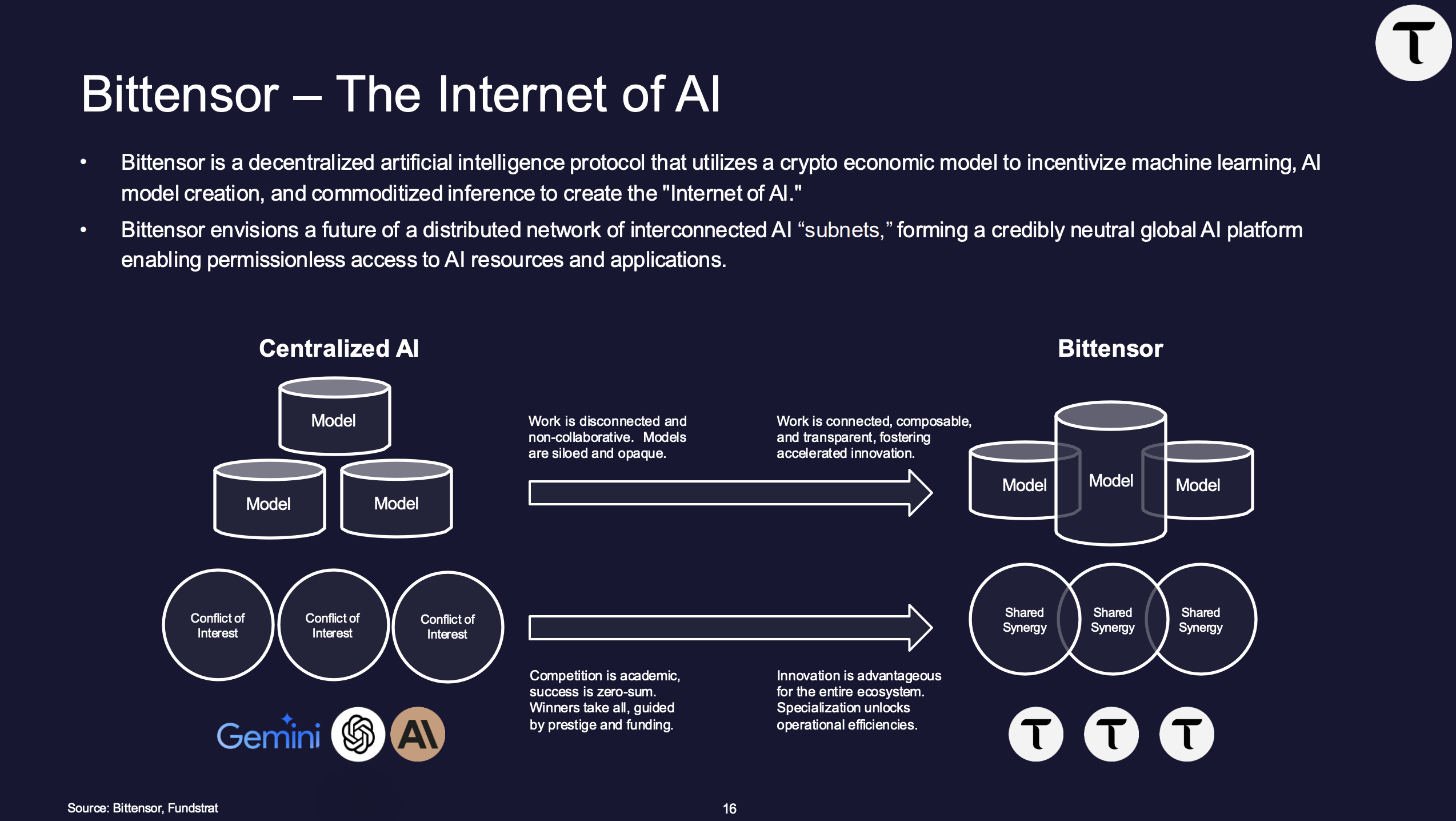
Its goal is to create an open marketplace for machine intelligence rather than concentrating development inside a single company; a vision that is compelling but challenging to execute.
READ ALSO: Should Crypto Be the Native Payment Layer for AI-to-AI Commerce?
Why Compute Access Remains the Biggest Barrier
Every serious discussion about decentralized AI eventually arrives at the same obstacle: Compute.
Among all the open-source AI compute challenges, access to computational resources remains the most important. Modern AI systems require specialized GPUs, high-speed networking, advanced cooling systems, optimized software environments, and substantial engineering expertise; these requirements create economies of scale. Large companies can negotiate hardware access more efficiently. They can even build larger clusters and spread costs across millions of users.
Decentralized networks face a different reality as they often rely on geographically distributed hardware owned by independent participants. While this increases openness, it can create challenges involving reliability, latency, coordination, and performance consistency.
The economics are difficult to ignore, and research on frontier AI costs suggests that training expenditures continue to rise dramatically, with some estimates indicating that future frontier models could require investments exceeding $1 billion.
This reality explains why compute has become one of the most strategically important assets in AI. The organizations controlling the largest GPU clusters possess enormous advantages in experimentation, training, and deployment, and for decentralized AI, overcoming this compute gap remains one of the biggest hurdles.
The Open-Source Revolution Changed Everything
For a while, it looked like the largest AI companies would dominate indefinitely, but then something unexpected happened. Open-source AI improved much faster than many experts predicted, and the release of models like Llama helped accelerate a global wave of experimentation. Researchers, startups, and independent developers suddenly had access to increasingly capable systems without needing to train models entirely from scratch.
The debate around decentralized AI vs centralized AI companies became more nuanced, and instead of asking whether decentralized projects could train the single largest model, people started asking whether open ecosystems could innovate fast enough to remain competitive.
According to Stanford’s AI Index, open-source model releases have increased significantly in recent years. In 2023, nearly two-thirds of newly released foundation models were open source, and even industry leaders noticed the trend. Meta’s chief AI scientist, Yann LeCun, argued that the success of open models such as DeepSeek demonstrates the power of open innovation and collaborative development, but proprietary models still lead on many advanced benchmarks.
The gap has narrowed, but it has not disappeared, and that distinction matters because while open source changed the conversation, it did not eliminate the challenges.
The Data Advantage Nobody Talks About Enough
When people discuss AI, most conversations focus on models and compute; data often receives less attention. Data may be one of the most important competitive advantages in the entire industry because companies such as Google and Meta operate platforms used by billions of people. Search engines, social networks, productivity tools, email systems, video platforms, and enterprise software all generate enormous amounts of user interaction data, creating a powerful feedback loop such that better products attract more users and more users generate more data.
More data improves future products, with decentralized projects often struggling to replicate this advantage. Many rely heavily on public datasets and open repositories, and while these resources remain valuable, acquiring large-scale proprietary interaction data is significantly harder.
This does not make competition impossible; it does, however, highlight another structural advantage enjoyed by centralized incumbents.
Can Blockchain Infrastructure Actually Improve AI Development?
One of the most interesting questions in this space concerns blockchain infrastructure for AI development. Supporters argue that blockchain systems create new ways to coordinate innovation, and instead of relying on traditional corporate hierarchies, decentralized networks can reward contributors directly through programmable incentives.
The theory is simple. Researchers, developers, infrastructure providers, and users all contribute value. Blockchain systems create mechanisms to measure those contributions and distribute rewards accordingly.
Projects like Bittensor attempt to operationalize this idea by rewarding network participants based on the value of their AI contributions, a concept that is innovative but whose results remain mixed.
Some researchers have argued that token incentives can sometimes create unintended consequences, including reward concentration and governance challenges. Studies examining decentralized AI networks have found evidence that incentive alignment remains a difficult problem. Now, this does not mean blockchain incentives cannot work; it simply means that designing sustainable economic systems is harder than launching a token.
The future of decentralized AI may depend as much on economics as it does on technology.
The Hidden Power of Distribution
Most discussions about AI focus on technical performance, but technology history teaches a different lesson, and that is, distribution often matters more.
Consider how people access AI today, Google integrates AI into Search, Android, Workspace, and Cloud. Microsoft integrates AI into Windows, Microsoft 365, GitHub, and Azure, Meta integrates AI into its social platforms used by billions. These distribution channels are incredibly powerful, and even if a decentralized model achieves technical parity, reaching users remains difficult.
This is one of the least-discussed realities in AI competition. Technology companies are not just competing with models, they are competing with ecosystems, and that ecosystem advantage may prove more valuable than raw model performance over the long term.
The Role of Cloud Providers in AI Centralization
Another important factor involves infrastructure ownership; the role of cloud providers in AI centralization has become impossible to ignore as the most advanced AI systems rely heavily on cloud infrastructure. Companies such as Amazon Web Services, Microsoft Azure, and Google Cloud provide the networking, storage, deployment environments, and computational resources that power much of today’s AI ecosystem, creating another concentration dynamic.
Even many AI startups depend on infrastructure controlled by a small number of cloud providers. Some analysts believe infrastructure ownership may ultimately become as important as model ownership because cloud platforms control foundational resources used throughout the industry.
For decentralized AI advocates, this presents a difficult reality and competing with AI giants often means competing with the infrastructure giants supporting them.
Lessons From Open Source Software
Open-source software has, time and again, held its own against proprietary competitors and sometimes decisively. The internet itself runs on technologies built by collaborative communities of developers who never met each other. Linux, Apache, PostgreSQL, Kubernetes: these aren’t footnotes; they shaped the infrastructure of modern computing.
What they demonstrate matters because open ecosystems can compete and occasionally, they win outright. People who advocate for decentralized AI often reach for these examples, and not without justification. If volunteer communities could build operating systems and databases that outpaced those produced by well-funded companies, why couldn’t something similar happen with AI?
But AI introduces complications that don’t have clean historical analogies. Training a competitive model today requires capital on a different order of magnitude than writing software. The infrastructure is heavier, the compute bills are real, and the barriers to entry are genuinely high in ways that open-source development never was.
The success stories from software are worth holding onto. They’re just not a guarantee of anything.
Where Decentralized AI Has the Best Chance
One common mistake is thinking decentralized AI has to beat OpenAI or Google head-on. That’s probably the wrong way to look at it; the biggest opportunities might be somewhere else entirely. Large companies naturally chase large markets, and that’s just how they work– they go where the money is biggest, and that sometimes means smaller, more specific opportunities often get ignored and ignored gaps are exactly where alternatives can take root.
Decentralized AI could do well in places like niche apps, community-owned platforms, local language models, open research, and spaces where people are free to experiment without asking permission first. Nobody’s really fighting over those territories yet, and this is actually how open-source software got started.
Linux wasn’t trying to destroy Windows on day one. PostgreSQL wasn’t gunning for Oracle. These projects found smaller communities that needed them, served those communities well, and grew from there. Some of them eventually became the backbone of the entire internet.
Decentralized AI could follow a similar path. Winning doesn’t have to mean replacing the giants. It might just mean building something useful that wouldn’t exist otherwise, and letting that be enough, at least for now.
What Happens If AI Becomes a Utility?
Perhaps the most important variable in this entire debate is whether AI models eventually become commodities, because if that happens, the competitive landscape could change dramatically.
There are already early signs of this shift, and as open-source models improve, differentiation increasingly centres on products, workflows, distribution, integrations, and user experiences rather than on foundational model capabilities alone. This matters because competing on applications requires far less capital than competing on frontier model training.
A useful comparison comes from cloud computing, and while a handful of companies built massive infrastructure platforms, thousands of businesses emerged by creating specialized software, developer tools, and industry-specific services.
AI could follow a similar trajectory where frontier models remain concentrated among a small number of organizations, while a much larger ecosystem develops around them. If that happens, decentralized networks gain new opportunities. They would not need to outperform the best proprietary models on every benchmark.
Instead, they could compete on transparency, openness, data ownership, community governance, interoperability, and cost efficiency.
Different users care about different trade-offs, and not everyone needs the most advanced model available. Some organizations may prioritize control, privacy, or flexibility instead of creating a far more diverse AI ecosystem than current headlines suggest.
What Industry Experts Are Saying
Interestingly, some of the most respected voices in AI no longer frame the future as a simple battle between open and closed systems. NVIDIA CEO Jensen Huang and other industry experts recently argued that the future likely involves both proprietary and open models working together inside larger AI ecosystems.
Similarly, researchers studying open-source AI increasingly describe the future as a spectrum rather than a binary choice. Open and proprietary approaches may coexist, each serving different needs and use cases.
Even recent industry commentary suggests that advances in local AI and open models could challenge assumptions about centralized dominance, particularly as open-source tools become easier to run and deploy. This may be the most important insight of all, and the future of AI might not belong exclusively to either centralized or decentralized systems but to both.
So, Can Decentralized AI Really Compete?
It depends on what you mean by competition, because if the question is whether decentralized networks will soon be outspending OpenAI, Google, or Amazon on cutting-edge AI research, then the answer is probably not. The big players have massive advantages: more money, more computers, more data, better distribution. That gap is real, and it isn’t closing fast.
But if the question is whether decentralized ecosystems can build something genuinely valuable and meaningful, that’s where it gets interesting. Open-source models keep getting better, and distributed networks keep growing as people keep coming up with new ways to organize, fund, and govern these projects. None of that is slowing down.
History has a pretty clear message here: don’t sleep on open systems. The internet was built on open protocols, and most of the software running the world today is open-source. AI could easily follow the same pattern.
The future probably isn’t one side crushing the other, but it’s more likely that both exist side by side. Big companies keep pushing the frontier of what AI can do, while decentralized ecosystems offer something different, and that is transparency, openness, and alternatives that don’t require trusting a handful of corporations with everything.
Honestly, that split might be healthier than either side “winning” and the bigger takeaway is that AI competition was never really just about who builds the smartest model. It’s about infrastructure, money, governance, and control. Who gets to make the rules? Who benefits? Who gets left out?
The fight over decentralized vs. centralized AI is really a fight over who shapes one of the most powerful technologies humans have ever created, and that question doesn’t have an answer yet.
Disclaimer: This article is intended solely for informational purposes and should not be considered trading or investment advice. Nothing herein should be construed as financial, legal, or tax advice. Trading or investing in cryptocurrencies carries a considerable risk of financial loss. Always conduct due diligence.
Enjoyed this? Bookmark DeFi Planet, explore related topics, and follow us on Twitter, LinkedIn, Facebook, Instagram, Threads, and CoinMarketCap Community for seamless access to high-quality industry insights.
Take control of your crypto portfolio with DEFI PLANET PRO, DeFi Planet’s suite of analytics tools.