















Three new rehabilitation courts were opened in South Korea (Daejeon, Daegu, and Gwangju) in March 2026, and one of their first moves was to make crypto losses easier to walk away from. Under new guidelines, debts tied to cryptocurrency and stock investments are now excluded from the calculations that determine how much a person owes in personal rehabilitation, a court-supervised debt restructuring process different from full bankruptcy liquidation. In simple terms, that means someone who borrowed to trade crypto and lost the money can have that loss taken off the books when the court works out a repayment plan.

That’s a genuine form of relief, and it comes at a moment when South Korea genuinely needs it. The country’s household debt-to-GDP ratio hit 92% in 2025, and Seoul’s Rehabilitation Court alone handled roughly 28,000 cases last year, a caseload that’s grown nearly 13% since 2023. In 2024, Lee Seok-jun, a Seoul Bankruptcy Court judge, also publicly pushed the government for more protections for crypto investors caught in this kind of debt spiral.
But that’s only half of what’s happening. In the months since, two other parts of the South Korean financial system have moved in the exact opposite direction. In June 2026, the Financial Services Commission revised its New Start Fund, a separate debt-relief program for small business owners and the self-employed, to require crypto asset disclosure and reduce debt forgiveness for applicants with meaningful holdings. And in July 2026, the Supreme Court’s National Court Administration proposed new rules that would let creditors seize debtors’ cryptocurrency directly in civil debt enforcement, with implementation targeted for October 1, 2026.
Put together, this isn’t a single policy decision about whether crypto debt deserves special treatment. It’s three different parts of the same legal system reaching three different answers depending on what kind of proceeding a debtor is in, and that tension is the more interesting story here.
Why Rehabilitation and Bankruptcy Aren’t the Same Thing
It’s worth being precise about what’s actually changing, because “bankruptcy” and “personal rehabilitation” aren’t the same thing under Korean law, and conflating them muddies the story.
Personal rehabilitation is a court-supervised debt restructuring process, closer to a structured repayment plan than a full liquidation. Basically, a debtor keeps their assets but follows a court-approved schedule to repay a portion of what they owe, based on income and financial capacity, adjusted for what the court determines they can realistically afford. Full bankruptcy, by contrast, typically involves liquidating a person’s assets outright to repay creditors.
The Daejeon, Daegu, and Gwangju courts’ new guidelines apply specifically to rehabilitation cases. Excluding crypto and stock losses from the calculation doesn’t erase a debt outright, it changes how much of a person’s remaining obligation gets counted when the court sets a repayment schedule. That’s a meaningfully softer intervention than eliminating debt entirely, though it can still substantially lower what someone ends up owing.
What the Three New Courts Are Actually Doing
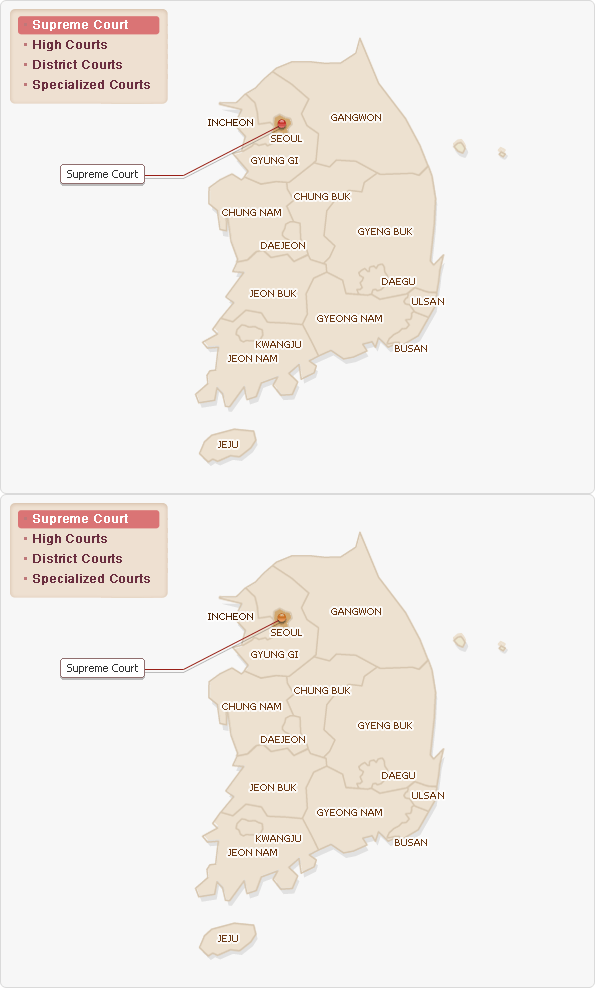
The change isn’t coming from new legislation; it’s coming from judicial guidelines at three specific courts. The Daejeon, Daegu, and Gwangju rehabilitation courts opened in March 2026 as part of an expansion of South Korea’s specialized insolvency court network, which now includes six courts nationwide alongside Seoul, Busan, and Suwon.
The underlying reasoning tracks two real problems with treating crypto like a traditional asset in these calculations. Prices move fast enough that a holding’s value on the day a case is filed can look very different by the time a repayment plan is finalized, unlike a house or a savings account, where valuation is comparatively stable. And custody is genuinely harder to pin down: crypto held in a personal wallet, rather than a bank or brokerage, can become permanently inaccessible if a private key is lost, raising real questions about whether a court should count assets a debtor may no longer be able to reach at all.
Courts are building in safeguards against the obvious risk this creates. The Daegu Rehabilitation Court has said it will punish any debtor who “intentionally conceals” crypto purchases by “disguising them as failed investments,” a direct response to the concern that debtors could exploit the exclusion by claiming fictitious losses.
What are the Potential Benefits of Excluding Crypto?
Excluding crypto losses from rehabilitation calculations offers something concrete. It stops the 92% household-debt-to-GDP backdrop from turning temporary market downturns into permanent, court-mandated repayment obligations. A debtor forced to have crypto losses counted at their lowest point loses the option to wait out a market cycle; excluding those losses removes that forced-timing problem; and it simplifies the court’s job too, since crypto’s volatility makes it a uniquely difficult asset to pin to a single fair valuation at any given moment, a genuine source of dispute between debtors and creditors that the exclusion sidesteps entirely.
Are There Risks and Legal Concerns?
The risk critics raise is straightforward: If crypto losses don’t count against a debtor, some debtors may be tempted to move assets into crypto before filing, precisely the scenario the Daegu court’s concealment penalty is designed to catch.
There’s also a fairness question for creditors, who recover less when an entire asset category is excluded from what a court considers: even within the assets these three courts now exclude, crypto and stock investment losses are treated the same way, while someone whose rehabilitation debt came from, say, a failed real estate investment or a personal loan gets no equivalent break.
In one 2025 report, the South Korean government provided 269 individual crypto traders with over $15 million in debt relief from a fund intended to help small companies.
Critics have warned that the policy risks putting courts in an uncomfortable moral position, forgiving losses from speculation in a way the system doesn’t extend to other risky investments.
But Elsewhere, South Korea Is Tightening the Net
While the rehabilitation courts were building in relief, two other arms of the South Korean financial system moved in the opposite direction.
In June 2026, the Financial Services Commission revised the New Start Fund, a debt adjustment program for small business owners and the self-employed, to require applicants to disclose both crypto holdings and unlisted shares on major won-based exchanges and financial platforms and submit virtual asset balance certificates.
Debt forgiveness under the program is now tied more closely to actual repayment capacity: borrowers whose repayment ability exceeds 100% face a minimum principal reduction of just 30%, down from 60% previously, specifically because their crypto and other previously hard-to-verify assets now count against them.
In July 2026, South Korea’s Supreme Court proposed amendments to the Civil Execution Rules that would formalize how courts seize, transfer, and liquidate a debtor’s cryptocurrency in civil enforcement cases, treating it similarly to how courts already handle bank accounts or other property.

The rules also include a provision allowing courts to freeze a debtor’s crypto wallet before a case is finalized, specifically to prevent debtors from moving funds to evade seizure mid-lawsuit. The comment period runs through August 11, 2026, with implementation targeted for October 2026.
Read against each other, these three developments don’t cleanly support “South Korea excludes crypto from bankruptcy” as a general statement. Investment losses get real relief in rehabilitation proceedings. Current holdings face more scrutiny in debt-relief eligibility. And going forward, crypto may become directly seizable in ordinary civil debt collection. The system is treating the same asset three different ways depending on which door a debtor walks through, and that inconsistency, more than any single rule, is what’s likely to draw the most legal criticism going forward.
Broader policy and regulatory issues
The bigger policy question isn’t whether South Korea should regulate crypto in debt proceedings; it’s already doing that, in three different ways at once. It’s whether those three approaches can stay this inconsistent for long without inviting legal challenges from creditors in the rehabilitation cases, or from debtors facing seizure under the new civil enforcement rules, each pointing to how a different part of the same government treats identical assets differently.
Three Different Answers, and No Sign They’ll Converge Soon
South Korea hasn’t actually settled the question this piece opened with. It’s answered in three different ways across three different parts of its legal system, and each reflects a different priority. Rehabilitation courts are trying to keep speculative losses from pushing already-strained households into deeper crisis. The New Start Fund is trying to make sure debt relief goes to people who genuinely need it, not people sitting on unreported crypto gains. And the Supreme Court’s new civil enforcement rules aren’t about debt relief at all, they’re a general update to how any court can seize and liquidate crypto to satisfy a judgment, which just happens to mean creditors now have a clearer path to collect from debtors who might otherwise shield wealth in crypto specifically.
Whether that patchwork holds up is a separate question from whether each individual piece makes sense, and it’s the one worth watching. As more countries confront the same basic tension, crypto’s volatility and custody risk make it a genuinely hard asset to treat like a stock or a bank account, but treating it differently creates real openings for inconsistency and abuse. South Korea’s current approach is less a model to copy than a live experiment in what happens when a legal system tries to have it both ways at once.
FAQs
Does South Korea exclude crypto debt from bankruptcy calculations?
Not exactly, and not everywhere. Three rehabilitation courts, in Daejeon, Daegu, and Gwangju, exclude crypto and stock investment losses from the calculations used to set repayment plans in personal rehabilitation, a form of debt restructuring distinct from full bankruptcy liquidation. This applies specifically to those courts and to rehabilitation proceedings, not to every debt case in the country.
What is personal rehabilitation, and how is it different from bankruptcy in South Korea?
Personal rehabilitation is a court-supervised debt restructuring process where a debtor keeps their assets but follows a court-approved repayment schedule based on their income and financial capacity. Full bankruptcy typically involves liquidating a debtor’s assets outright to repay creditors. The new crypto-exclusion guidelines apply to rehabilitation, not bankruptcy liquidation.
Can debtors hide assets by claiming crypto losses in South Korea?
Courts have built in safeguards against this. The Daegu Rehabilitation Court has said it will punish any debtor who “intentionally conceals” crypto purchases by disguising them as failed investments, specifically to prevent people from exploiting the exclusion with fabricated losses.
Does South Korea require crypto disclosure for debt relief programs?
Yes, but through a separate program. The Financial Services Commission revised the New Start Fund, a debt-relief program for small business owners and the self-employed, to require applicants to disclose crypto holdings and unlisted shares, and to reduce debt forgiveness for applicants whose repayment capacity is stronger once those assets are counted.
Can creditors seize cryptocurrency in South Korea?
Increasingly, yes. In July 2026, South Korea’s Supreme Court proposed amendments to the Civil Execution Rules that formalize how courts can seize, transfer, and liquidate a debtor’s cryptocurrency in civil enforcement cases, similar to how bank accounts or other property are already handled. The rules also let courts freeze a debtor’s crypto wallet before a case is finalized to prevent assets from being moved to evade seizure.
Disclaimer: This article is intended solely for informational purposes and should not be considered trading or investment advice. Nothing herein should be construed as financial, legal, or tax advice. Trading or investing in cryptocurrencies carries a considerable risk of financial loss. Always conduct due diligence.
Enjoyed this? Bookmark DeFi Planet, explore related topics, and follow us on Twitter, LinkedIn, Facebook, Instagram, Threads, and CoinMarketCap Community for seamless access to high-quality industry insights.
Take control of your crypto portfolio with DEFI PLANET PRO, DeFi Planet’s suite of analytics tools.






