


























































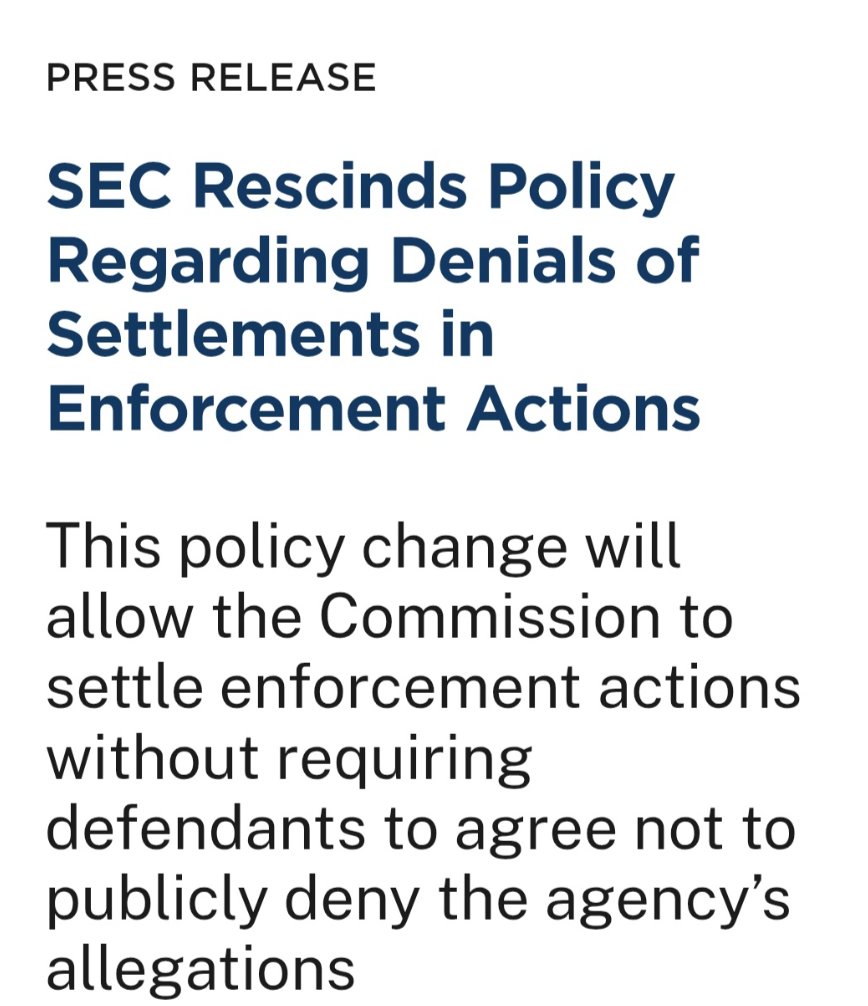
The U.S. Securities and Exchange Commission (SEC) has officially cancelled its long-standing policy that required defendants in enforcement settlements to agree not to publicly deny the agency’s allegations.

Defendants no longer required to stay silent after settlement
The rule, known as Rule 202.5(e), had required settling parties to accept a “no-deny” condition whenever a financial penalty was imposed. Its removal means companies and individuals can now settle SEC cases without being forced to stay silent about the claims made against them.
SEC Chair Paul S. Atkins said the change aligns the agency with most federal regulators and reflects a broader effort to make settlements more flexible and efficient.
SEC says change will speed up settlements and reduce friction
According to the SEC, removing the rule will make it easier to resolve enforcement actions, reduce legal friction, and help return funds to harmed investors more quickly.
The agency also noted that the old policy was unusual compared to other U.S. federal agencies. Officials said the restriction may have created unnecessary tension in settlement negotiations and sometimes slowed down resolution timelines.
Under the new approach, defendants can still settle without admitting wrongdoing, and the SEC retains full discretion to negotiate terms, including admissions where appropriate.
Shift raises questions about transparency and tone of enforcement
The policy change also raises broader questions about how enforcement cases will be discussed publicly after settlement.
With defendants now able to challenge or deny allegations after agreeing to a settlement, observers say the public narrative around SEC cases may become more contested.
However, the SEC stressed that the change does not weaken its enforcement powers or alter its ability to require admissions in certain cases. It also confirmed that existing “no-deny” provisions will no longer be enforced going forward. The move signals a shift toward a more flexible enforcement framework, but it also introduces new uncertainty around how settled cases will be interpreted in the public domain.
Meanwhile, SEC has delayed approval for a wave of prediction-market exchange-traded funds (ETFs), marking a pause in one of the fastest-growing crypto-adjacent product categories. The filings, led by firms including Roundhill, Bitwise, and GraniteShares.
Enjoyed this? Bookmark DeFi Planet, explore related topics, and follow us on Twitter, LinkedIn, Facebook, Instagram, Threads and CoinMarketCap Community for seamless access to high-quality industry insights.
“Take control of your crypto portfolio with DEFI PLANET PRO, DeFi Planet’s suite of analytical tools”