



























































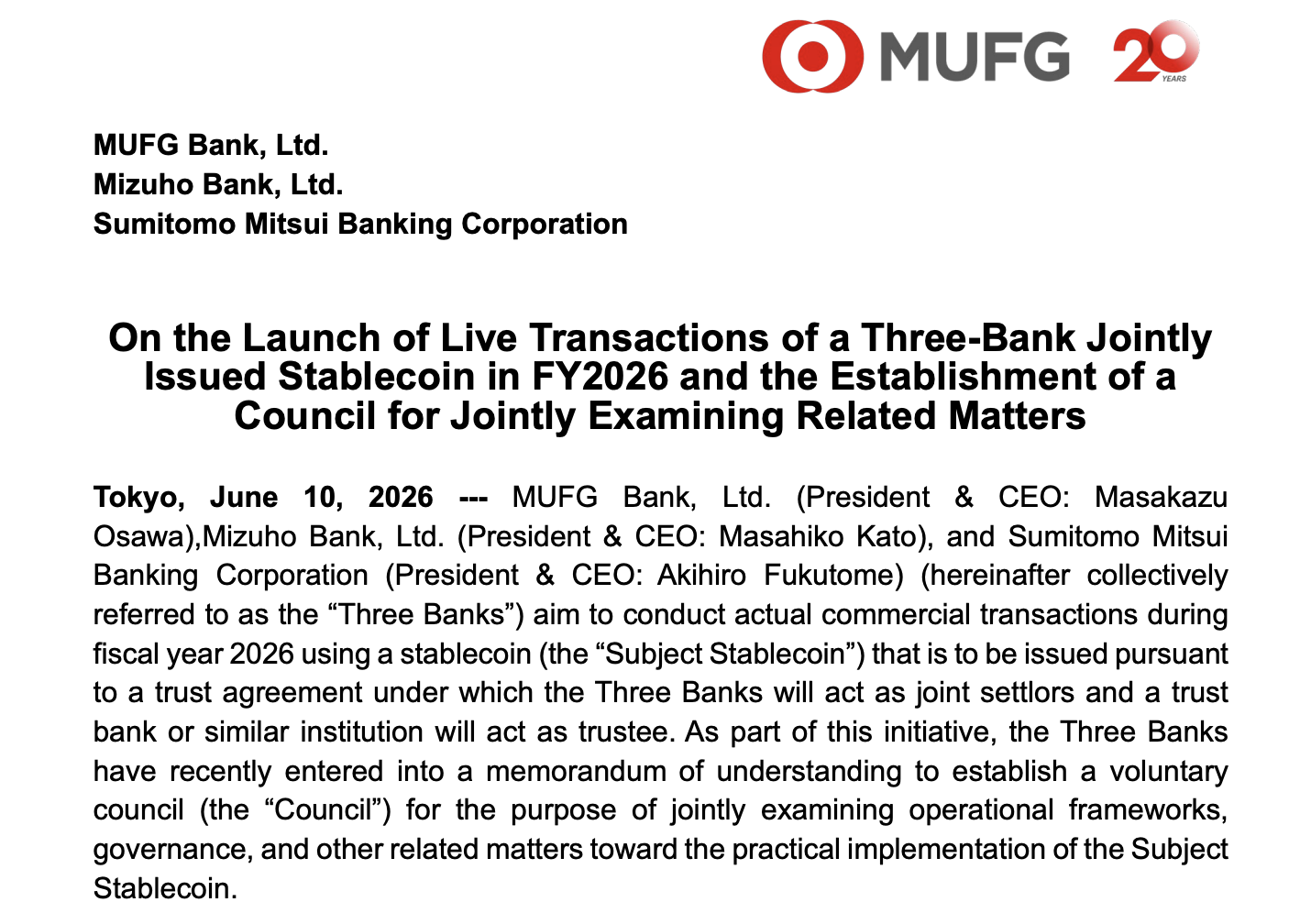
MUFG Bank, Mizuho Bank, and Sumitomo Mitsui Banking Corporation have announced plans to begin live commercial transactions using a jointly issued stablecoin during fiscal year 2026, marking one of Japan’s most coordinated bank-led digital currency initiatives to date.

The stablecoin will be issued under a trust structure where the three banks act as joint settlors, while a trust bank or similar institution will serve as trustee. The banks confirmed they have signed a memorandum of understanding to establish a dedicated council that will oversee operational design, governance structures, and system implementation ahead of launch.
The initiative is currently progressing through a FinTech Proof-of-Concept Hub project supported by Japan’s Financial Services Agency, following earlier joint experiments focused on issuance feasibility and system design.
How Japan’s three-bank stablecoin will be structured and governed
The stablecoin is expected to operate through a shared issuance framework that allows the three institutions to coordinate governance while relying on a regulated trust infrastructure.
The newly formed council will evaluate key components, including issuance systems, operational workflows, compliance frameworks, and potential participation from additional financial institutions. The banks said the council will also assess how the stablecoin can be integrated into real-world payment and settlement use cases.
The goal is to go beyond experimentation and establish a functioning model capable of supporting live transactions within fiscal year 2026.
Why Japanese banks are focusing on stablecoins
Tokenized deposits and stablecoins are being tested by major financial institutions to improve payment efficiency and speed up settlement processes.
Across international markets, banks and financial groups are exploring blockchain-based payment systems as traditional cross-border infrastructure faces delays and rising costs. Japan’s coordinated approach stands out due to the scale of collaboration between its largest banking institutions. Similar initiatives are emerging globally, with financial institutions in the U.S., Europe, and Asia testing tokenized money frameworks for settlement and liquidity management.
Meanwhile, Japan’s ruling Liberal Democratic Party has advanced a new policy proposal focused on AI, blockchain finance, and tokenized payments. A major part of the proposal focuses on stablecoins and how they should be treated under Japanese law. The document calls for clearer legal guidance on whether stablecoins can eventually be used for salaries, tax payments, and corporate capital contributions.
Enjoyed this? Bookmark DeFi Planet, explore related topics, and follow us on Twitter, LinkedIn, Facebook, Instagram, Threads and CoinMarketCap Community for seamless access to high-quality industry insights.
“Take control of your crypto portfolio with MARKETS PRO, DeFi Planet’s suite of analytics tools.”