












Quick Breakdown
- India is testing blockchain-based land registries and property tokenization through statewide pilots, district-level deployments, and platforms enabling fractional real estate ownership.
- Legal and technical roadblocks remain, including outdated property laws, data-scaling challenges, trust concerns, and the need for stronger digital public infrastructure.
- If successful, blockchain titles and tokenized land could reduce disputes, boost transparency, unlock liquidity, and make property investment more accessible to everyday citizens.

India is exploring a bold new way to manage land with blockchain land registry technology, and in this model, property ownership records would be stored on a distributed ledger, creating a tamper-proof and transparent system. One important piece of context is India’s existing Digital India Land Record Modernization Programme (DILRMP), which aims to digitize land records across the country.
More recently, the state of Maharashtra announced a sandbox pilot for property tokenization using blockchain, and what this means is that parts of real estate, real-world assets, could become tradeable digital tokens that live on the blockchain. A platform called Landbitt has also launched in India to tokenize real estate, allowing fractional ownership: investors can buy digital tokens that represent parts of land parcels.
At the local level, the Dantewada district in Chhattisgarh digitized over 700,000 land records and anchored them on the Avalanche blockchain, in partnership with a blockchain startup. Meanwhile, the Supreme Court of India has urged the federal government to adopt blockchain-based property registration to make the process more secure and less prone to fraud.
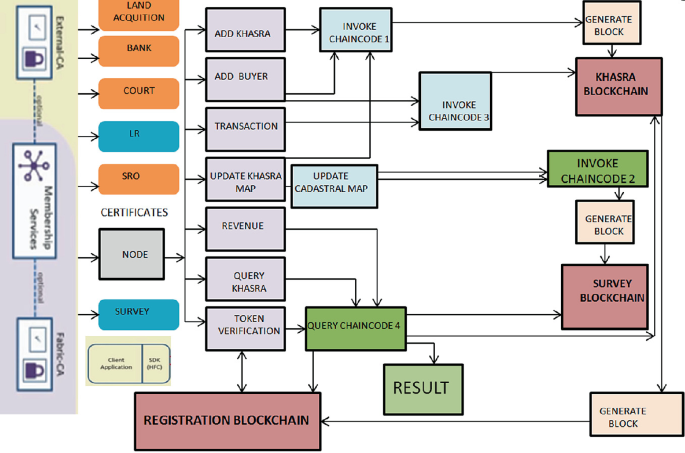
To build this system, India’s planners are looking to integrate blockchain with existing land registry frameworks. According to a strategy paper by NITI Aayog, creating a distributed ledger for land records would help unify old paper deeds, maps, and cadastral data into one modern system. At the same time, India is working on giving each land parcel a unique ID – called the Unique Land Parcel Identification Number (ULPIN), much like an “Aadhaar for land.”
Legal and Technical Challenges
Introducing a blockchain land registry in India is not simple, and legally, many existing property laws would need to be updated. For one, the Supreme Court has recommended reforming laws like the Transfer of Property Act and the Registration Act so that blockchain-based titles could be “conclusive” rather than merely recorded. Without these legal changes, tokens or on-chain records might not carry the same weight as traditional property deeds.
From a technical perspective, scaling is a key concern and using blockchain for real-world property means dealing with huge amounts of data. Maps, survey records, and deed copies all need to be represented accurately. There is a trade-off between putting those records fully on-chain (which can be expensive and raises privacy concerns) and just storing verification hashes on-chain (which preserves proof but keeps sensitive data off-chain).
Another challenge is trust because many landowners and officials might not immediately trust the blockchain infrastructure. There is also a risk that tokenized property, the real-world asset, could be misused if regulation is weak. Fractional ownership, i.e. when a land parcel is broken into tokens, raises questions: who holds the title legally? How are governance and decision-making handled when many people co-own a piece of land via tokens?
Finally, public infrastructure must be ready for this shift. For blockchain land registry to work, state and local governments need a strong digital infrastructure. Without reliable internet, secure nodes, and trained personnel, the promise of a transparent, decentralized registry might fall short.
Broader Implications for Real-World Asset Adoption

If India succeeds in building a blockchain-based land registry, the impact could be transformative. By tokenizing property, real-world assets like land can become more liquid and what that means is, people could buy and sell digital tokens of land instead of having to purchase the entire plot. This democratizes access to property investment, making it easier for individuals with smaller capital to participate.
For the broader economy, this could unlock value trapped in illiquid assets, and landowners might seek to monetize underused parcels. Investors could treat tokenized real estate like another class of digital asset, bringing fresh capital into real estate markets. As more property becomes tokenized, this could also encourage innovation in public infrastructure, since ownership and usage rights could be more transparently governed.
On the social side, a blockchain land registry could reduce land disputes by making records unalterable, thereby reducing the likelihood of fraudulent or duplicate deeds. This strengthens legal clarity around land ownership and inheritance. Over time, this kind of system could reduce litigation, helping ordinary citizens who face long, painful property disputes.
At a more visionary level, tokenized land becomes part of a Web3 economy of real-world assets, showing how blockchain is not just for cryptocurrencies, but for real infrastructure. If successful, India’s model could inspire other countries to follow, and a tokenized land market could be a global example of how blockchain finance brings together property, public infrastructure, and modern technology in a fair and transparent way.
In Conclusion,
India’s journey to a blockchain land registry is more than just a tech experiment. It is a serious effort to reshape how people own, trade, and verify property and by combining real-world assets like land with blockchain, India is betting that property tokenization will make ownership more liquid, transparent, and accessible.
Success is however not guaranteed, and legal reforms must catch up. Technical systems must be robust, and public infrastructure must support a distributed ledger. Trust must be built, especially among people who are used to traditional property documents and face-to-face registration offices.
If India can get this right, the long-term payoff could be huge and not only could land disputes shrink, but the property market could open up to more people. Public infrastructure projects might be planned more efficiently, and real estate investment could become more inclusive. Most importantly, India’s move could show the world how blockchain is not just for digital coins; it is a tool for real change, one land parcel at a time.
Disclaimer: This article is intended solely for informational purposes and should not be considered trading or investment advice. Nothing herein should be construed as financial, legal, or tax advice. Trading or investing in cryptocurrencies carries a considerable risk of financial loss. Always conduct due diligence.
If you want to read more market analyses like this one, visit DeFi Planet and follow us on Twitter, LinkedIn, Facebook, Instagram, and CoinMarketCap Community.
Take control of your crypto portfolio with MARKETS PRO, DeFi Planet’s suite of analytics tools.”






