





















































President Bola Ahmed Tinubu signed the Presidential Executive Order on Virtual Assets Coordination, 2026, on July 17, 2026, establishing Nigeria’s most comprehensive attempt yet to coordinate oversight of its digital asset sector. The Order creates a Virtual Asset Council, chaired by the Central Bank of Nigeria, with the Nigeria Revenue Service and the Securities and Exchange Commission serving as vice-chairs, and the Nigerian Financial Intelligence Unit and the Office of the National Security Adviser also participating. It divides regulatory responsibility along functional lines: the SEC oversees securities-related virtual assets, while the CBN handles non-securities activity like payments, settlement, and custody.

Against that backdrop, the proposed Virtual Asset Service Providers (VASP) Regulation Bill, 2026 (SB 956) represents the next stage of Nigeria’s regulatory evolution. Rather than duplicating the Executive Order, the bill seeks to establish a dedicated statutory framework governing the licensing, supervision, and obligations of virtual asset service providers. If enacted, it would provide legislative certainty for a sector that is increasingly being regulated through coordinated executive action and existing SEC rules.
For compliance teams managing Nigerian operations, exchanges eyeing market entry, and everyday crypto users trying to understand what changes are coming, this bill has direct and practical implications.
This tracker breaks down what is actually in the bill, where it currently stands in the legislative process, and what each development means for the industry. It will be updated as the bill progresses through the National Assembly and toward potential enactment.
Current Status
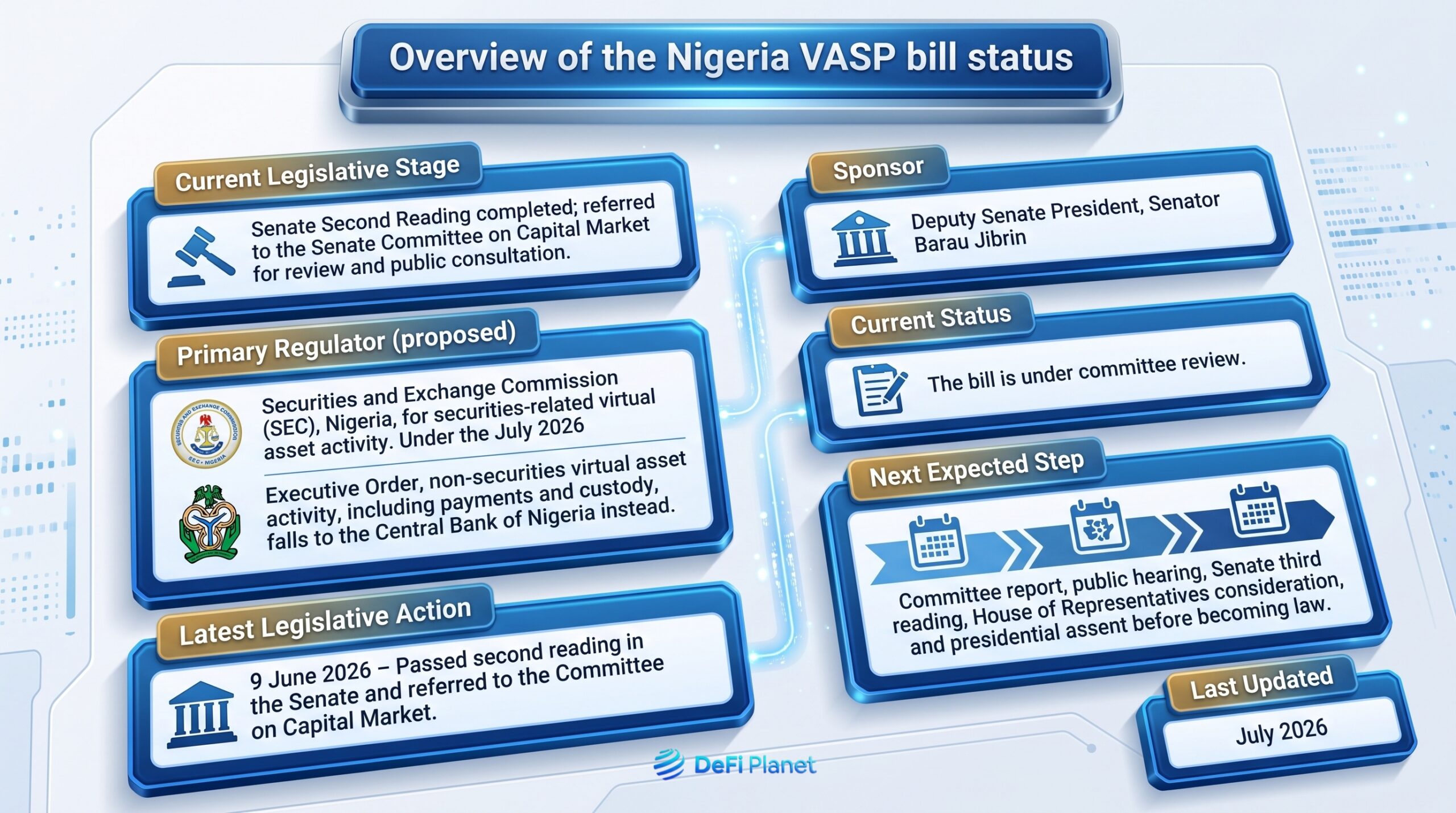
Here is an
Overview of the Nigeria VASP bill status
What the Nigeria VASP Bill Actually Does
The SEC’s VASP rules exist to bring order to a market that was operating largely outside supervision. SB 956, if passed, would give that framework, and much of what follows, a firmer legislative foundation. The rules cover investor protection, market transparency, and anti-money laundering compliance, and apply to more businesses than many crypto exchanges currently realize.
Who must register
Businesses that provide regulated virtual asset services in Nigeria must register with the SEC. These include platforms that enable the trade, exchange, or transmission of virtual assets, as well as firms that offer portfolio management, investment advice, custody, nominee services, and token issuance.
What registration actually requires
For registration as a VASP, the entity must be incorporated as a body corporate, maintain a physical address in Nigeria, and be managed by a director based in the country. The entity must also demonstrate solvency, confirm it isn’t in receivership, ensure all information submitted to the SEC is accurate, and maintain a fair, transparent market on its platform.
It is important that the directors, CEO, or any other principal officer meet the ‘fit and proper’ requirements of the SEC. This requires that the persons be free from any criminal convictions, not involved with any failure in financial institutions, and lack any form of financial improprieties before the courts or regulators.
Ongoing compliance obligations
Apart from registration, there are other operational and reporting obligations that VASPs have to follow in line with the regulations set out by the SEC. This includes making sure that all their operating rules are enforced, that they treat all their users fairly, and that all their disclosures are accurate and non-misleading.
All users have to sign an acknowledgement of risk prior to investment and should be informed that no loss is insured under any investor protection fund on the platform.
The VASP is supposed to put in place AML/CFT policies. The SEC will perform an inspection of the platform and may access all its books, records, and any other material information.
Foreign operators serving Nigerian users
The Rules apply to foreign vendors who market to Nigerian investors, including through the use of local agents, advertising or publications distributed in Nigeria, or emails sent to Nigerian addresses. A platform may be required to register with the SEC even if it’s incorporated entirely outside the country.
Who is excluded
The Rules do not apply to technology providers that only supply infrastructure or software to an exchange, communication service providers that only route orders, or financial portals that aggregate content and link to financial websites without providing regulated virtual asset services.
Enforcement
The SEC may cancel a VASP’s registration if it submits false or misleading information, fails to comply with the Rules, stops carrying on its licensed activities for six consecutive months, or fails to pay prescribed fees. The SEC may also impose additional financial requirements based on the nature and risk profile of the VASP’s business.
What Happens Next?
The VASP Bill went through the second reading in the Senate on 9 June 2026, after which it was referred to the Senate Committee on Capital Market for its review. At this point, it is accepted by the lawmakers that the bill will be considered; however, it is not a law yet.
It will undergo review by the committee and will need stakeholder opinions before it is reported back to the Senate for the next step.
What must happen before it becomes law
Before SB 956 can become law, it must:
- Pass the Senate Committee review
- Pass a third reading in the Senate
- Pass all required stages in the House of Representatives
- Be reconciled if the Senate and House pass different versions
- Receive presidential assent
What could delay progress?
First, the conflict that may arise from harmonizing the bill with other acts can affect its adoption into law. According to Senator Adetokunbo Abiru, who spoke in the Senate debate on the bill, it ought to be harmonized with the Investment and Securities Act and the Banks and Other Financial Institutions Act to avoid legal inconsistencies.
A second potential difficulty is the lengthy committee phase, where the members of parliament will need additional time to study or change the bill. This is because the full details of the bill have not yet been released publicly.
What could accelerate it?
Broad support during the Senate discussion might hasten its passage. The lawmakers also used the progress made in terms of regulation in South Africa, Kenya, Mauritius, and Ghana as reasons why Nigeria’s VASP regulations need to be passed.
Timeline
There is no publicly available timeline for the bill’s full passage into law. After its second reading on June 9, 2026, it was referred to the Senate Committee on Capital Markets for an initial four-week review period, a window that has since elapsed without a public committee report, itself an early sign of the kind of delay talked about above.
How the Bill Fits With Existing Nigerian Crypto Regulation
The Investments and Securities Act (ISA) 2025 provides a legal basis for regulating virtual asset service providers in Nigeria. The law reiterates the role of SEC as the capital market regulator and subjects VASPs, Digital Asset Offering Platforms (DAOPs), and Digital Asset Exchanges (DAEs) to its regulation.
Moreover, the ISA Act has been recognized as securities, while the definition of a securities exchange has been amended to cover virtual assets trading platforms. These changes give the SEC’s digital asset regulations a statutory footing.
SB 956 was not created to repeal the ISA 2025. It aims to create separate legislation that will regulate VASPs. The precise way this bill will interact with the ISA 2025 will be clearer after the legislative process is completed.
Relationship with existing SEC VASP rules
SEC began building its regulatory framework for VASPs from 2022 when it came up with its Rules on Issuance, Offering Platforms and Custody of Digital Assets. The Rules were revised in December 2024 and implemented on June 30, 2025. The regulator also established its Accelerated Regulatory Incubation Programme (ARIP) in 2024 and awarded its first provisional VASP licences to Busha and Quidax during the same year.
If passed, SB 956 would sit alongside this existing framework. There is no indication of the extent of the relationship between the bill and SEC’s rules. At the Senate debate on the proposed legislation, it was pointed out that it should be consistent with ISA 2025 and other financial laws to prevent overlap of requirements.
Interaction with BOFIA
In December 2023, the CBN lifted its ban on banks providing services to crypto firms and gave guidelines on bank accounts opened by VASPs according to BOFIA 2020. Banks can offer their services to VASPs with a valid licence from the SEC.
As a result, the SEC and the CBN already share oversight of the sector. The SEC regulates VASP activities, while the CBN regulates their banking relationships.
It is not yet clear how SB 956 will interact with this existing framework. Since the bill has not been published fully, it is still not clear whether it will alter or merely work together with the functions of the SEC and the CBN.
What has been clarified
The ISA 2025 established that virtual assets and digital assets are securities and can be regulated in accordance with the SEC regulations. In addition, the SEC clarified in the January 2026 circular that VASPs shall have minimum paid-up capital requirements that need to be fully complied with by June 30, 2027.
What remains unresolved
Several issues have to be determined now since the text of SB 956 has not been released yet. Among the open questions: how this bill will affect the SEC’s existing licensing regime, and whether current applicants will need to adapt to a new one if SB 956 passes as said.
It’s also not clear how the bill will interact with CBN’s role under BOFIA, how it will affect foreign VASPs already registered with the SEC, and whether it grants the SEC any additional powers beyond what ISA 2025 already provides.
What This Means in Practice
Exchanges operating in or targeting the Nigerian market should treat full regulatory oversight as a matter of when, not if. Businesses that haven’t started the SEC registration process should determine whether they’re required to register and whether they can currently meet the SEC’s standards.
For VASPs and crypto businesses
Providers of wallets, custodians, token issuers, and other cryptocurrency firms need to see whether their operations are covered by the term VASP according to the regulations of the SEC. They also need to prepare themselves in terms of AML/CFT, taxes, and capital compliance prior to the capital compliance deadline of 30 June 2027.
For Nigerian crypto users
There are no immediate changes because SB 956 is yet to be enacted. Users can use cryptocurrency platforms regulated under the current legislation of the SEC.
In case the bill passes into law, many crypto businesses will come under the control of the SEC. Users should make sure whether the platform is registered with the SEC.
Disclaimer: This article is intended solely for informational purposes and should not be considered trading or investment advice. Nothing herein should be construed as financial, legal, or tax advice. Trading or investing in cryptocurrencies carries a considerable risk of financial loss. Always conduct due diligence.
Enjoyed this? Bookmark DeFi Planet, explore related topics, and follow us on Twitter, LinkedIn, Facebook, Instagram, Threads, and CoinMarketCap Community for seamless access to high-quality industry insights.
Take control of your crypto portfolio with DEFI PLANET PRO, DeFi Planet’s suite of analytics tools.