



























































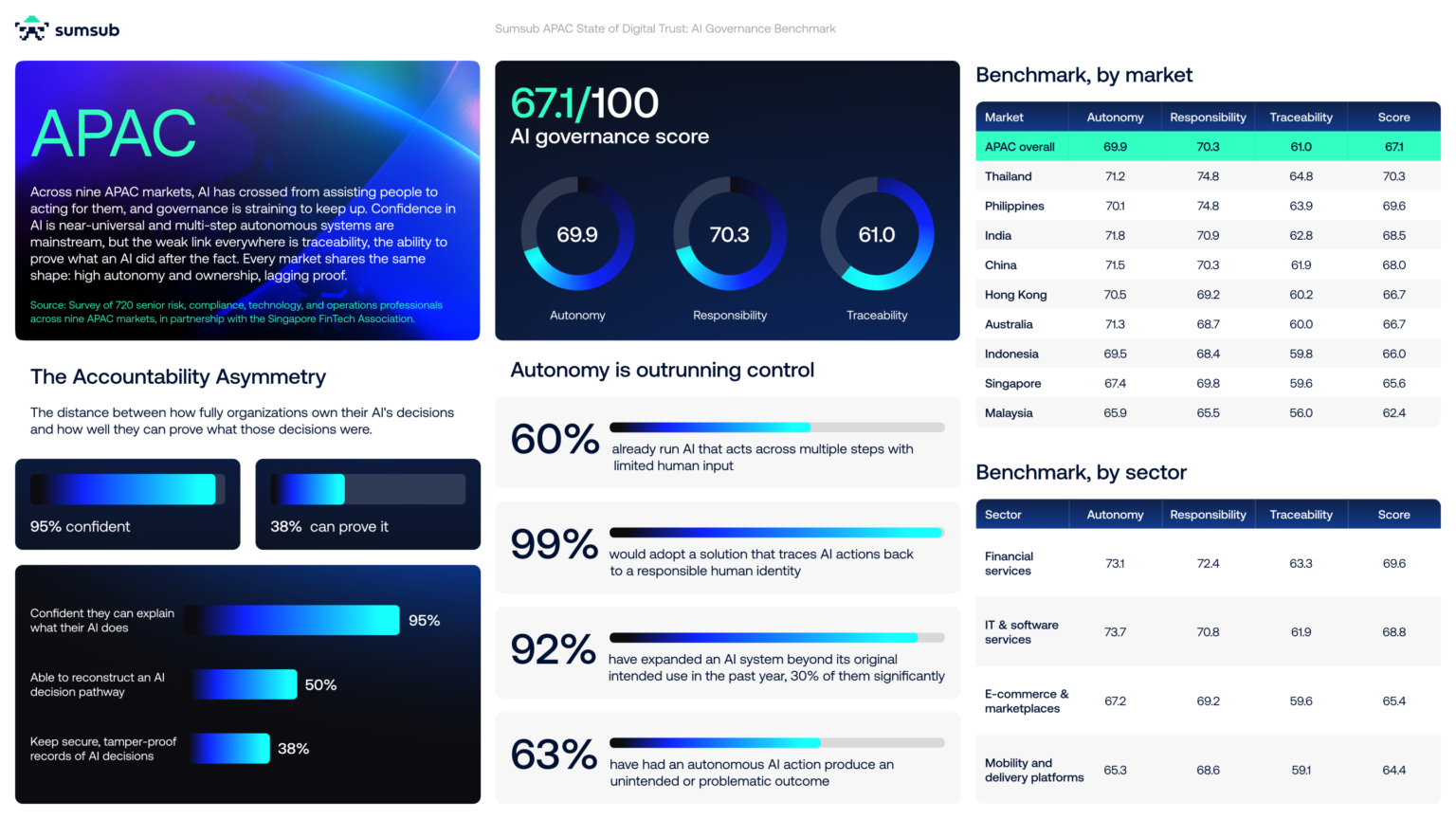
Most businesses in Singapore have assigned responsibility for artificial intelligence (AI) systems, but far fewer can actually show how those systems arrive at their decisions, according to a new report by Sumsub and the Singapore FinTech Association (SFA).

The findings are based on a survey of 720 senior professionals across nine Asia Pacific markets, conducted between April and June 2026, spanning financial services, IT, e-commerce, and mobility and delivery.
The report “The APAC State of Digital Trust: AI Governance Benchmark” found that 70% of organizations in Singapore have designated a person or team to oversee AI outcomes. Only 29% could produce an audit trail showing the data and processes behind an AI-generated decision, a figure that trails the broader APAC average of 38%.
Speaking during a media briefing, Sumsub Vice President for Asia Pacific Penny Chai said many companies know who is accountable for AI decisions but lack the documentation needed to demonstrate how those decisions were made.
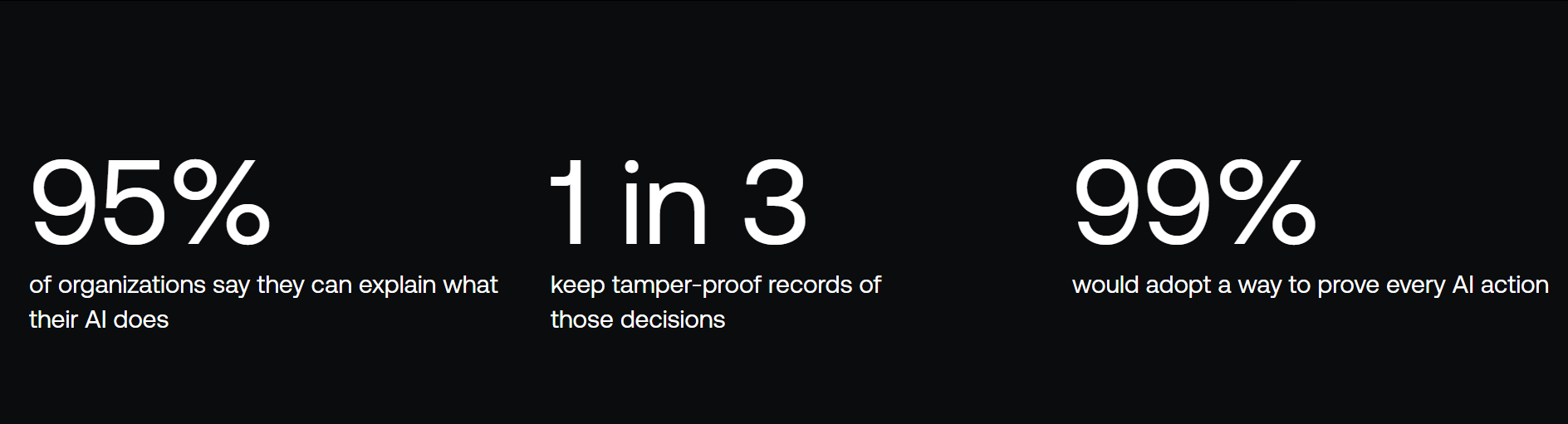
The report goes on to describe this gap as an “Accountability Asymmetry”. Across APAC, 95% of organizations say they are confident they can explain an AI-driven decision, but only half can actually reconstruct how that decision was reached. 94% of Singapore respondents are already using or testing multi-step AI systems, even as most remain cautious about expanding AI into higher-risk functions.
The more AI does, the harder it is to explain
Survey respondents ranked model complexity as the top obstacle to documentation, cited by 66%, followed by difficulty integrating different technology platforms, at 50%, and challenges tracking actions taken by external or third-party AI tools, at 49%. As organizations adopt multi-step AI models that interact with different software and third-party services, documenting every action becomes harder, which makes it more difficult to trace how a decision was reached or identify where an error occurred.
READ ALSO: Can AI Agents Become Liquidity Drivers for Stablecoins?
The challenge isn’t unique to Singapore. A 2025 survey by Deloitte found that while AI adoption is accelerating globally, only about one-third of organizations had mature governance practices in place. IBM’s Global AI Adoption Index similarly found that governance, explainability, and risk management remain among the biggest barriers preventing companies from expanding AI into mission-critical operations, suggesting technical oversight is becoming as important to enterprise AI strategy as the models themselves.
In finance, an AI decision you can’t explain is a liability
Financial institutions are adopting AI more cautiously than many other industries because automated decisions carry direct financial and regulatory consequences. An incorrect payment, refund, lending decision, or insurance assessment can expose firms to financial losses, customer disputes, or regulatory action, which makes traceability a requirement before AI expands further into these areas.
Holly Fang, president of the Singapore FinTech Association, said the more pressing question isn’t how quickly AI is advancing but whether governance is keeping pace. As AI moves into autonomous agents handling critical workflows, she said, the focus needs to now move toward building the traceability and accountability needed to deploy AI at scale.
Singapore has already moved on this front, introducing the Model AI Governance Framework for Agentic AI and the Monetary Authority of Singapore’s Safeguards for Agentic Finance at Runtime (SAFR). Rather than focusing solely on model performance, both frameworks push organizations to build AI systems that can be monitored, documented, and reviewed throughout operation. Yet the report’s own findings suggest that policy has moved faster than practice: even in a market that was the first globally to issue formal agentic AI governance guidance, fewer than a third of firms can currently produce the documentation those frameworks call for.
As autonomous systems take on more responsibility, organizations that can demonstrate how their AI reaches decisions may be better positioned to satisfy regulators, enterprise customers, and business partners than those relying on performance metrics alone. The gap between Singapore’s governance policy and its governance practice may be the clearest test yet of whether that positioning holds.
Enjoyed this? Bookmark DeFi Planet, explore related topics, and follow us on Twitter, LinkedIn, Facebook, Instagram, Threads, and CoinMarketCap Community for seamless access to high-quality industry insights
Take control of your crypto portfolio with DEFI PLANET PRO, DeFi Planet’s suite of analytics tools.