


















































Quick Breakdown

- DAOs may not be as decentralized as they claim. An ECB study shows governance power in major DeFi protocols is heavily concentrated among a small group of token holders, delegates, and insiders.
- While tokens are widely distributed, top holders and active voters dominate decisions, often controlling the majority of voting power through delegation and low participation.
- Because of this concentration, DAOs may struggle to qualify as “fully decentralized” under MiCA, potentially exposing them to stricter oversight and pushing the ecosystem toward more structured, hybrid governance models.
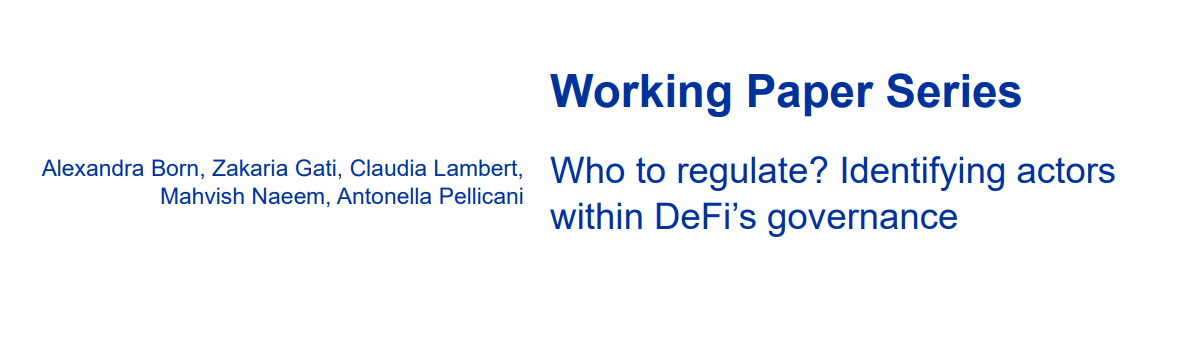
Decentralized Autonomous Organizations (DAOs) were designed to remove intermediaries and spread control across communities, but new evidence is challenging that foundation. A European Central Bank (ECB) working paper published on March 26, 2026 found that governance in four major DeFi protocols is actually highly concentrated, raising difficult questions about who really holds decision-making power in these systems and who should fall under regulatory frameworks like MiCA.
This finding sharpens a growing tension at the heart of DeFi: the promise of decentralization versus the reality of concentrated influence among a small group of token holders or insiders. As regulators in Europe and beyond take a closer look at how governance actually functions, the key question becomes harder to ignore: if DAOs are not truly decentralized in practice, can they still claim exemption from traditional financial oversight?
What DAOs Were Supposed to Be vs What They Actually Are
The concept behind the development of DAOs was straightforward and revolutionary. This included creating a company whose management structure would allow decisions to be taken collectively by the members of the community without any need for CEOs, management, or a board of directors. Theoretically, the system would involve all token owners having an equal say in governance processes.
However, many DAOs do not adopt such an equitable model. On the contrary, they follow the principle of token-weighted voting. Under such circumstances, a larger number of tokens gives individuals more say and control over operations within the organization. As a result, control ends up in the hands of the initial investors or insiders.
There are also some structural barriers that hinder genuine participation:
- First, low turnout rates occur in practice, which means that only a small percentage of token holders participate in the proposal process.
- Second, “whales” are dominant because token holders have significant power to determine outcomes in case of being in a minority position.
- Third, there is an asymmetry of information since many proposals are highly technical to comprehend by ordinary people.
For this reason, DAOs are likely to function not as genuinely decentralized systems but rather as soft corporations that have governance mechanisms established on-chain, yet their actual decision-making process remains highly centralized.
Evidence of Governance Concentration in DAOs
The ECB study examined four major protocols:
- Aave
- MakerDAO
- Ampleforth
- Uniswap
It found that while governance tokens appear to be spread across tens of thousands of wallet addresses, actual control is heavily concentrated. In each case, the top 100 holders control more than 80% of the total token supply, suggesting that ownership is far more centralized than the “decentralized” label implies.
The concentration becomes even clearer when looking at where tokens are actually held. A significant share of governance tokens is linked either to the protocols themselves or to centralized and decentralized exchanges. Notably, Binance emerged as the largest identified centralized exchange holder across all four protocols, raising further questions about how independent governance truly is when large portions of voting power sit within exchange-controlled wallets.
Beyond ownership, the ECB paper also examined who actually votes in governance decisions and found that voting power is even more concentrated in practice. Many DAOs rely on delegated voting systems, in which token holders delegate their voting rights to delegates. However, this creates a second layer of concentration.
The findings show that the top 20 voters in Ampleforth control 96% of delegated voting power, while the top 10 voters in MakerDAO control 66%, and the top 18 in Uniswap control 52%. In other words, even though participation is open in theory, real decision-making power is held by a small group of active delegates.
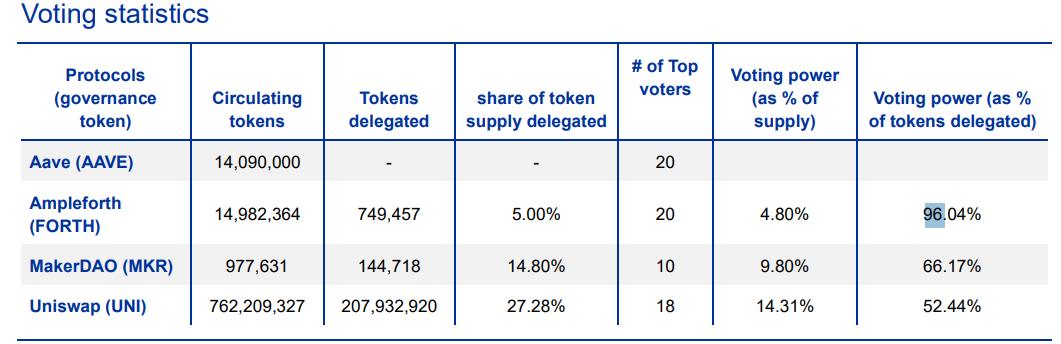
The study also highlights a transparency issue: around one-third of top voters cannot be publicly identified, and among those that are, the largest groups include individuals, Web3 companies, venture firms, and university blockchain groups. This mix raises further questions about accountability, especially when significant influence is exercised by entities whose identities or incentives are not fully clear.
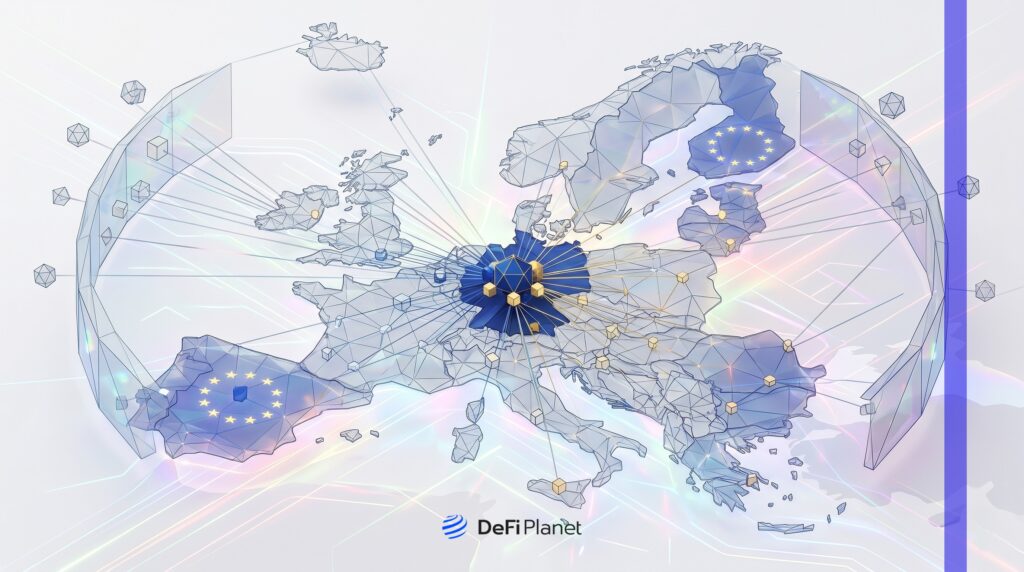
These findings directly challenge the idea that DAOs are inherently decentralized, and they also complicate how regulators might classify them under frameworks like the EU’s Markets in Crypto-Assets Regulation (MiCA), which currently excludes “fully decentralised” services. As the ECB paper suggests, determining what is “truly decentralized” becomes difficult when control is structurally concentrated but spread across pseudonymous participants and delegated systems.
Criticism of this structure is not limited to regulators. Kavi Jain, senior research associate at Bitwise, summarizes the practical reality of DAO governance, noting that many systems are still early in their evolution. He explains:
“Many large DeFi protocols were not as decentralized in practice as they might appear, especially in the earlier stages, where a small group still has meaningful influence over decisions.”
He further highlights how governance dynamics can remain concentrated even within formal DAO structures, citing cases such as Aave, where voting power remains heavily influenced by a limited number of participants.
This evidence suggests that while DAOs distribute tokens widely, actual governance power often consolidates around exchanges, early insiders, and active delegates. This creates a system that looks decentralized on the surface but behaves more like a controlled governance network in practice, raising fundamental questions about how decentralization should be defined, measured, and regulated.
Regulatory Implications Under MiCA and EU Crypto Law
According to MiCA, the regulatory obligations are usually attributed to specific issuers, operators, or service providers. Systems that are genuinely decentralized and cannot be controlled by anyone would not be covered under MiCA. Nevertheless, the problem here becomes complicated. In cases when the governance mechanism inside a DAO depends on a small number of token holders, delegates, or other insiders, regulators might claim that such control exists despite the fact that the system is technically decentralized.
This is precisely what distinguishes the importance of governance concentration. From the standpoint of crypto law, decentralization is not only an element but a prerequisite. When a couple of members can impact the proposal process, manage the protocol treasury, or influence the protocol updates, it means that there is a certain degree of control exercised.
This is evident in the findings of the European Central Bank. The results indicate that numerous DAOs might find themselves unable to meet the requirement of being a “fully decentralized organization,” meaning that they would not be exempt from regulation according to MiCA. In simple terms, when centralization exists, authorities would not consider the DAO designation but rather view the protocol as a system similar to an organized financial network.
Such an interpretation has several implications. There are some examples of DAOs that might fall under the category of legal entities, where there will also be identifiable operators, depending on whether the governance is tied to certain people or groups. In such a case, the DAOs need to adhere to several regulations.
Impact on DAOs and DeFi Ecosystems
As regulators begin to question how decentralized DAOs really are, the ripple effect could reshape how DeFi projects are built, governed, and adopted across the entire ecosystem.
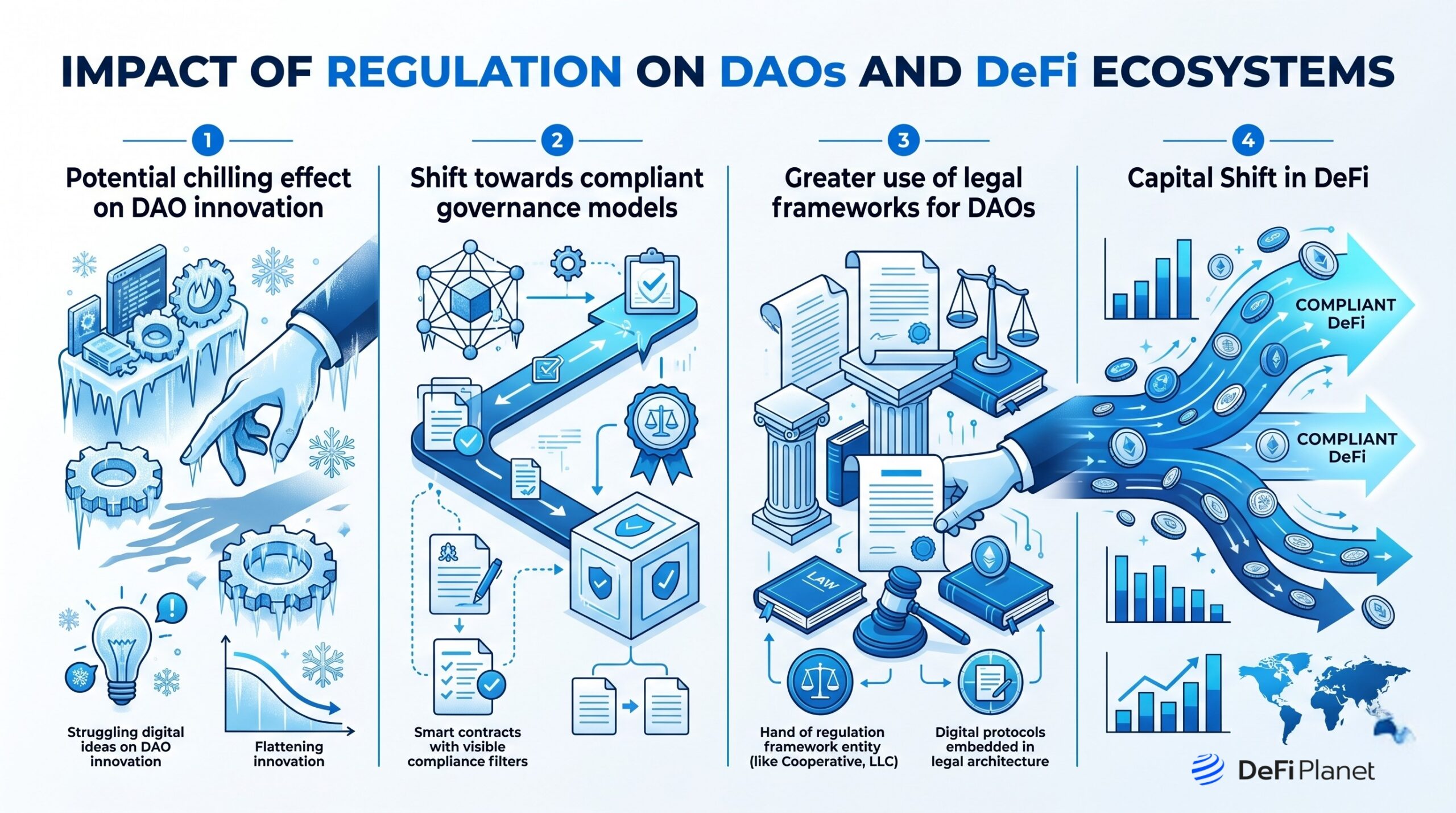
Potential chilling effect on DAO innovation
As regulations become stricter, founders may become hesitant to develop DAOs in a completely open manner. They will be less inclined to innovate for fear of being liable for their actions or failing to comply with existing crypto laws.
Shift towards compliant governance models
To adapt, most blockchain-based companies will likely focus on developing governance frameworks that can be easily justified before the government authorities. This approach implies creating more transparent systems with clear decision-making procedures where anonymity is not welcome.
Greater use of legal frameworks for DAOs
We’re likely to see a greater number of DAOs, which will be incorporated into a legal framework in the form of a foundation, company, or hybrid structure. These legal structures are a mediator between on-chain governance and real-life laws, thereby ensuring that the project remains decentralized.
Capital flow in DeFi
Large investors and institutions may hold back from engaging with DAOs that have unclear governance or regulatory status. Without legal clarity, the risks around accountability and compliance can be too high for institutional capital.
At the same time, capital may flow toward DeFi platforms that align more closely with regulatory expectations. DAOs that have characteristics such as transparency, structure, and compliance will be better suited to receive long-term interest from institutions.
In the future, there may be two distinct trajectories for the environment – DAOs that seek regulation and develop within a regulatory framework and those that are completely decentralized and operate outside of all frameworks.
The Future of DAO Structures
Due to growing regulatory pressure and increased adoption, it’s unlikely the concept of a DAO will disappear; rather, it will evolve into a more structured form.
One of the trends we can predict is the tendency toward developing hybrid forms of organization. To address the lack of liability, a combination of blockchain-based decision-making with off-chain processes is possible. This means that all decisions are made on the blockchain, while legal bodies handle contracts.
At the same time, there is the development of multi-level governance structures, which divide decision-making into several components and involve not only token holders but also delegates and core contributors with particular responsibilities. In Europe, such trends may result in the development of “regulated DAOs,” which would incorporate features of decentralized organizations from the very beginning but would be designed to correspond to MiCA requirements as well.
As for the technical developments, new solutions are emerging that may allow making the process of governance more balanced and avoiding any domination by big holders. Quadratic voting is among the options to decrease the impact that whales exert because this solution allows small voters to have a higher impact compared to larger token holders.
Decentralized identity (DID) systems can provide the possibility to link voting rights to unique users rather than particular wallets.
Looking forward, the key question is whether there is room for growth without these organizations heading toward traditional hierarchies once again. Regulation and efficiency may lead to a loss of decentralization due to the growing complexity of the system.
The challenge for the next generation of DAOs is to maintain an open model of collaboration while creating an infrastructure capable of sustaining itself in the real world.
Are DAOs Too Centralized to Escape MiCA?
The idea that DAOs operate beyond regulation is becoming harder to defend as evidence of concentrated governance continues to emerge. This reality weakens the argument that they are “fully decentralized,” making it more likely that regulators under frameworks like MiCA will treat them as identifiable systems with accountable participants.
That doesn’t mean DAOs will disappear, but it does mean they will have to evolve. As governance becomes more structured and hybrid models take shape, the line between decentralization and regulation will continue to blur. In the end, DAOs may not escape oversight entirely, but instead redefine what decentralization looks like in a regulated financial world.
Disclaimer: This article is intended solely for informational purposes and should not be considered trading or investment advice. Nothing herein should be construed as financial, legal, or tax advice. Trading or investing in cryptocurrencies carries a considerable risk of financial loss. Always conduct due diligence.
Enjoyed this? Bookmark DeFi Planet, explore related topics, and follow us on Twitter, LinkedIn, Facebook, Instagram, Threads, and CoinMarketCap Community for seamless access to high-quality industry insights.
Take control of your crypto portfolio with DEFI PLANET PRO, DeFi Planet’s suite of analytics tools.”