




















































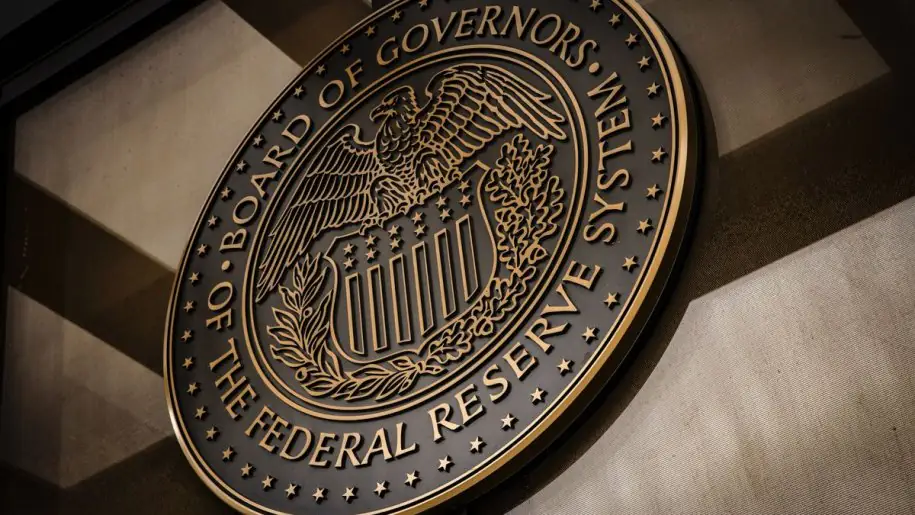
The U.S. Federal Reserve has proposed a new regulatory framework that would categorise cryptocurrencies as a distinct asset class in uncleared derivatives trading, potentially triggering significantly higher initial margin requirements for market participants.

In a working paper released on Thursday, 12 February 2026, Fed researchers argued that digital assets like Bitcoin and Ethereum do not fit into traditional risk categories such as equities or commodities due to their unique volatility profiles. The proposal aims to protect the financial system by ensuring traders post more collateral as a buffer against potential liquidations in the growing $2 trillion crypto derivatives sector.

New risk weights for “floating” and “pegged” assets
The Federal Reserve’s Board of Governors suggested that the current Standardised Initial Margin Model (SIMM) is insufficient for managing the unique financial risks associated with distributed ledger technology.
Under the new proposal, cryptocurrencies would be split into two primary categories: “floating” assets, which include volatile coins like Bitcoin ($BTC) and Ether ($ETH), and “pegged” assets, such as stablecoins. This distinction would allow regulators to apply differentiated risk weights, ensuring that the collateral held against a $DOGE position is substantially higher than that for a dollar-pegged stablecoin.
Furthermore, the researchers proposed creating a benchmark index that balances volatile and pegged digital assets.
Aligning with global Web3 regulatory momentum
This move comes as the U.S. banking sector faces a pivotal shift in its approach to digital assets. In late 2025, the Federal Reserve reversed its previous guidance limiting bank engagement with cryptocurrencies, effectively opening the door for supervised banks to participate in novel banking activities.
In context, the Fed’s proposal follows similar tightening measures by other regulators. For instance, the European Union’s Markets in Crypto-Assets (MiCA) regulation has already established strict reserve requirements for stablecoin issuers to prevent liquidity crises. By introducing these margin standards, the U.S. appears to be harmonising its internal markets with international expectations for transparency and risk management.
Enjoyed this piece? Bookmark DeFi Planet, explore related topics, and follow us on Twitter, LinkedIn, Facebook, Instagram, Threads and CoinMarketCap Community for seamless access to high-quality industry insights.
“Take control of your crypto portfolio with MARKETS PRO, DeFi Planet’s suite of analytics tools.”