









































Quick Breakdown
- The Philippines aims to build a $60B tokenized asset market by 2030, led by PDAX and major digital wallets.
- Over 14% of Filipinos already use crypto, creating a “tokenized-first” investment pathway.
- Government bonds are now tokenized from as low as ₱500, expanding retail access nationwide.

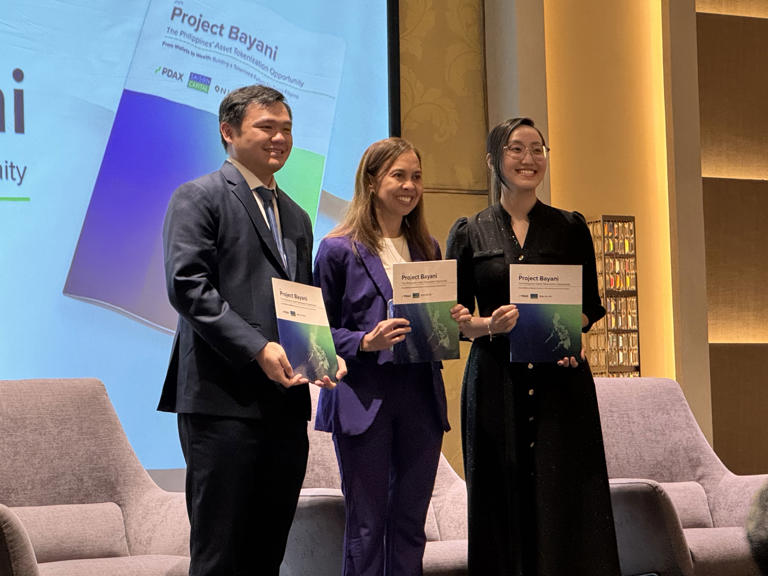
The Philippines is positioning itself as a global pioneer in tokenized finance, with a new report estimating a $60-billion market for tokenized assets by 2030. The study, released by Project Bayani, a collaboration between the Philippine Digital Asset Exchange (PDAX), Saison Capital, and Onigiri Capital, projects that tokenized public equities, government bonds, mutual funds, and other assets will be a major driver of the country’s digital financial growth.
🚨 REPORT: @pdaxph, @OnigiriVC, and @SaisonCapital published a research that forecasts a $60B tokenized asset surge in the Philippines by 2030, using blockchain wallets to leapfrog traditional finance. 👇 pic.twitter.com/Ar5j26FdEl
— BitPinas (@bitpinas) November 27, 2025
Tokenization democratizes access to investments
According to the report, public equities could account for $26 billion of the market, government bonds $24 billion, mutual funds $6 billion, and other asset classes $4 billion. Tokenized government bonds, distributed via PDAX and GCash, have already lowered the minimum investment to just P500, making first-time investing accessible nationwide.
“Blockchain wallets are already mainstream in the Philippines,”
said Nichel Gaba, CEO of PDAX.
“The infrastructure exists in the pockets of millions. Our goal is to link this to regulated, real-world financial products.”
With over 14 per cent of Filipinos holding crypto compared to under 5 per cent owning traditional investments, the report underscores the potential for blockchain to leapfrog conventional finance.
Blockchain Integration Fuels Financial Inclusion
The Bureau of the Treasury’s partnership with PDAX and GCash serves as a case study in broadening retail access to government bonds. Treasurer Sharon Almanza highlighted the initiative as “a bold leap forward in democratizing access to public financial instruments.”
Leading wallets such as GCash, Maya,
PDAX and Coins.ph already integrate blockchain-enabled wallets, allowing users to hold crypto and tokenized assets without overhauling traditional infrastructure. Qin En Looi, managing partner at Onigiri Capital, noted,
“Tokenization is a natural next step for Filipinos, given how deeply blockchain is embedded in daily financial activity.”
The report predicts that tokenized assets will become the first investment for many Filipinos, making blockchain-based versions the most widely distributed form of traditional financial products in the country by 2030.
In a parallel development, the Philippine government launched a blockchain-powered document notarization system on the Polygon network, coincidentally on the same day the network experienced a brief service disruption.
If you would like to read more articles like this, visit DeFi Planet and follow us on Twitter, LinkedIn, Facebook, Instagram, and CoinMarketCap Community.
Take control of your crypto portfolio with MARKETS PRO, DeFi Planet’s suite of analytics tools.”