











In times of war, when banks shut down, roads are blocked, and daily life is disrupted, money can become difficult to move or even access. Yet people still need food, shelter, medicine, or simply a way to escape danger. The question is: how does help reach them when traditional systems stop working?

In some cases, alternative systems step in. In countries like Russia, for example, cryptocurrencies have been used during periods of conflict and economic restriction to navigate Western sanctions, particularly in cross-border trade and oil payments with partners like China and India.
This raises a bigger question: how extensive is crypto’s role in times of war?
Unlike traditional money, which relies on banks and government systems, crypto can be sent directly from one person to another. It is fast, borderless, and difficult to control. But that also makes its role more complex.
This article examines how crypto has been used in recent conflicts, including the war in Ukraine, the situation in Gaza, and the ongoing tensions involving Iran. Some see it as a lifeline in crisis. Others view it as a tool that can be used to bypass restrictions or obscure financial activity. The reality sits somewhere in between.
Crypto on the Frontlines: How Soldiers and Civilians Use Digital Money in War Zones

In the middle of a war, getting money can be just as hard as getting food or water, as banks and financial institutions are often closed. Cash may be worthless, and roads may be blocked, yet people still need to survive and sometimes, even fight back. Crypto has played pivotal roles, not just for governments or big aid groups, but also for everyday people and even soldiers.
During the war in Ukraine, some soldiers used crypto to quickly buy protective gear like helmets, vests, and night-vision goggles, as in many cases they couldn’t wait days or weeks for government supplies. Crypto enabled them to receive money from friends, family, or even strangers online and spend it almost instantly. For these soldiers, digital money became a tool for staying alive on the battlefield.
Civilians have also found creative ways to use crypto during wartime, when shops closed, and banks stopped working, some stores began accepting Bitcoin or other coins directly. People with crypto could still buy food, medicine, and transport, and one man even said he crossed a border with nothing but a phone and the secret code to his crypto wallet in his head.
In Gaza, where people are cut off from many traditional financial systems, civilians have used crypto to receive support from relatives abroad, with some relying on small amounts of Bitcoin or stablecoins to pay for food or electricity when nothing else works.
Crypto in a war zone is not always easy; internet access can go down, devices can break, and not everyone understands how digital wallets work. Still, for many, it has become a safer and faster option than walking around with a bag of cash or hoping that a money transfer service will be open.
Even in the most dangerous places, crypto gives people a way to take control of their finances, turning a phone into a bank and a code into a lifeline. Whether on the battlefield or in bomb shelters, more people are turning to blockchain as a tool for survival in a time when everything else seems to break down.
Ukraine: Crypto as a Lifeline

When Russia invaded Ukraine in 2022, millions of people lost access to banks, and many had to flee their homes with only what they could carry. Government systems were damaged, and sending help from other countries became harder.
In response, people from around the world started sending crypto donations to help Ukraine. In just a few weeks, Ukraine raised over $40 million in crypto, including Bitcoin, Ethereum, and other tokens. The money was used to buy food, bulletproof vests, first-aid kits, and even drones, and Ukraine’s government created official donation wallets so people could donate safely.
This showed how crypto in war could act as a lifeline, giving people power to help directly without going through long bank systems. Even when roads and communication lines were down, the blockchain kept working.
Many Ukrainian families who had saved money in crypto were able to escape with it, unlike cash or gold, which could be stolen or lost; crypto could be stored in a simple phone app or even remembered using a secret code. That gave people more control over their own money amid chaos.
Gaza and Crypto: A More Complicated Story
Gaza has been under heavy restrictions for years, and many banks don’t work there as they do in other places. Because of this, some charities and groups have used crypto to send humanitarian aid, including food, medicine, and shelter.
But not all uses of crypto in Gaza are good; some terrorist groups in the region have also used it to get money from supporters around the world. These groups have found ways to use crypto to get around financial sanctions. Sanctions are typically imposed by countries to prevent money from reaching bad actors, but because crypto doesn’t go through banks, it can be used to circumvent these rules.
This creates a problem. On one hand, crypto helps innocent people in Gaza who need urgent help; on the other hand, it can be used by dangerous groups to fund violence. This is why some people have said crypto in war can be both a lifeline and a loophole.
The Iran War: Market Stress, Restrictions, and Fragile Access
The ongoing conflict involving Iran adds another layer to how crypto functions in wartime; not just as a tool for access, but as a system tested under real-world constraints.
For many individuals, crypto continues to serve as a practical alternative in a restricted financial environment. Years of sanctions, currency pressure, and limited access to global banking systems have contributed to the steady use of digital assets within the country, particularly for storing value and interacting with external markets.
At the same time, recent developments show how quickly that access can become fragile.
Following the start of U.S.–Israeli strikes on February 28, activity around Iran’s largest exchange, Nobitex, showed an increase of roughly $3 million in combined inflows and outflows. However, researchers caution that these movements are not necessarily unusual when compared to the exchange’s normal operating patterns, making it difficult to draw firm conclusions about user behaviour during this period.
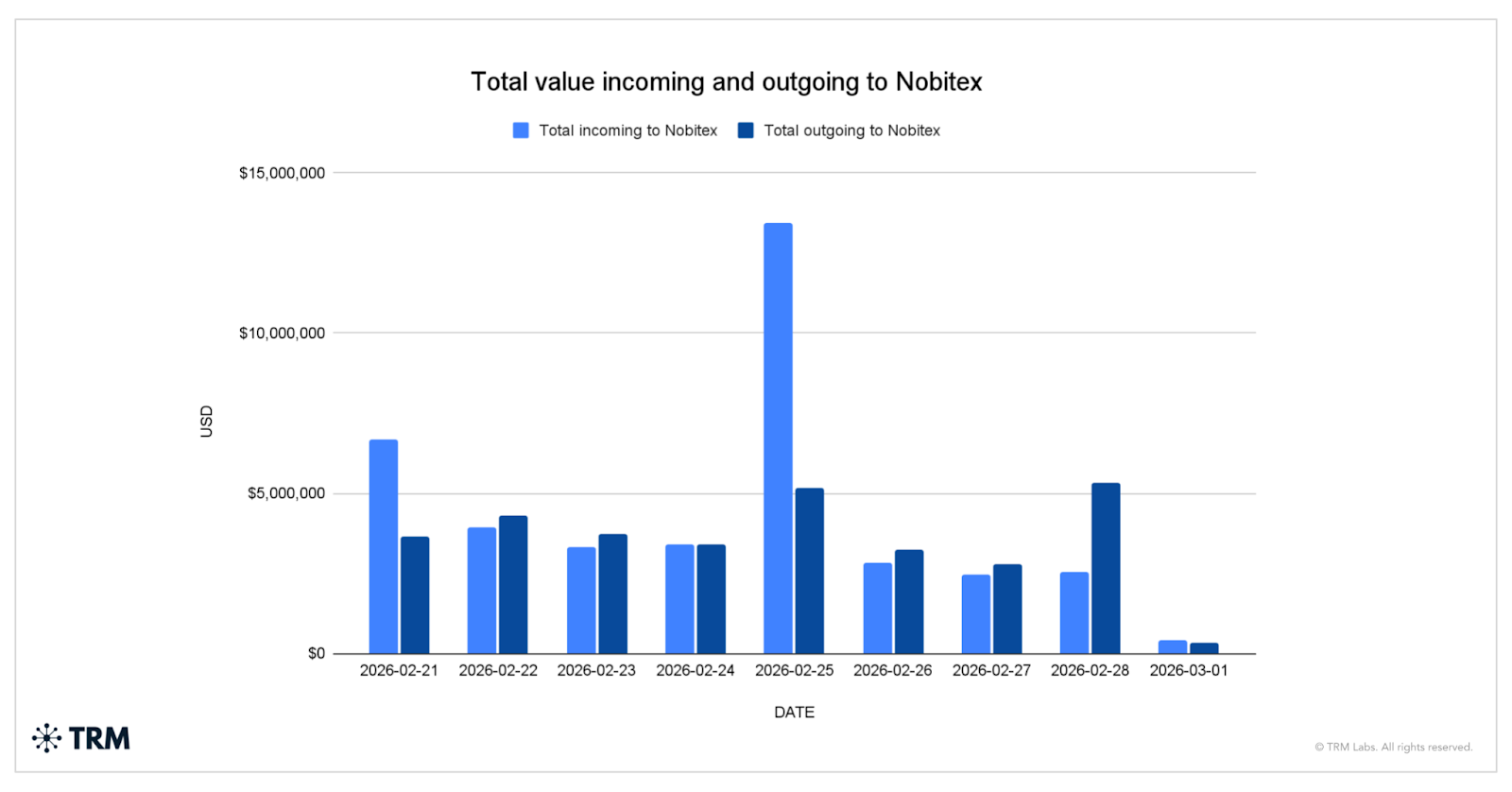
What became more immediately visible was the impact on access and market functionality.
Observers reported widespread internet outages across Iran, limiting the ability of users to actively trade or interact with crypto platforms. Rather than triggering a surge in activity, the disruption appeared to constrain participation, effectively shrinking market activity during the early phase of the conflict.
Domestic exchanges remained operational, but conditions shifted. Most platforms moved into risk containment mode, suspending or batching withdrawals, reducing market depth, and issuing guidance to users. These measures point less to system failure and more to infrastructure stress management, as platforms adjusted to uncertain conditions.
There were also signs of direct intervention at the market level.
Under guidance from Iran’s Central Bank, several exchanges temporarily halted trading on the USDT–Toman pair, which serves as a primary bridge between crypto and the local currency. This move slowed the process of fiat repricing during a period of volatility, limiting how quickly users could react to market changes.
When trading resumed, the effects were visible. Thin order books and short-lived price dislocations suggested reduced liquidity and impaired market depth, even if only temporarily.
At the same time, crypto’s role extends beyond individual use.
Some reports indicate that state-linked entities and networks tied to Iran are increasingly using crypto as part of broader sanctions-evasion strategies. In 2025 alone, Iranian-linked actors were responsible for billions of dollars in crypto flows, with some activity tied to government-affiliated groups.
Taken together, these developments highlight a critical but often overlooked reality: In times of conflict, crypto systems may remain technically operational, but access, liquidity, and usability can still be significantly constrained.
Sanctions Evasion: Breaking the Rules?
Crypto has become a way for some governments and groups to get around international sanctions. For example, if a country like Russia is blocked from using global banks, it might turn to crypto instead.
The problem is that sanctions are often used to stop wars or punish human rights abuses. But if crypto helps people avoid these punishments, then it could be assisting bad behaviour. That’s why many countries are now creating stronger regulations on the use of crypto and blockchain during times of war.
Governments are asking crypto companies to track where money comes from and report illegal transactions, but crypto is hard to control, and people can use private wallets or secret coins that hide where they send these monies. This makes it a constant battle between the good uses of crypto and the bad ones.
Humanitarian Blockchain: A New Hope?
Even with all the risks, many people believe in the power of blockchain for good and humanitarian blockchain projects are being built to help refugees, feed the hungry, and provide education to children in war zones.
For example, the World Food Programme has used blockchain to send food vouchers to people in need. These vouchers are stored on a blockchain and can be used in local stores. This helps reduce fraud and makes sure the help goes to the right people.
Blockchain also allows people who lost everything: home, job, ID, etc to rebuild their lives and with crypto, they can receive money, save it safely, and prove their identity over time. This is especially useful for children and families who have been forced to move from place to place due to war.
Some aid groups are even exploring using NFTs to track aid shipments or raise funds through digital art.
So, is Crypto Good or Bad in War?
That’s a tricky question because in places like Ukraine, crypto has clearly become a powerful tool for survival and resistance. It has allowed people to send and receive help when everything else was falling apart. But in places like Gaza, crypto has been used by both helpers and harm-doers; it’s a tool that doesn’t choose sides, and that is the loophole.
The truth is, crypto in war is like fire; it can cook food or burn houses, and the morality of such utility will depend on how people use it. That is why there is a big need for better rules, smarter technology, and more honest platforms. If the world can find ways to use crypto to help without letting it hurt, then it could change the way we handle war, aid, and rebuilding in the future.
The Future of Crypto in Crisis
As more wars and disasters happen around the world, crypto will likely play a bigger role. It is fast, borderless, and doesn’t need banks. For many people, that’s the kind of tool that can save lives, but at the same time, if the wrong people use it, it could make things worse.
To make sure crypto stays a lifeline and not a loophole, more education is needed, and people need to learn how blockchain works, how to spot scams, and how to protect their wallets. Crypto companies need to follow the law and help stop bad actors with aid groups, helping by building better systems to reach those who need help the most. Whether it saves lives or causes harm depends on the people who use it and the systems we build around it.
If done right, blockchain and crypto could become a light in dark times, and if misused, they could add to the danger. The choice is ultimately ours.
Disclaimer: This article is intended solely for informational purposes and should not be considered trading or investment advice. Nothing herein should be construed as financial, legal, or tax advice. Trading or investing in cryptocurrencies carries a considerable risk of financial loss. Always conduct due diligence.
If you want to read more market analyses like this one, visit DeFi Planet and follow us on Twitter, LinkedIn, Facebook, Instagram, and CoinMarketCap Community.
Take control of your crypto portfolio with MARKETS PRO, DeFi Planet’s suite of analytics tools.”