














In early crypto lore, DAOs were imagined as unstoppable, uncensorable machines, headless swarms governed by smart contracts and consensus, free from the baggage of legal entities, tax obligations, and boardroom politics. Fast forward to 2025, and that narrative is being stress-tested by a harsh legal reality. Over the past year, DAOs have been pulled out of their permissionless comfort zones and into courtrooms, government filings, and legislative hearings. Mango Markets shut down. Lido faced legal liability. U.S. regulators clarified that blockchains can write the rules, but the law still enforces them.

This article dives deep into the shifting legal terrain of DAOs in recent years: the lawsuits, the legislative breakthroughs, the wrapper structures gaining traction, and the uncomfortable but necessary tradeoffs decentralization must make to survive.
The End of Entity-less DAOs?
The DAO experiment began as a challenge to corporate orthodoxy: Why form a company when smart contracts could more transparently and equitably coordinate behavior? The past two years have forced a rethink. Without a legal wrapper, courts have increasingly treated DAOs as general partnerships or unincorporated associations, structures that carry unlimited liability for members.
This legal ambiguity reached a boiling point in Samuels v. Lido DAO, where a federal judge allowed a lawsuit to proceed, arguing that token holders and VC backers of Lido DAO were effectively general partners. The court’s refusal to dismiss VC firms like a16z and Paradigm as mere passive investors sent shivers across the ecosystem. Meanwhile, the SEC’s hammer came down on Mango Markets for the unregistered sale of MNGO tokens, culminating in a settlement, token burn, and eventual DAO shutdown.
The message from regulators was unambiguous and unsettling. As Jorge Tenreiro stated:
“The label ‘DAO’ does not change the reality of who is behind a project, what activities they engage in, or whether their activities need to be registered.”
— Jorge Tenreiro, Chief of the SEC’s Crypto Assets Unit
The message from regulators was unambiguous and unsettling. That warning reverberated far beyond Mango.
Jurisdictions Race to Catch Up
In response, several jurisdictions have rolled out novel DAO entity types to address the need for legal personality, liability shields, and tax clarity. In the U.S., Wyoming and Utah are leading the charge.
Wyoming’s Decentralized Unincorporated Non-profit Association (DUNA), effective July 2024, is a non-profit structure that allows token holders to be default members with limited liability without requiring full corporate governance. Its purpose-driven orientation makes it especially suitable for protocol DAOs.
Utah’s Limited Liability DAO (LLD) law took a more granular approach, requiring on-chain governance, public transparency, and role documentation. Utah’s framework uniquely allows pseudonymity protections via bylaws and recognizes smart contracts as governance infrastructure. While uptake is still cautious due to possible federal disclosure conflicts, the intent is clear: the state wants to become the Delaware of DAOs.
Offshore, the Marshall Islands DAO LLC structure has seen growing adoption, particularly via the MIDAO platform. It offers a path to legal recognition, limited liability, and pseudonymity-friendly compliance outside U.S. jurisdiction. Cayman Islands foundation companies (e.g., Lido’s BORGs) and Swiss Vereins also remain popular among established DeFi protocols.
However, perhaps the most ambitious entry comes from the UAE. Ras Al-Khaimah’s RAK DAO Association Regime launched in October 2024, offering DAOs full corporate privileges, including bank accounts and IP ownership, under a dual-tiered structure depending on DAO size. It’s one of the most DAO-native legal environments available today. DeXe is collaborating with RAK DAO to help expand operational tooling and legal accessibility for DAO builders.
Reimagining Legal Wrappers in a DAO Ecosystem
Legal wrappers are no longer seen as monolithic shells encasing an entire DAO. The emerging paradigm treats them as modular, composable components: tools that enable decentralized coordination in the real world without undermining on-chain autonomy.
This model typically consists of two layers:
Base Layer
A non-profit legal entity that recognizes all token holders as limited-liability members. It serves as the governance substrate, granting the DAO legal personality without centralizing power.
Operational Layer
Set of SubDAOs or affiliated legal entities tasked with executing specific functions: managing grants, holding IP, running contributor agreements, or operating treasury arms.
Each layer has a defined scope and legal purpose, making the overall structure more flexible and resilient. Wrappers in this framework act like specialized service nodes, signing contracts, opening accounts, or holding assets on behalf of the DAO without ever becoming “the DAO” themselves.
This architecture allows multiple wrappers to coexist, introduces built-in checks and balances, and makes legal infrastructure as modular as smart contracts. The DAO remains a non-custodial, on-chain coordination layer. At the same time, real-world execution happens through legally empowered agents, all under community oversight.
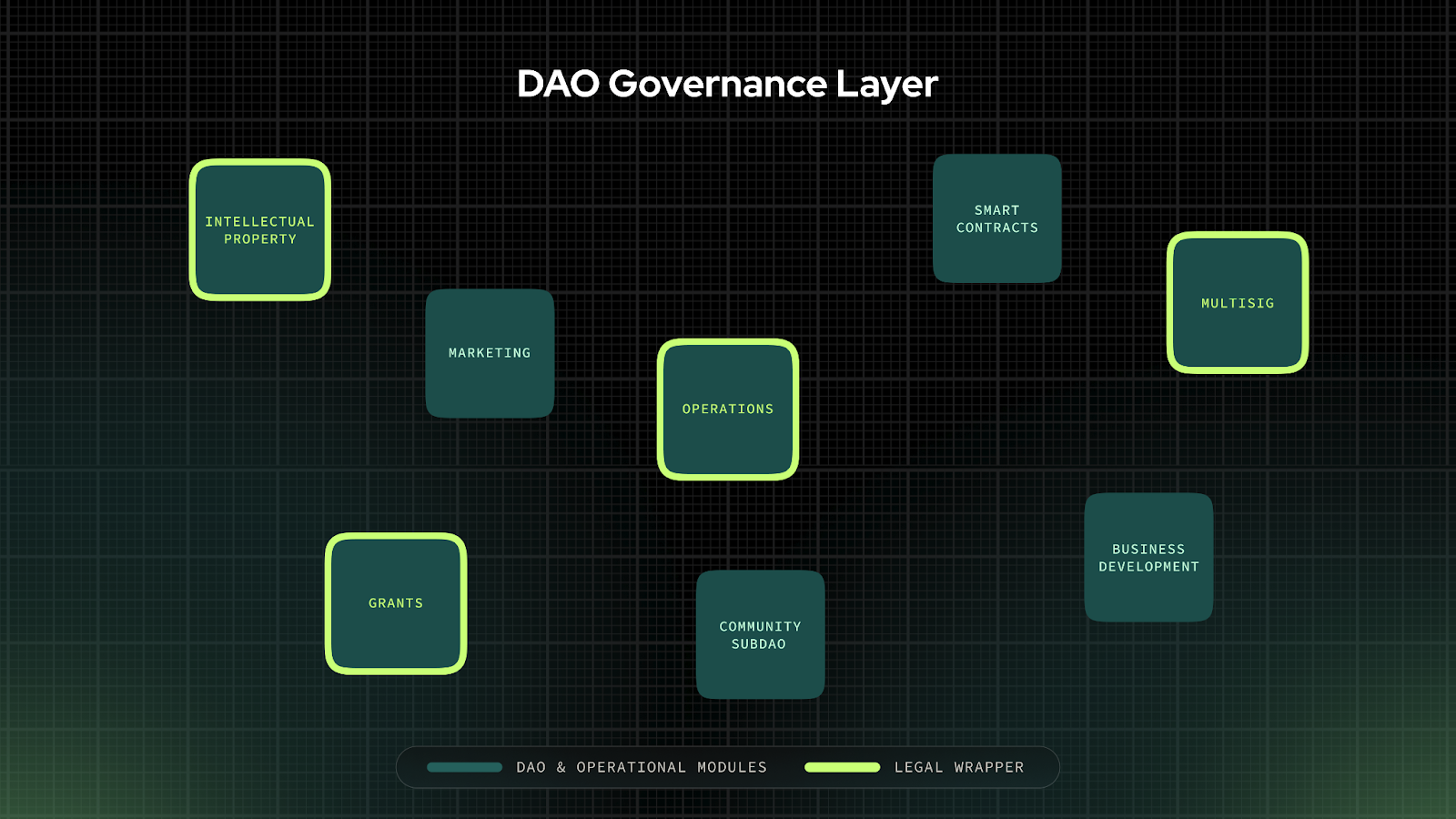
The aim isn’t to centralize control, but to create lightweight legal scaffolding that empowers contributors and preserves the autonomy of the DAO core.
BORGs, Wrappers, and Legal Modularity
Not all DAOs need a full-stack legal structure with base and operational layers. Some opt for modular compliance only where required. One popular approach is the BORG: Blockchain Optimized or Organized entities, popularized by Lido. A BORG is typically a narrow-scoped foundation (e.g., in the Cayman Islands) that executes specific mandates (grants, hiring, research) under bylaws controlled by on-chain votes. It acts like a DAO-controlled arm rather than a wrapper over the entire DAO.
This modular approach is catching on. Many DAOs now treat legal structuring like code architecture: different modules (treasury, HR, R&D) are wrapped in legal shells that plug into the core DAO rather than force the DAO into a single monolithic entity. It’s composable compliance.
Risks, Tensions, and Legal UX
The DAO ecosystem is waking up to a brutal truth: without a legal wrapper, even passive tokenholders may face liability, as demonstrated in the Ooki and Lido cases. In response, projects are exploring protective measures like voting disclaimers, contributor insurance, and tokenholder terms of service. But even with these guardrails, a deeper tension persists. For some, incorporating feels like betrayal. Yet if DAOs hope to scale beyond Discord chats and multisig wallets, they must engage with the legal layer, not to surrender autonomy, but to defend it.
Final Thoughts: Legible, Scalable, Accountable
Legal wrappers are not the end of the decentralization dream, they’re its next evolution. Governance today requires both technical enforceability and legal resilience. Just as DAOs redefined how we coordinate, legal innovation now redefines how we protect what we’ve built. Looking ahead, DAOs will increasingly:
- Adopt dual-layer governance: on-chain rules + enforceable legal by laws;
- Combine jurisdictions for different DAO functions (e.g., DUNA in the U.S. for governance, Cayman Foundation for treasury);
- Bake in dispute resolution mechanisms and director recall protocols;
- Educate members on legal risks before onboarding.
DAO legal structuring in 2025 is about surviving and scaling under scrutiny. The goal is to ensure a designated legal interface when the law knocks, not 10,000 anonymous voters left holding the bag. Legibility doesn’t mean giving up decentralization; instead, it means building defensible architectures where smart contracts carry legal context, contributors are shielded from liability, and governance bridges both code and law.
And now, a new layer is emerging. AI agents are entering DAOs: proposing, executing, voting, and advising. But their presence raises pressing questions: Who bears responsibility for agent-led actions? Can algorithms hold fiduciary roles? Should they be wrapped in legal protections of their own? These are no longer theoretical concerns.
The next major leap in Web3 won’t be a governance primitive. The legal-operational OS will make DAOs and their agents safe, scalable, and sovereign. We’ve built coordination. We’re building protection. Now, we must build accountability for humans and machines alike.
Author: Roman Melnyk, the chief marketing officer at DeXe.io






