

























































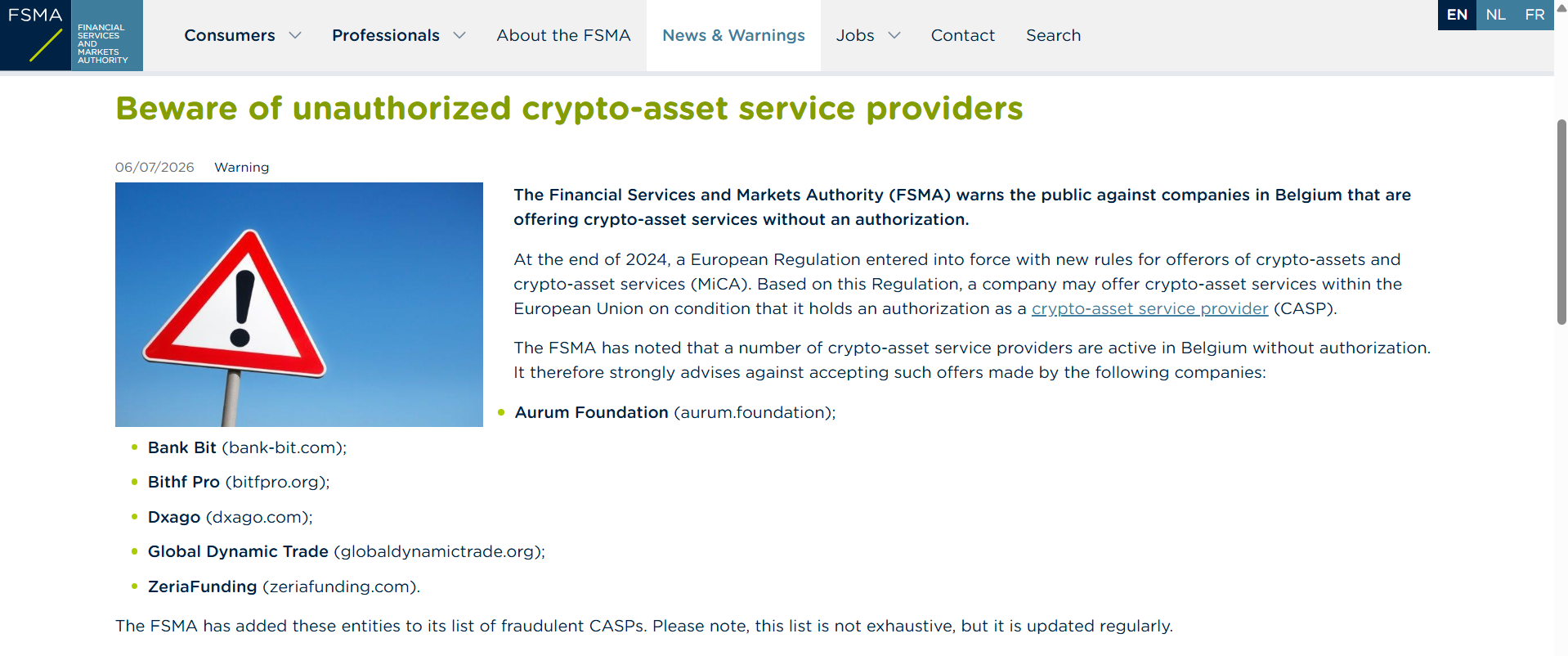
Belgium’s financial markets regulator has warned investors to avoid six crypto firms that it says are operating in the country without the authorization required under the European Union’s Markets in Crypto-Assets (MiCA) regulation.

The Financial Services and Markets Authority (FSMA) on Monday identified Aurum Foundation, Bank Bit, Bithf Pro, Dxago, Global Dynamic Trade, and ZeriaFunding as crypto-asset service providers (CASPs) offering services without the necessary approval. The regulator added all six firms to its list of fraudulent CASPs and urged consumers not to engage with them.
The action comes just days after the EU’s MiCA transitional period ended on July 1, marking the start of stricter enforcement of the bloc’s unified crypto rules.
Why has Belgium taken action now?
The FSMA’s warning follows the expiration of Belgium’s MiCA transition period, after which crypto firms must hold the required authorization to legally provide services in the country.
Under MiCA, authorized CASPs can offer services including crypto custody, trading platforms, crypto-to-fiat and crypto-to-crypto exchanges, order execution, asset transfers, investment advice, and portfolio management.
The regulator advised users to verify whether a crypto provider appears in its official CASP register before using its services. It also reminded investors that crypto assets remain highly volatile, may face liquidity risks, and are not protected by compensation schemes that reimburse customer losses.
MiCA enters its enforcement phase across Europe
MiCA became fully effective at the end of 2024, introducing a single regulatory framework for crypto companies operating across the European Union.
With the July 1 deadline now passed, existing crypto businesses that failed to obtain authorization are expected to stop providing regulated crypto services or risk enforcement action from national regulators.
Belgium’s latest warning indicates that regulators across the EU are beginning to actively enforce the new licensing rules as the transition period comes to an end.
Crypto firms face growing regulatory pressure
The new licensing requirements have increased pressure on crypto companies seeking to continue operating across Europe.
Last month, crypto exchange Binance withdrew its MiCA license application in Greece, saying it would instead pursue authorization in another EU member state ahead of the July 1 deadline. While the exchange said it was not leaving Europe, it acknowledged that some users could be affected as it works to meet regulatory requirements. Binance later assured customers that their funds remain safe as new regulatory changes under the MiCA framework begin taking effect across the region.
Enjoyed this? Bookmark DeFi Planet, explore related topics, and follow us on Twitter, LinkedIn, Facebook, Instagram, Threads, and CoinMarketCap Community for seamless access to high-quality industry insights
Take control of your crypto portfolio with DEFI PLANET PRO, DeFi Planet’s suite of analytics tools.