





















































Many in the crypto world would see the conviction and 30-year sentence of the operator of Incognito Market as a win for law enforcement. But it’s also something more consequential: a demonstration that one of the industry’s most carelessly spewed catchphrases — that crypto can deliver “anonymity” at scale — falls apart once illegal money needs to move like regular money.

Rui-Siang Lin, a Taiwanese national who prosecutors say ran the Tor-based marketplace under the handle “Pharoah,” was sentenced by a Manhattan federal court to 30 years in prison and ordered to forfeit $105,045,109.67. Authorities said Incognito sold more than $105 million of narcotics from its launch in October 2020 until Lin shut it down in March 2024.
This case again reminds everyone that privacy in crypto isn’t just something you can toggle on or off. It requires careful attention at every step, and if used for illicit purposes would more often than not break down when the criminal operation needs things like cash flow, infrastructure, customers, support, domains, servers, and eventually, a way to move money into the regular economy.
A dark-web market that ran like a startup
Incognito wasn’t a static list of dealers. Prosecutors described an operation modelled after mainstream e-commerce: branding, advertising, customer service and an internal payments layer called the “Incognito Bank,” which let buyers and vendors keep each other at arm’s length while the platform took a 5% cut. Lin made over $6 million in profits, prosecutors said, and the platform grew to more than 400,000 buyer accounts, more than 1,800 vendors and more than 640,000 transactions. (Department of Justice)
The platform grew quickly. According to the criminal complaint, investigators found that the market’s Bitcoin and Monero wallets brought in at least $83.6 million in revenue by early January 2024. The 5% commission alone made about $4.18 million, and deposits rose sharply from $14.8 million in 2022 to $65.5 million in 2023.
These stupendous sums involved challenges the idea that crypto crime is just small-time opportunism. Incognito was a real business with steady growth, organized cash management, and clear operations, which meant it left behind business-like records.

What “blockchain tracing” looked like in practice
The investigation didn’t crack Monero or “deanonymize” the dark web like what you’d see in movies. It relied on a more durable principle: if you can find the main wallets — the ones where ‘profits’ consolidate — you can map behaviour, spot patterns, and wait for the parts of the system that are not private.
Investigators described Incognito’s internal “bank” wallets as the main collection points, then traced a series of wallets that received large portions of those funds. One of those, “Administrator Wallet-1,” received the most funds from the market’s Bitcoin bank wallet. Investigators noted a pattern they treated as profit-taking: a meaningful share of transfers were whole-number amounts like 1 BTC or 5 BTC — the kind of “round-number” behaviour you’d expect when someone is moving proceeds, not paying bills.
Lin and his associates also talked too much in the wrong places. The complaint cites forum posts by “Administrator-1” discussing operational security, site infrastructure and “canary” messages — classic dark-web rituals meant to signal that the site hasn’t been seized. While these posts don’t prove identity on their own, they do show who was in charge and what their intentions were.
The main laundering tactic was familiar: convert traceable assets into harder-to-trace ones, then move the money back into places where it can be spent.
Investigators described repeated transfers in which Bitcoin from “Administrator Wallet-1” was sent to an online swapping service and converted into Monero (XMR), with Monero then appearing shortly afterward as deposits into a centralized exchange wallet tagged “Crypto Account-1.” One example cited in the complaint: on May 15, 2022, 1 BTC was sent to “Swapping Service-1,” swapped into Monero, and within about 40 minutes, the exchange account received a large Monero deposit. Similar sequences were documented again days later and again with a 2 BTC swap.
The Incognito probe in a glaring way reveals how investigators approach privacy coins: they don’t need to see inside every Monero hop if timing, amounts, and repeated behaviour tie the “before” and “after” together—and if the “after” lives in a custodial account with records.
Then came the identity hooks.
According to the complaint, documents from the provider of “Crypto Account-1” showed the account used a phone number and email address associated with Lin and included a Taiwanese driver’s license submitted as proof of identity.
Investigators also followed the infrastructure. The complaint says “Administrator Wallet-1” conducted multiple transactions with Namecheap and helped pay for domains, including one linked to a site described as promoting the marketplace. A Namecheap account involved in the purchase was registered to “RuiSiang Lin,” with a Taiwan phone number, a Taipei address, and an email address that included “ruisiang.”
Summarily, the blockchain trail didn’t singularly identify Lin on its own but it helped narrow down the suspects and linked the money to services that keep records.
The exit scam that doubled as evidence
In March 2024, prosecutors said Lin shut Incognito down by stealing at least $1 million users had deposited in the Incognito Bank and then tried to extort buyers and vendors, threatening to publish their histories and crypto addresses unless they paid.
It’s a familiar ending: the operator who sells “trust” as a product ultimately monetizes the trust directly. Evidentiary-wise, it’s worse for the operator. Extortion postings, sudden shutdown behavior, and the mechanics of taking user balances are the kind of operational acts that strengthen the argument that one person had ultimate authority.
What this case really does to the crypto industry
The Incognito case shows that blockchain tracing is not just a law enforcement tool; it’s reshaping trust, compliance, and strategy across the crypto market.
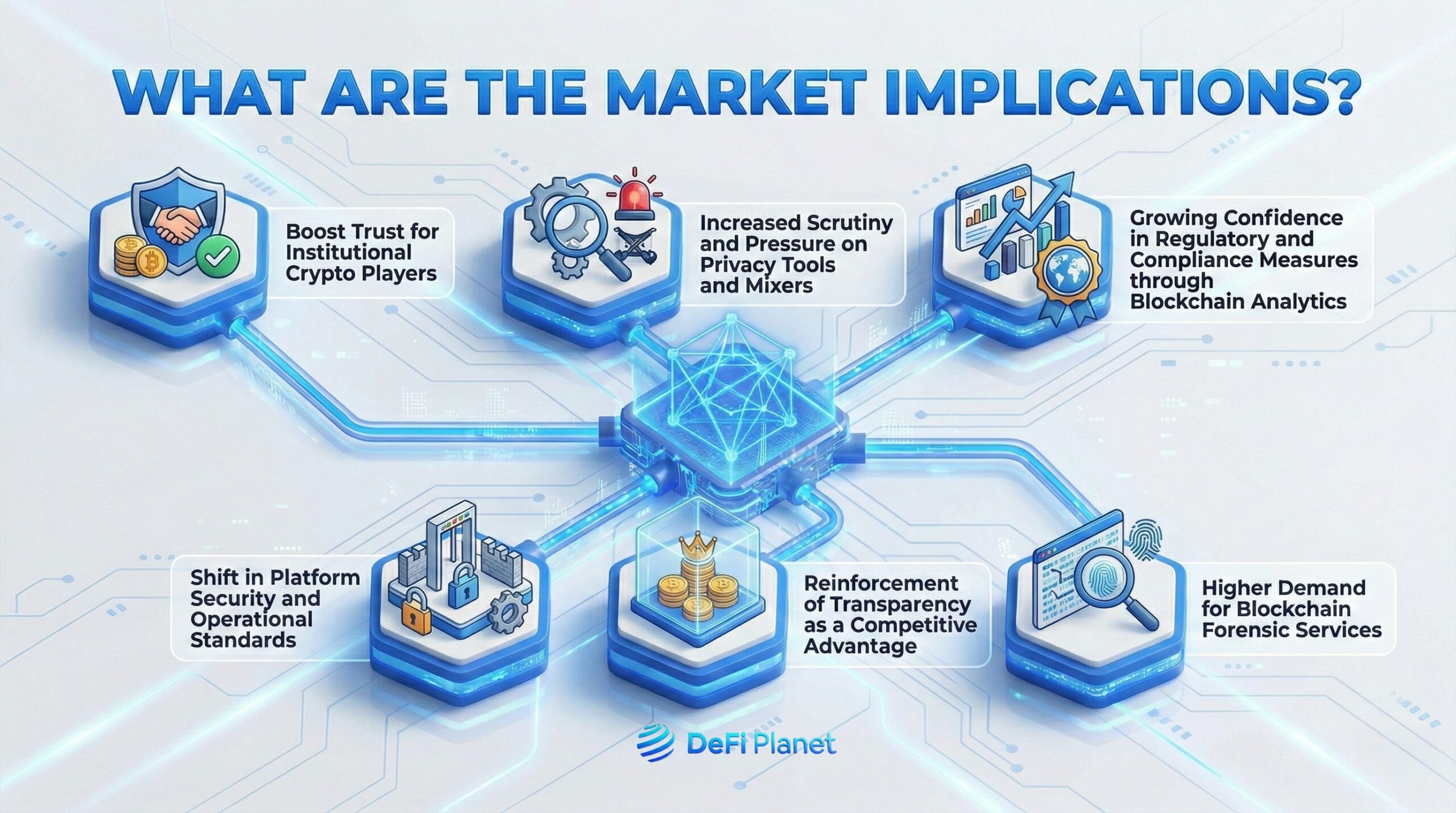
Boost in trust for institutional crypto players
Institutions now see that even complex crypto crimes can be traced, which increases confidence in entering digital asset markets. With stronger evidence that blockchain analytics can track illicit activity, banks, hedge funds, and investment firms feel safer allocating capital to crypto, reducing fears of uncontrollable risk.
Increased scrutiny and pressure on privacy tools and mixers
Cases like Incognito put privacy-focused tools and mixers under the spotlight. Regulators are likely to impose stricter rules on these services, and platforms using them may need to improve reporting and compliance, or risk legal penalties and reputational damage.
Growing confidence in regulatory and compliance measures through blockchain analytics
The ability to trace illicit flows demonstrates that blockchain analytics can support compliance and risk management. This encourages both regulators and platforms to adopt monitoring and auditing tools, creating a safer environment for traders and reinforcing legal frameworks around digital assets.
Shift in platform security and operational standards
Exchanges and DeFi platforms are now expected to implement stronger due diligence for accounts, transfers, and domain registrations. Platforms that fail to monitor large transfers, identify suspicious wallets, or enforce verification processes may be vulnerable to criminal exploitation and investor distrust.
Reinforcement of transparency as a competitive advantage
Platforms that embrace transparent operations, audits, and traceable transactions can stand out in a crowded market. By demonstrating accountability and proactive monitoring, these platforms attract more users, institutional partners, and liquidity, turning transparency into a long-term growth strategy.
Higher demand for blockchain forensic services
The Incognito case has shown that specialized blockchain forensics can uncover criminal activity that traditional investigations might miss. This is driving demand for firms and tools that can trace transactions, analyze wallet behaviour, and produce audit-ready reports, creating a growing market segment within crypto security.
A complication regulators can’t ignore: the informant controversy
The simple narrative that “technology can’t hide you” has a more complicated side. A Wired report from February 19, 2026, described defence claims that an FBI confidential source took part in Incognito’s daily operations after joining, including approving vendors and settling disputes. Prosecutors disagreed with this view. (WIRED)
Even if that dispute plays out only in appeals and legal filings, it raises a real policy question: how long should law enforcement allow a dangerous marketplace to continue operating in order to gather evidence? While the tension around this doesn’t dilute the new learnt lessons on dirty money tracing, it does shift the debate about tactics — and it will be cited the next time agencies argue that prolonged undercover access is necessary to dismantle a network.
Transparency as Crypto’s Double-Edged Sword
The Incognito case shows that crypto transparency can be both a weakness and a strength. While it allows criminals to operate in seemingly anonymous spaces, it also gives investigators the tools to trace illicit activity, recover funds, and hold perpetrators accountable.
Looking ahead, blockchain tracing is likely to redefine trust, compliance, and risk in crypto. Platforms, law enforcement, and investors all have lessons to learn: platforms must strengthen monitoring and user verification, regulators can rely on analytics to enforce rules, and investors need to prioritize security in their strategies. Transparency, when paired with vigilance and technology, may become the most important defence against crypto crime.
The bottom line
Crypto can enable fast, global, and hard-to-reverse transfers; useful qualities for both legitimate finance and illicit trade. But at scale, a criminal enterprise has to touch the real world: customers need access, operators need infrastructure, and profits need an exit…and that point is where the long arms of justice wait for the kill.
Privacy is one of crypto’s core tenets. For law-abiding users: financial privacy is a legitimate need, not a suspicious one, and it remains part of the value proposition that drew many people to digital assets in the first place.
Cases like Incognito don’t discredit that principle…they do something more useful: drawing a clear line between legitimate privacy and criminal concealment. Putting these prosecutions in the public domain serves an important purpose. It reminds criminals, extremists and other bad actors who exploit crypto — and in doing so damage the industry’s credibility — that privacy tools don’t confer immunity, and that investigators can trace activity, identify operators and bring them to court.
This is the distinction the industry needs to preserve: defend privacy for lawful users, and demonstrate harsh consequences for those who use the same technology to facilitate harm.
Disclaimer: This article is intended solely for informational purposes and should not be considered trading or investment advice. Nothing herein should be construed as financial, legal, or tax advice. Trading or investing in cryptocurrencies carries a considerable risk of financial loss. Always conduct due diligence.
Enjoyed this piece? Bookmark DeFi Planet, explore related topics, and follow us on Twitter, LinkedIn, Facebook, Instagram, Threads, and CoinMarketCap Community for seamless access to high-quality industry insights.
Take control of your crypto portfolio with MARKETS PRO, DeFi Planet’s suite of analytics tools.”