



















































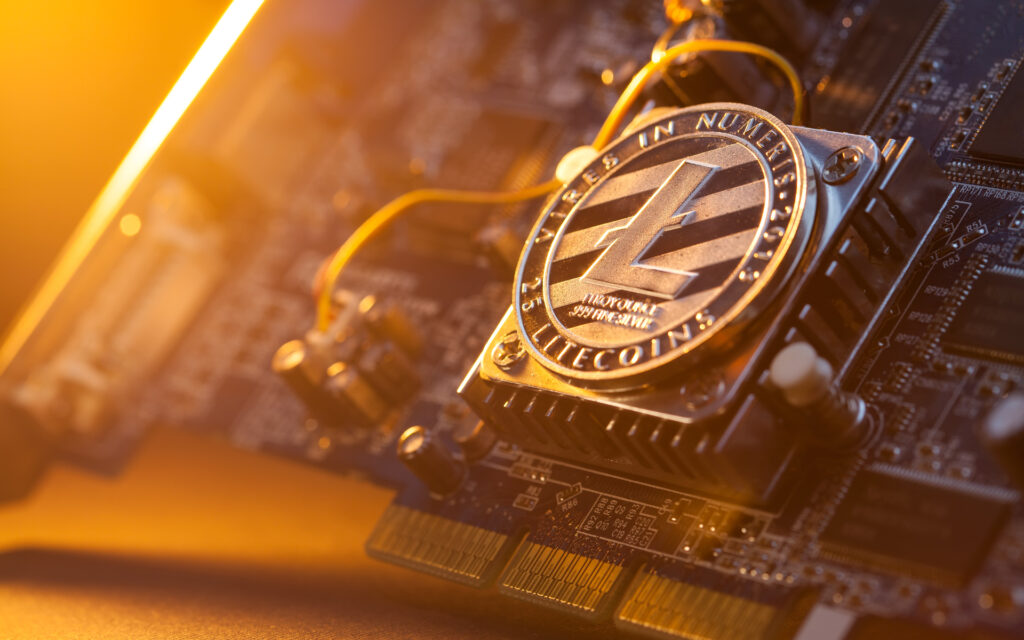
Litecoin was once the world’s third-largest cryptocurrency by market capitalization. The broader cryptocurrency market’s cyclical swings explain part of why that slide happened, but Litecoin’s persistently strong correlation with Bitcoin remains one of the more consistent factors behind it.


Litecoin’s value has always tracked Bitcoin’s closely, and one structural link between the two remains central to that relationship: both undergo periodic halving events that reduce new coin issuance.
Examining Price Movements Surrounding Bitcoin and Litecoin Halvings
Bitcoin and Litecoin share similar technological foundations and undergo halving events roughly every four years. Bitcoin’s halving occurs every 210,000 blocks; Litecoin’s happens every 840,000.
Bitcoin’s fourth halving took place on April 19, 2024, reducing block rewards from 6.25 BTC to 3.125 BTC. Litecoin’s most recent halving occurred in August 2023, cutting its issuance from 12.5 LTC to 6.25 LTC per block.

A historical data analysis shows that Bitcoin and Litecoin halvings have coincided with significant bull market cycles. A closer look at price trends six months before each halving and up to a year after reveals that Bitcoin has witnessed substantial gains, with a remarkable 20,000% surge taking place around the 2012 event, a 560% increase during the 2016 halving, and a rise of 780% in the 2020 episode. Interestingly, most of Bitcoin’s notable gains took place almost a year after each halving.
That pattern held again after the 2024 halving. Bitcoin traded around $64,000 on the day of the halving, consolidated for roughly seven months, then entered a new bull phase that carried it to a fresh all-time high of $126,210 on October 6, 2025. By April 2026, it had pulled back to around $71,000, a roughly 44% drawdown that, by Bitcoin’s own historical standards, was relatively mild. Bitcoin’s fifth halving is expected around April 2028, when the block reward will drop again to 1.5625 BTC.
Litecoin’s halving events follow a different pattern than Bitcoin’s post-halving rallies. Rather than gaining momentum in the year after a halving, Litecoin’s biggest moves have historically come in the six months before one.
Though there is no clear pattern in Litecoin’s price performance in the year following each event, there is a consistent trend in the six months before its previous two halvings. Litecoin’s price peaked at approximately 320% gains around 45 days before each halving but then lost most of those returns in the following month. Nevertheless, Litecoin managed to end the year after each event with gains ranging between 80% and 110%.
As of mid 2026, Litecoin trades around $45 to $51, with a market capitalization near $3.4 to $3.9 billion depending on the exchange. That’s down significantly from where it traded in late 2023, and roughly 88% below its all-time high of $410.26, set in May 2021.
Litecoin’s price tends to rise ahead of its own halving, a pattern that plays out on a different timeline than Bitcoin’s post-halving rally.
After Litecoin’s halving, its price tends to consolidate before rising alongside Bitcoin’s broader bull cycles, cycles that have historically, though not guaranteed, begun within roughly a year of each Bitcoin halving.
Litecoin and Bitcoin’s Intriguing Relationship
 Litecoin is often referred to as “the silver to Bitcoin’s gold” a nod to how closely the two are linked. That correlation isn’t simple, though, it reflects a mix of shared technical foundations, overlapping investor bases, and Litecoin’s own standing as a long-running, low-drama network.
Litecoin has proved over time that it can be as reliable as Bitcoin. Since its launch, the blockchain has maintained 100% uptime and has had no hacking incidents, just like Bitcoin.
The appeal of low transaction fees and a limited coin supply makes Litecoin even more attractive to seasoned investors and traders, contributing to its relatively lower volatility compared to other cryptocurrencies.
As a major altcoin, Litecoin isn’t only moved by Bitcoin, it’s also shaped by broader altcoin market sentiment and its own news cycle. Positive developments tend to lift its price; negative headlines tend to weigh on it.
Other Potential Factors that Could Affect Litecoin’s Price
One development worth watching is growing corporate treasury interest in Litecoin. MEI Pharma became the first public US company to adopt a Litecoin Treasury Strategy. It added 929,548 LTC to its treasury in August 2025.
MEI Pharma became the first public US company to adopt a Litecoin Treasury Strategy.
929,548 $LTC were acquired for ~$100M at ~$107.58 per token.
Thanks to the involvement of @SatoshiLite & @GSR_io, we’re bringing the people’s currency to institutional portfolios.$MEIP pic.twitter.com/EuRDtfse8m
— Lite Strategy (@LiteStrategy) August 14, 2025
Similarly, Luxxfolio Holdings maintains a smaller, ongoing corporate LTC position of roughly 20,000 coins.
Corporate treasury adoption has become a meaningful demand driver across several cryptocurrencies since 2024, and Litecoin’s inclusion in that trend marks a departure from its earlier reputation as a purely retail-traded asset.
The Litecoin Foundation’s Litecoin.Space initiative has continued operating since its launch, funding core contributors and open-source development on the network as part of an effort to sustain long-term development independent of price cycles.
Final Thoughts
The 2024 halving cycle has now played out in full, following Bitcoin’s familiar pattern: consolidation, then a rally to new highs roughly a year and a half later, then a significant pullback. Litecoin’s own August 2023 halving followed its own historical pattern too, a run-up beforehand, a pullback after, and modest year-later gains.
What hasn’t changed is the underlying relationship. Litecoin’s price still tracks Bitcoin’s closely, for better and worse, and its slide down the market cap rankings has happened alongside Bitcoin’s continued dominance of investor attention and capital. Whether growing corporate treasury interest is enough to meaningfully decouple Litecoin’s price from Bitcoin’s cycles, or whether it simply remains one more asset moving in Bitcoin’s shadow, is the more relevant open question heading into Bitcoin’s next halving in 2028.
Disclaimer: This article is intended solely for informational purposes and should not be considered trading or investment advice. Nothing herein should be construed as financial, legal, or tax advice. Trading or investing in cryptocurrencies carries a considerable risk of financial loss. Always conduct due diligence.
Enjoyed this? Bookmark DeFi Planet, explore related topics, and follow us on Twitter, LinkedIn, Facebook, Instagram, Threads, and CoinMarketCap Community for seamless access to high-quality industry insights.
Take control of your crypto portfolio with DEFI PLANET PRO, DeFi Planet’s suite of analytics tools.