














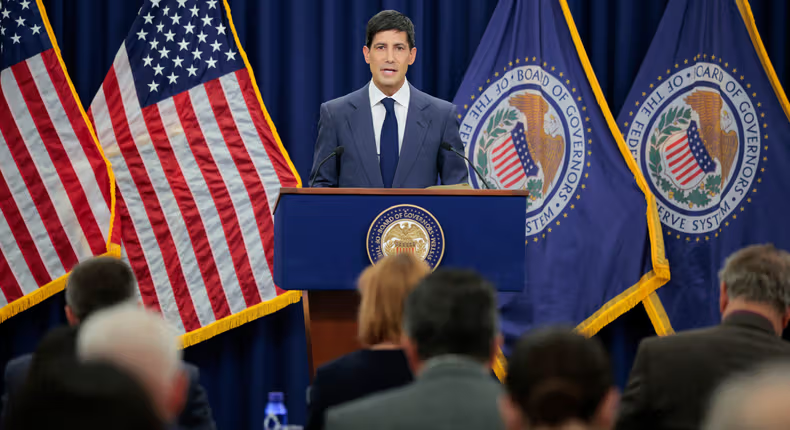
Kevin Warsh has begun his role as the new Federal Reserve Chair by launching cross-functional task forces to review the central bank’s mission, practices, and monetary policy from scratch.

Warsh, a former Fed governor appointed by President Donald Trump after Jerome Powell, is using corporate-style management to change how the bank works. This major change aims to update the institution but opens up fresh debates on policy direction.
Kevin Warsh’s Fed leadership debuted with a corporate flair, launching task forces to reevaluate monetary policy. Experts told Business Insider about the potential impacts on the institution. https://t.co/AUtAQnwpbD
— Insider (@thisisinsider) June 18, 2026
The sudden changes have raised concerns among economic experts and financial market participants. Analysts warn that changing systems might hurt the Fed’s institutional memory, staff skills, and neutral standing. Furthermore, new communication methods could cause uncertainty in global markets, leading to higher bond market volatility.
Why does the new Fed review matter to global markets?
Warsh wants to fix how the Fed handles its goals of steady prices and maximum employment. However, critics feel that treating a central bank like a private firm might upset the long-term staff who guide interest rate decisions.
Market experts say this shake-up arrives during a time of heavy political pressure. Diane Swonk, KPMG US chief economist, said inflation is “starting to get a mind of its own” and is becoming entrenched after five years. She forecasts the Fed will “raise short-term interest rates, not cut them, twice in late 2026” and hold rates higher “well into 2027.” Swonk warned: “The Fed needs to signal optionality on its next move in rates, it could be up instead of down”.
How will this change impact crypto and Bitcoin?
Bond markets reacted fast to the press conference, with yields moving up and down as traders tried to guess the Fed’s next moves. Historically, changes in how the Fed talks to the public alter how people plan for rate decisions. If Warsh hints at higher interest rates to save the dollar, fixed-income markets will face a rough ride.
For digital assets, Bitcoin often shows how investors feel about cash supply and inflation fears. Bitcoin fell 2.96% to $63,841.40 recently, following a broader market drop caused by new Fed Chair Kevin Warsh’s aggressive stance on interest rates. Its 63% correlation with the S&P 500 shows that Bitcoin is currently moving in sync with traditional financial markets.
Mohamed El-Erian, president of Queen’s College, Cambridge, highlighted the FOMC’s “unanimous decision to hold rates at 3.5-3.75% and maintain balance sheet policy, as widely anticipated.” Under new Chair Kevin Warsh, “the statement is notably shorter and more concise, with one official skipping the dot plot projections.” The dot plot shows a “hawkish tilt: 9 officials forecast rate hikes this year, median inflation forecast revised upward, and the prior easing bias removed.”
Meanwhile, Michael Saylor argues that, “Bitcoin does not need staking, inflation, or protocol-based yield mechanisms to deliver value”. He said returns should come from financial products built around Bitcoin while the cryptocurrency itself remains “pure digital capital” unchanged, with yield from credit structures
Enjoyed this? Bookmark DeFi Planet, explore related topics, and follow us on Twitter, LinkedIn, Facebook, Instagram, Threads and CoinMarketCap Community for seamless access to high-quality industry insights.
Take control of your crypto portfolio with DEFI PLANET PRO, DeFi Planet’s suite of analytics tools.






