











The artificial intelligence race has spent the last three years chasing one goal; to build the smartest model, spend the most money, and hope customers jump on the technology. That formula has worked for the most part, and as we all thought, it would continue to work as long as a handful of companies had the money to train frontier AI systems. OpenAI, Anthropic, Google DeepMind, and xAI became household names because building state-of-the-art models required billions of dollars in computing power, thousands of advanced GPUs, and massive research teams.

Then came a different kind of challenge; instead of trying to outspend Silicon Valley, Chinese startup Moonshot AI asked a simpler question. What if the next breakthrough wasn’t building the biggest AI model, but making one powerful enough that almost anyone could afford to use it?
That idea is behind Kimi K3, Moonshot AI’s newest large language model, which, on paper, looks like another AI release. It supports text, images, and video, and offers a context window of one million tokens, meaning it can process the equivalent of several books in a single conversation. It also arrives with a reported 2.8 trillion parameters, placing it among the largest AI systems announced publicly.
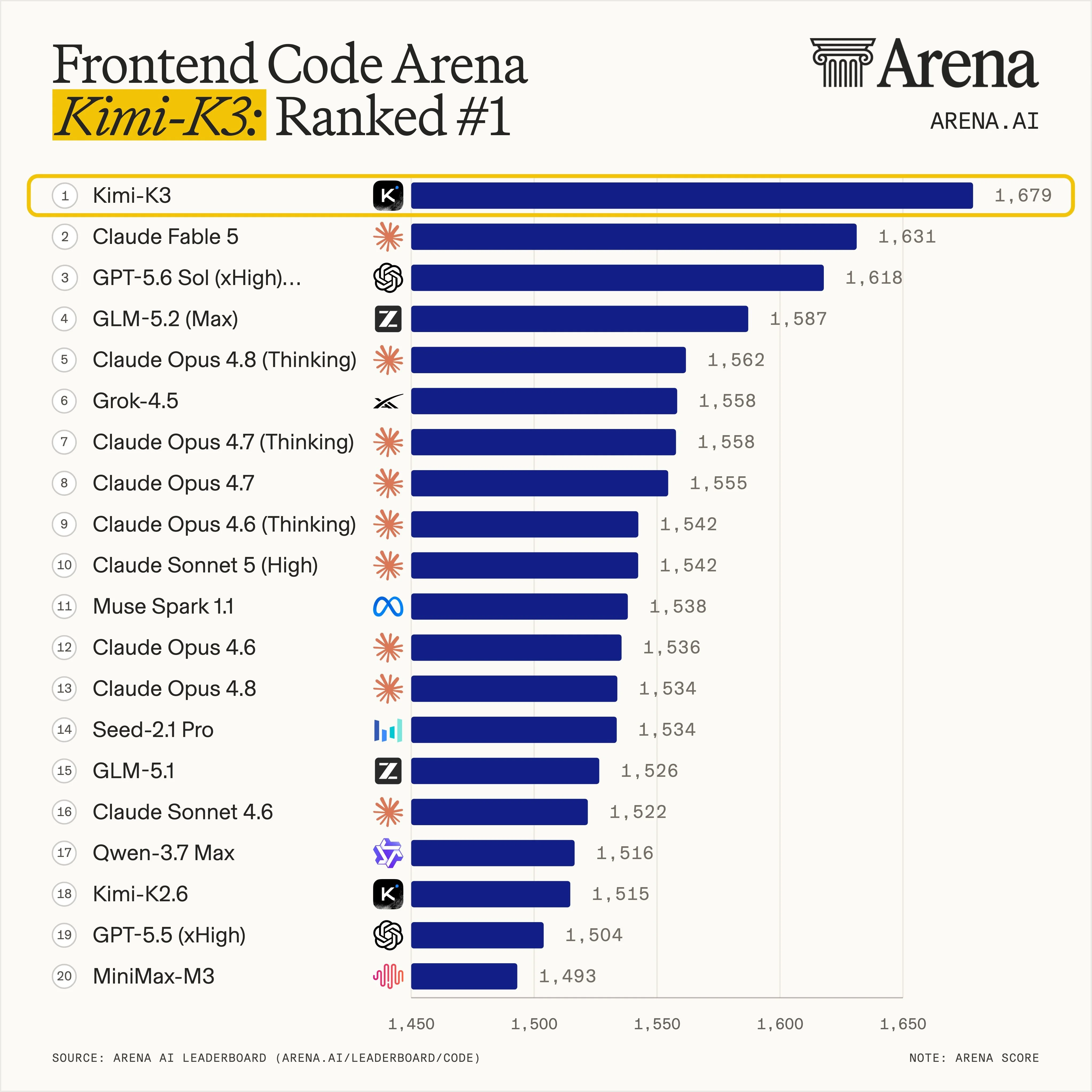
The thing that makes K3 notable isn’t that it’s the cheapest model available, it isn’t. Models like DeepSeek’s V4-Flash ($0.14/$0.28 per million tokens) and Alibaba’s Qwen3.7 Flash ($0.03/$0.13) undercut it by a wide margin. What makes K3 notable is that it scores near the very top of the field while pricing well below what the top labs charge: $3 input and $15 output puts it roughly in line with Anthropic’s mid-tier Sonnet pricing, a fraction of what GPT-5.6 Sol or Claude Fable 5 cost, while still ranking within a few points of them on independent benchmarks.
The AI Race Is Becoming an Economics Competition
When ChatGPT launched in late 2022, a lot of the conversation focused on intelligence. Which company had the smartest chatbot? Which model could write better code? Which AI answered questions more accurately? And although those questions still matter, businesses are now asking a different question, and that is, can we afford to run this model every day?
This has made AI inference costs one of the most important metrics in the industry because training an AI model is expensive, and although it only happens once, inference is different. Every prompt a customer sends, every document an employee summarizes, and every AI-powered customer support chat generates new computing costs.
When a bank uses AI to answer 20 million customer questions every month, even a tiny difference in pricing can translate into millions of dollars saved or spent every year, and this explains why companies are paying close attention to Kimi K3 pricing instead of focusing only on benchmark scores. A cheaper AI model allows businesses to serve more customers without increasing their infrastructure budgets, it also lowers the barrier for startups that could never afford expensive AI APIs during the early days of generative AI.
Why the Cheapest Model Isn’t Always the “Cheapest”
There is an important lesson hidden behind Kimi K3’s headline price, and that is the fact that API pricing tells only part of the story. Most AI companies charge separately for input and output tokens, but input tokens represent the information users send into the model, and output tokens represent everything the AI generates in response, and all these sound simple until reasoning enters the picture.
Unlike some competing models that allow developers to choose between faster and deeper reasoning modes, Kimi K3 currently operates with maximum reasoning enabled. The model performs more internal thinking before producing an answer, and this often improves quality, especially on difficult tasks involving coding, mathematics, and complex reasoning. The trade-off being that it may generate more output tokens.
Independent testing has suggested Kimi K3 can produce significantly more output tokens than competing models on identical tasks, and since output tokens are billed separately, a model with the same published API price may still cost more to operate depending on how much it generates during inference.
Experienced engineers rarely compare models using price alone but on the basis of questions like: How accurate is the answer? How quickly does it respond? And how much does each completed task actually cost?
Affordable AI Is Opening Doors for Smaller Companies
For many years, access to advanced AI was pretty much reserved for well-funded technology companies, and a start-up building a legal assistant or financial analysis tool will have to carefully think about how to send thousands of API requests everyday. This high cost meant higher subscriptions for their customers but an AI that is relatively cheap tends to completely flip that equation.
A startup that previously spent $100,000 each month on AI infrastructure could reduce expenses dramatically if newer models deliver similar quality at lower operational costs. What this means is that money can instead fund product development, hiring, or customer acquisition, which is one reason analysts believe low-cost AI models could accelerate innovation across industries.
Instead of spending most of their budgets on AI infrastructure, companies can invest in building better products, and this is a trend that could benefit independent developers, who are now able to gain access to technology that was previously out of reach
Kimi K3 fits this story less as the cheapest option and more as proof that frontier-adjacent quality no longer requires frontier-level spend. Startups chasing the lowest possible cost still have cheaper options in DeepSeek and Qwen; what K3 demonstrates is that the gap between “cheap” and “genuinely capable” has narrowed enough that neither has to mean settling for less.
READ ALSO: Can AI Agents Become Liquidity Drivers for Stablecoins?
The AI Price War Has Officially Begun
Technology companies have always competed on performance, but AI companies are now competing on economics. As we have it, Moonshot AI is not the only company lowering prices, and in fact isn’t even leading on price. DeepSeek’s V4-Flash undercuts Kimi K3 by roughly 20 to 50 times per token, and Alibaba’s Qwen3.7 Flash goes lower still. OpenAI, Anthropic, Google, and others have all adjusted pricing, introduced smaller models, or launched more efficient reasoning systems over the past year. The market is moving from a period where companies competed to build the smartest model to one where they compete on the entire cost curve, from rock-bottom pricing at one end to frontier-capable-but-affordable at the other, and Kimi K3 sits firmly in the second camp, not the first.
Competition pushes companies to optimize how models are trained, how efficiently they run, and how much computing power they consume. Every improvement makes AI more accessible to businesses that previously could not justify the cost, this is the same way the smartphone grew. In the early days, only premium devices offered powerful processors and advanced cameras, but over time, competition reduced prices while improving quality. Today, features that once appeared only in flagship phones are available in devices that cost a fraction of the price. Artificial intelligence appears to be entering the same phase.
Intelligence Alone Is No Longer Enough
One of the most interesting lessons from Kimi K3’s launch is that benchmark scores tell only part of the story. Independent evaluations placed Kimi K3 among the highest-performing models available, ranking fourth on Artificial Analysis‘ Intelligence Index shortly after release, and that immediately caught developers’ attention because it suggested a newcomer could compete with models from much larger companies.
But benchmarks do not always reflect real-world performance because a model might excel in coding tests but struggle with long customer conversations. Another might perform well in mathematics but respond too slowly for live customer support, and even something as simple as the software used to test a model can influence the final score.
Moonshot acknowledged that different evaluation harnesses produced different results during testing. In one benchmark, Kimi K3 actually performed better using a compressed 300,000-token context than its full one million-token window, which pretty much serves as a reminder that benchmark numbers should be read carefully rather than accepted as absolute proof that one model is better than another. For developers building production systems, reliability often matters more than winning a leaderboard.
The Bigger Challenge for Billion-Dollar AI Labs
The companies leading today’s AI race have invested enormous sums in research, talent, and computing infrastructure, yet Kimi K3 illustrates that large budgets alone no longer guarantee market dominance, and if smaller companies can produce highly capable models at lower operating costs, they force larger competitors to respond.
That does not necessarily mean established leaders will lose, it does, however, mean that they still possess advantages in infrastructure, developer ecosystems, enterprise relationships, and research depth. They may only need to rethink pricing strategies, and just as cloud computing eventually became more affordable through competition, AI services may follow the same path, and customers benefit when providers compete not only on intelligence but also on value.
The Future Will Be Measured in Cost Per Outcome
The launch of Kimi K3 signals something much larger than another model release because it highlights a move in how artificial intelligence will be evaluated over the next decade with businesses beginning to ask questions like “Which model helps us serve more customers, automate more work, and reduce costs without sacrificing quality?” and this is a much more practical way to measure progress because the winners of the next phase of AI may not simply be the companies building the biggest models.
They may be the companies delivering the best balance of intelligence, reliability, flexibility, and affordability. Moonshot AI’s Kimi K3 won’t replace every frontier model overnight, and it isn’t even the cheapest option in its own competitive set. But its arrival, alongside DeepSeek’s and Qwen’s far more aggressive pricing, sends a clear message to the rest of the market: intelligence and affordability are no longer opposing goals, they’re two separate races, and the labs that only compete in one of them are increasingly exposed on the other.
FAQs
Is Kimi K3 the cheapest AI model available?
No. At $3 per million input tokens and $15 per million output tokens, Kimi K3 is priced well below top Western frontier models like Claude Fable 5 or GPT-5.6 Sol, but it’s far from the cheapest option overall. Models like DeepSeek’s V4-Flash ($0.14/$0.28 per million tokens) and Alibaba’s Qwen3.7 Flash ($0.03/$0.13) undercut it by 20 to 100 times. Kimi K3’s real distinction is ranking near the top of the field in capability while pricing well below what top-tier labs charge, not being the lowest-priced model on the market.
How does Kimi K3 compare to Claude and GPT on benchmarks?
Kimi K3 scores within a few points of the top proprietary models on the Artificial Analysis Intelligence Index, placing it among the strongest open-weight models available. It doesn’t lead the field outright, but it closes a gap that, until recently, would have required a much larger budget to approach.
Why is Kimi K3 more expensive than DeepSeek or Qwen if they’re all Chinese AI labs?
Pricing differences come down to strategy, not nationality. DeepSeek and Qwen have both leaned into aggressive, high-volume pricing to win developers on cost alone. Moonshot AI priced Kimi K3 to compete on frontier-level capability instead, positioning it closer to what Anthropic charges for its mid-tier Sonnet models than to true budget-tier options.
Why does Kimi K3 sometimes generate more output tokens than competing models?
Kimi K3 currently runs with maximum reasoning enabled by default, rather than offering a faster, shallower response mode. That extra internal reasoning tends to improve answer quality on difficult tasks, but it also means the model can generate more output tokens per response, and since output tokens are billed separately from input tokens, that can raise the effective cost of running it even when the listed price looks competitive.
What does it mean for a company to have “open weights,” and does Kimi K3 have them?
Open weights means the underlying model files are published for anyone to download, inspect, modify, or run on their own infrastructure, rather than being accessible only through a company’s paid API. Kimi K3’s full weights were released on Hugging Face on July 27, 2026, under a modified MIT license, making it usable outside Moonshot’s own hosted API, though self-hosting a 2.8-trillion-parameter model requires substantial hardware.
Is a cheaper AI model always a better deal for a business?
Not necessarily. List price only reflects part of the actual cost. A model that generates more output tokens per task, takes longer reasoning passes, or requires more retries to get a usable answer can end up costing more in practice than a slightly pricier model that solves a task in fewer tokens or fewer attempts. Cost-per-completed-task, not cost-per-token, is the more reliable comparison for businesses evaluating which model to run in production.
This article is intended solely for informational purposes and should not be considered trading or investment advice. Nothing herein should be construed as financial, legal, or tax advice. Trading or investing in cryptocurrencies carries a considerable risk of financial loss. Always conduct due diligence.
Enjoyed this? Bookmark DeFi Planet, explore related topics, and follow us on Twitter, LinkedIn, Facebook, Instagram, Threads, and CoinMarketCap Community for seamless access to high-quality industry insights.
Take control of your crypto portfolio with DEFI PLANET PRO, DeFi Planet’s suite of analytics tools.