

























































Quick Breakdown

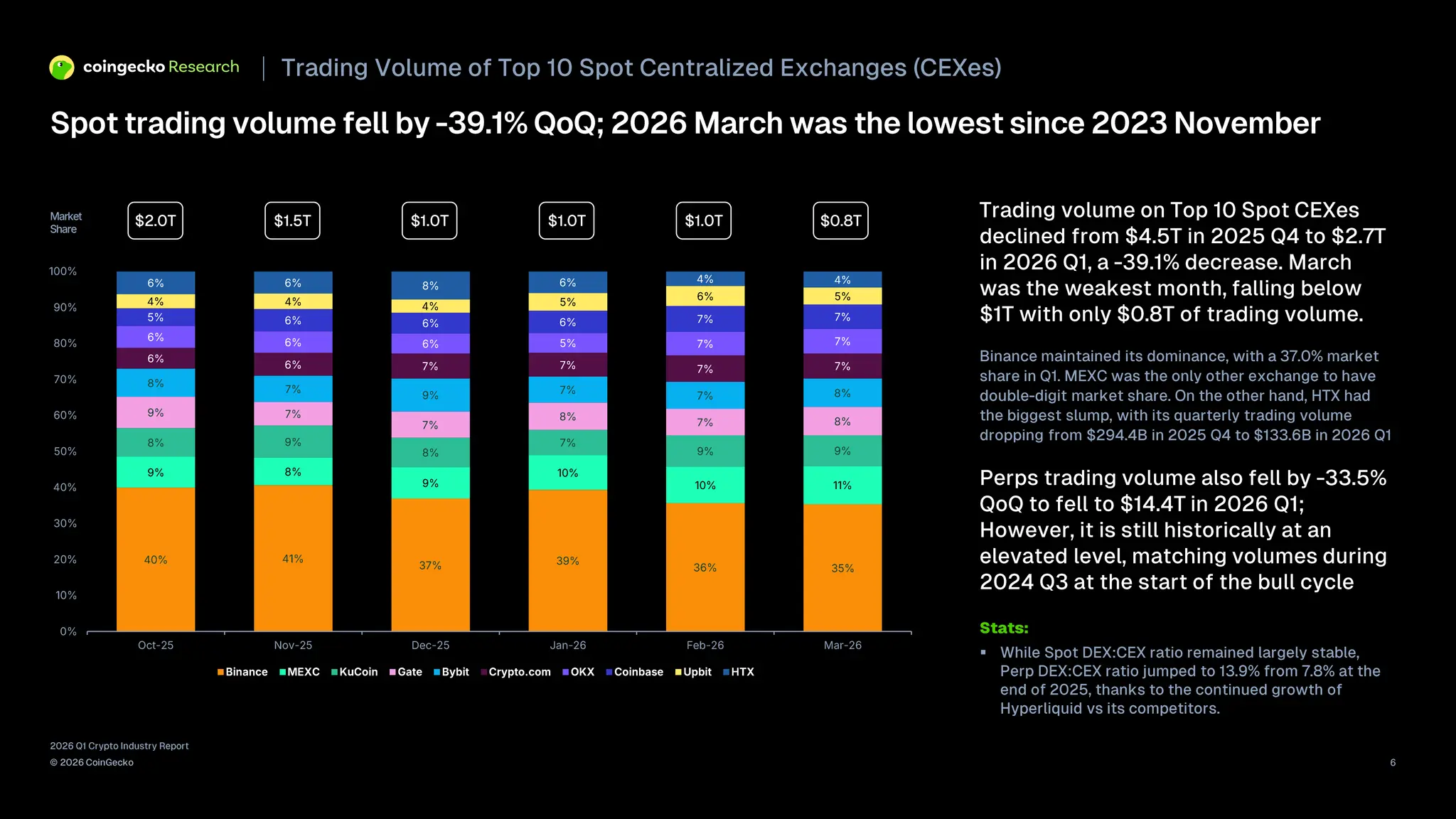
- The first quarter of 2026 was a slow one for centralized crypto exchanges. Spot trading volume across the top ten platforms fell 39%, dropping from $4.5 trillion in Q4 2025 to $2.7 trillion by the end of March — the weakest stretch since November 2023.
- The reasons are connected: Bitcoin lost momentum after its peak, market sentiment turned cautious, macroeconomic conditions tightened, and some trading activity drifted toward alternative platforms.
- The volume drop reflects real changes in how the market is behaving — thinner liquidity, quieter retail participation, and a trading environment that increasingly rewards patience over speed.
For most of crypto’s history, centralized exchanges (CEXs) have been where the action is…handling the bulk of global spot and derivatives trading, and for long have been the default starting point for both retail and institutional participants. Therefore, when the market is moving, CEX volumes are usually the first thing to show it.
In Q1 2026, they showed something else entirely.
Spot trading volume across the top ten centralized exchanges fell 39% in the first quarter of the year, according to data from CoinGecko, dropping from $4.5 trillion in Q4 2025 to $2.7 trillion by March. At the same time, total crypto market capitalization shrunk by more than 20%. Together, the figures describe a market that entered 2026 with considerably less energy than it left 2025 with.
The question worth asking is whether this is a pause in momentum driven by external factors or something more permanent.
The Data: What Actually Happened Quarter by Quarter
The slowdown did not arrive suddenly. January and February held relatively steady, each posting around $1 trillion in trading volume. It was March that broke the pattern, seeing volume fall sharply to roughly $800 billion, making it not just the weakest month of the quarter but the weakest single month since November 2023.
A 39% quarterly drop is significant on its own. But when the lowest point lands at a level not seen in over a year, it suggests the decline was not merely a routine correction off an unusually strong Q4. Something in the market’s underlying behaviour has shifted.
What Drove the Drop?
No single factor explains a move of this size. It can be claimed with a fair amount of certainty that the Q1 slowdown was the product of several things happening at roughly the same time.

Momentum ran out after Bitcoin’s peak
After Bitcoin climbed above $126,000, it entered a period of consolidation. The dramatic price swings that had driven traders to their screens began to flatten out. CEX volumes are closely tied to volatility and as such when prices are moving sharply, traders pile in. When they are not, many of them step back and wait. With the momentum gone and the market rangebound, the opportunities that fuel high-frequency activity simply were not there.
Decrease in speculation and declining market sentiment
CoinGecko characterized the quarter as a drift toward a sustained crypto winter, and the mood among traders reflected that. Geopolitical tension, specifically US military involvement in campaigns against Iran, added to the unease and pushed speculative traders further toward the exit. With declining hopes for a profit in the short-term, activities in the market slowed.
Macroeconomic pressure and tightening of financial conditions
Donald Trump’s nomination of Kevin Warsh for Federal Reserve chair hints at an impending tightening of monetary policy. In practice, that means less liquidity flowing through financial markets and less appetite for risk. Cryptocurrencies tend to feel that kind of macro pressure quickly, and Q1 2026 was no exception. With capital becoming scarcer, the pool of funds actively moving through centralized exchanges shrank.
Some activity moved elsewhere
Not all of the missing volume disappeared, some of it likely migrated. Decentralized exchanges and other non-traditional trading venues have been steadily building capacity, and there is evidence that some traders followed. CEX volumes falling does not necessarily mean total crypto trading activity fell by the same amount.
READ ALSO: Can AI Agents Become Liquidity Drivers for Stablecoins?
Market Implications: What the Volume Drop Signals
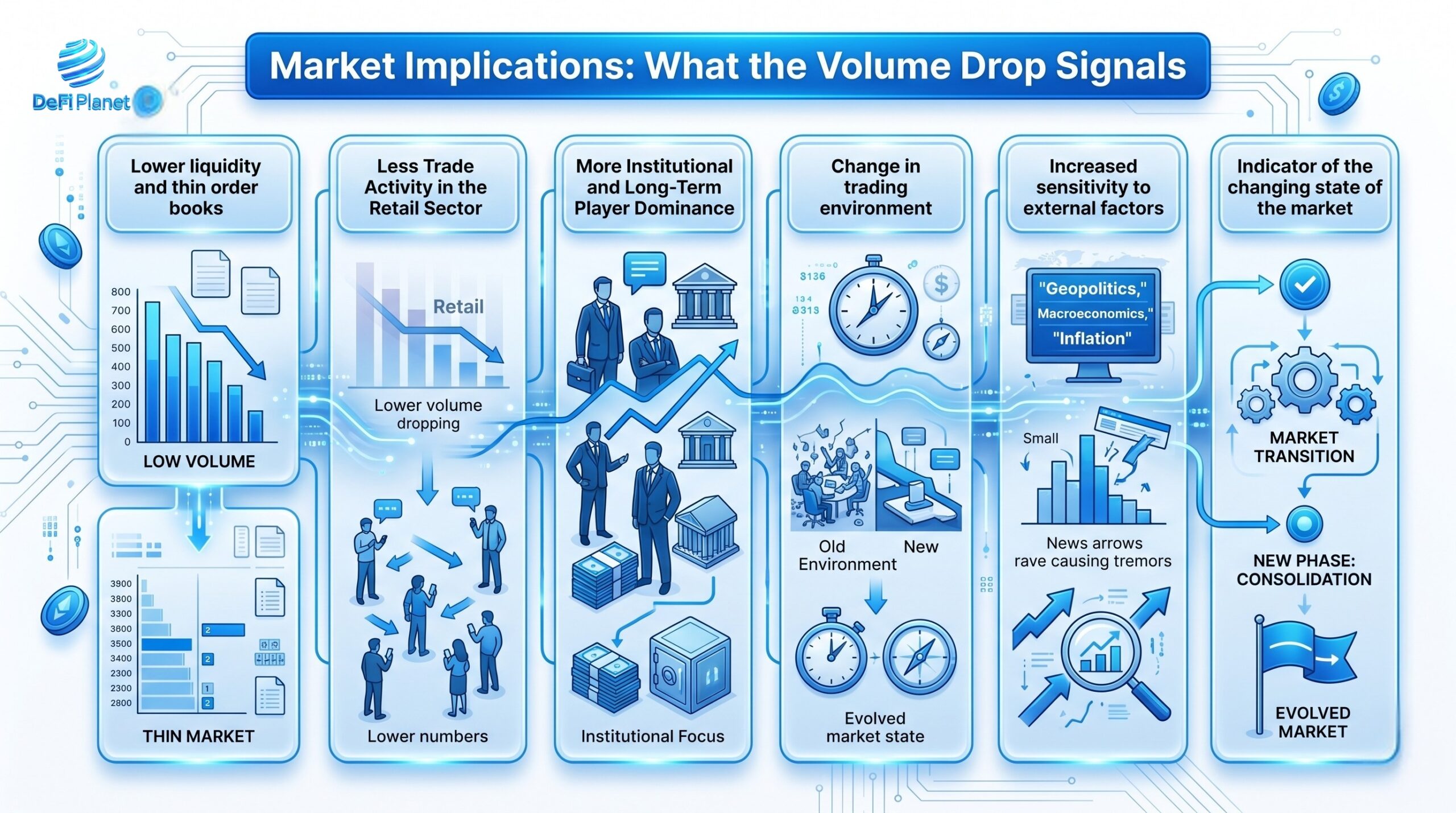
The sharp decline in CEX trading volumes is not just a short-term data point, it reveals deeper shifts in market behavior, liquidity conditions, and where activity is moving.
Low liquidity and thin order books
As trading volumes decrease, so does the liquidity on centralized exchanges. The lack of liquidity results in thinner order books, increased bid-ask spreads, and higher slippages, particularly when placing large orders. From a technical perspective, executing large orders without affecting the market is increasingly challenging.
Less trade activity in the retail sector
Retail participation tends to be the most cyclical part of any market. Retail traders are drawn in by momentum and pushed out when it fades. The Q1 data suggests a meaningful pullback in retail activity which is exactly what you would expect in a quarter where Bitcoin stopped making headlines for breaking records and started making them for consolidating.
More institutional and long-term player dominance
If speculations become less common, then institutional players and long-term investors have a greater influence on the market. Since institutions are less frequent but larger traders, they move slowly and methodically without causing any significant changes in prices.
Change in trading environment
A loss in CEX volumes does not imply a decline in total market activity. This could mean that some of the trading activities might be shifting to other sources such as decentralized exchanges, over-the-counter trading desks, and internalization.
Increased sensitivity to external factors
With reduced volumes, the market could be more susceptible to the influences caused by external variables. The lower levels of liquidity will make the markets more prone to shocks due to news or any other information coming from outside the trading floor.
Indicator of the changing state of the market
In general, the volume reduction indicates a market that is already exiting the phase of expansion. Instead, this marks the phase of change and the transition of the market into another cycle.
A Liquidity Reset, Not a Collapse
The fact that CEX volumes are dropping indicates a rebalance rather than an outright downturn in the market. Capital allocation is becoming increasingly strategic while trading practices are moving away from momentum-driven behavior. Such trends usually indicate that investors are moving away from trying to make quick gains towards more cautious trading approaches.
Moving forward, the key question will be whether or not liquidity comes back in the same way that it left or whether or not there will be structural changes. If liquidity starts to consolidate again through exchanges, it would be evidence of a cycle. On the other hand, a continued dispersion across different liquidity pools would indicate that structural changes were happening.
Disclaimer: This article is intended solely for informational purposes and should not be considered trading or investment advice. Nothing herein should be construed as financial, legal, or tax advice. Trading or investing in cryptocurrencies carries a considerable risk of financial loss. Always conduct due diligence.
Enjoyed this? Bookmark DeFi Planet, explore related topics, and follow us on Twitter, LinkedIn, Facebook, Instagram, Threads, and CoinMarketCap Community for seamless access to high-quality industry insights.
Take control of your crypto portfolio with DEFI PLANET PRO, DeFi Planet’s suite of analytics tools.