









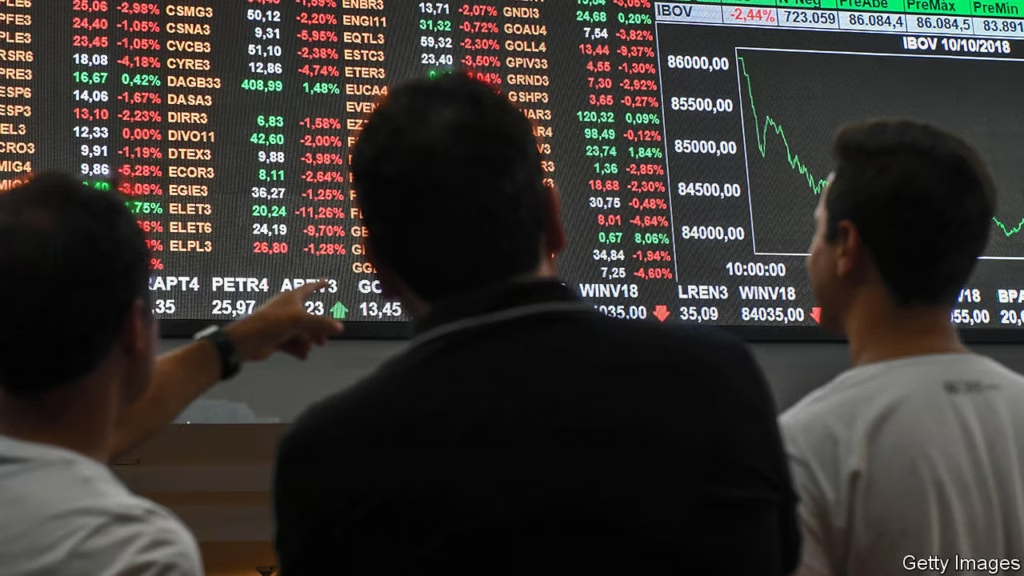
The Brazilian stock market fell sharply as investors rushed to sell their assets. The sell-off highlighted the risks of a crowded trade. When everyone tries to sell at once, there are not enough buyers to support prices. As the market fell, traders online debated what triggered the decline.

Brezilya piyasalarındaki satış dalgası, gelişmekte olan piyasa yatırımcılarına çarpıcı bir uyarı gönderdi: kalabalık pozisyonlar, ürkütücü bir hızla dağılabilir https://t.co/2HLa1O03ED…
— Koçibey (@ibrahim_koc_1) November 1, 2026
On X, @Greg highlighted the risks of crowded trades, noting that when too many investors hold the same position, a sudden rush to sell can leave too few buyers to absorb the assets. He also questioned how many investors had realized just how heavily positioned the market was in Brazil.
@business A selloff moving that fast in Brazil is a good reminder. When everyone’s in the same trade, nobody’s left to buy when it turns.
Honestly how many people even knew they were that crowded into Brazil?
— Greg Tomaselli (@GregTomaselli) November 2, 2026
Meanwhile, another commenter on X, @Mata, pointed to Brazil’s past market performance under President Lula, arguing that financial markets had recorded strong gains during his previous administrations. Mata also suggested that the panic surrounding the sell-off had begun to fade.
@business THE GOVERNMENTS IN WHICH THE FINANCIAL MARKET MADE THE MOST PROFIT WERE DURING THE LULA ADMINISTRATIONS. THE MARKET HYSTERIA FEVER HAS ALREADY SUBSIDED.
— MATA HARI (@MATAHARI00707) November 1, 2026
READ ALSO: Brazilian Olympic Committee Partners With Cardano to Bring Blockchain and AI to Sports
What happens when everyone buys the same coin?
The Brazilian market crash illustrates exactly how a digital coin can collapse. In the financial world, a crowded trade means millions of people buy the same asset to make quick money.
When a massive crowd tries to buy the same digital coin at once, the market breaks down in three specific steps. First, the price shoots up artificially. Because millions of people want to buy and very few want to sell, buyers are forced to offer higher prices to get the token. This causes the value to skyrocket within minutes, driven entirely by the sudden rush rather than by the coin having any real-world use.
As more people rush to buy, the network quickly becomes overloaded. Every crypto trade requires the blockchain system to process the data. Because the line of buyers is too long, users must pay extra transaction fees to push their order to the front. The system gets jammed, so the network fee often becomes more expensive than the digital coin they are trying to buy.
Finally, this crowded trade always ends in an instant crash. The people who bought the coin early eventually sell it to take their cash profits. The moment they sell, the price stops rising, triggering immediate panic. Everyone who bought late realizes the rush is over and tries to sell at the exact same minute to save their money. With everyone rushing for the exit and no new buyers left, the price instantly collapses to zero.
This happened with Terra Luna digital Coin in May 2022. The Luna token dropped from 80 dollars down to zero in less than a week. The crash wiped out 40 billion dollars. When a crypto project becomes too crowded, the exit door is always too small for everyone to leave safely.
Investors are losing crypto by betting against politicians
The Brazil selloff also reveals how political hate destroys investors’ money.
According to a local user on X, @ Poly, some investors sold their Brazilian stocks because of their opposition to the country’s president, rather than concerns about business performance. They argued that the sell-off was driven more by political views than by financial facts.
@business This sell-off was nothing more than the defeat of some people who bet against Brazil. But they forgot to check the reality, and Brazil won. It was not a market movement grounded in facts, but was driven only by the political and ideological views of losers.
— 🚩🇧🇷Svarog Polyowyk🇧🇷🚩 (@polyowyk) November 1, 2026
Poly also argued that the sell-off was driven largely by political and ideological opposition to Brazil rather than the country’s actual economic performance. He suggested that investors who bet against the market had overlooked the financial realities of Brazilian businesses and were caught off guard when those expectations failed to materialise.
Meanwhile, Brazilian Finance Minister Dario Durigan announced that the government will offer specialized business loans to help companies manage the financial strain of two massive economic overhauls.
Enjoyed this? Bookmark DeFi Planet, explore related topics, and follow us on Twitter, LinkedIn, Facebook, Instagram, Threads, and CoinMarketCap Community for seamless access to high-quality industry insights.
Take control of your crypto portfolio with DEFI PLANET PRO, DeFi Planet’s suite of analytics tools.