












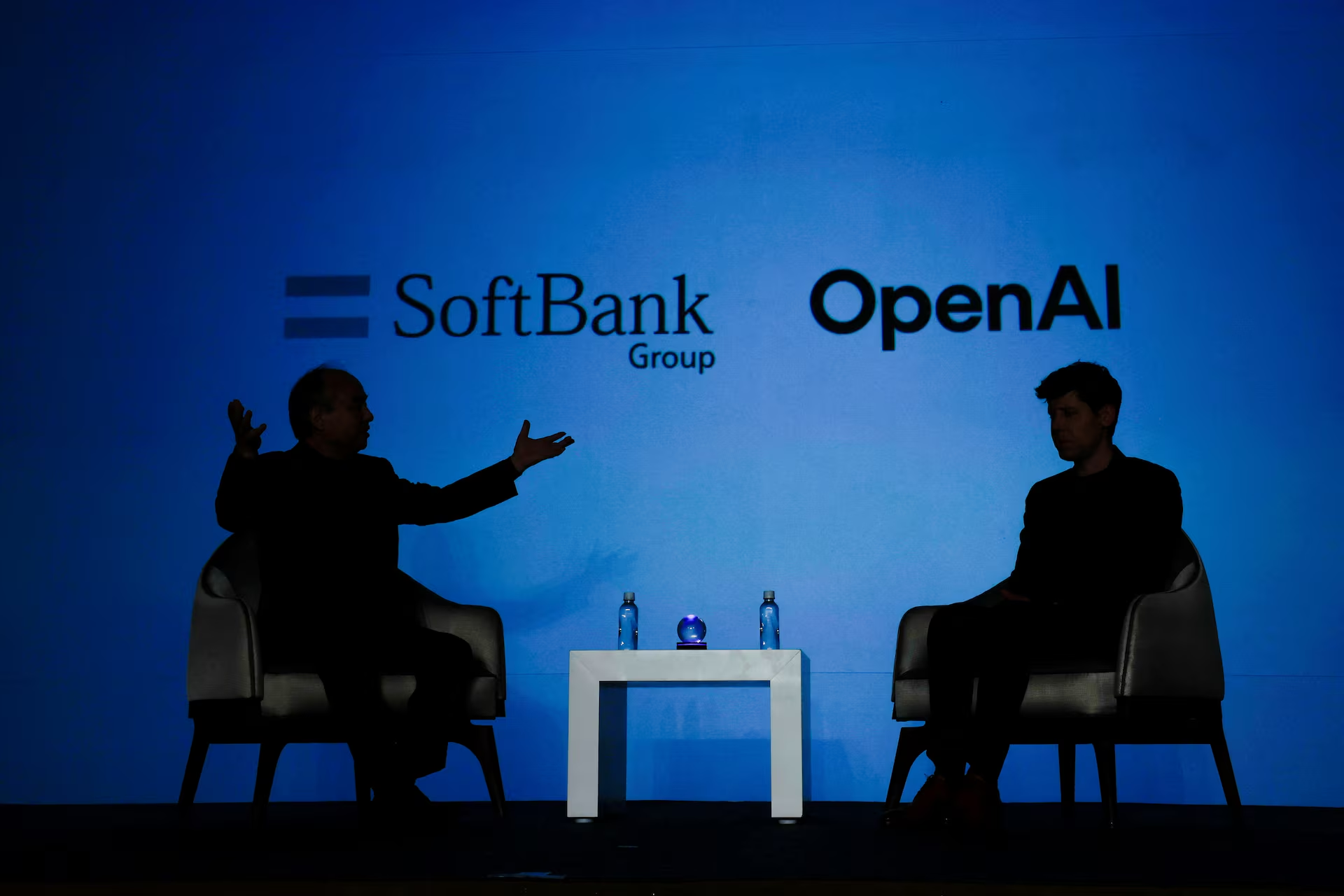
As earlier reported by DeFi Planet, SoftBank Group has completed a second $10 billion investment in OpenAI, moving closer to fulfilling its planned $30 billion follow-on commitment as competition for artificial intelligence leadership continues to reshape the technology industry.

To fund that investment, SoftBank has launched a $10 billion dollar-denominated and €1 billion euro-denominated bond sale. If completed at the planned size, the offering would become the largest non-financial corporate bond deal ever recorded in Asia Pacific and Japan, beating 7-Eleven’s $10.93 billion sale in January 2021. The bonds will fund a $10 billion payment for SoftBank’s third investment tranche in OpenAI, expected to close on October 1. The proposed notes have a BB+ rating from Fitch.
AI’s trillion-dollar buildout is increasingly being financed with debt
The AI boom is no longer being funded only from the cash generated by technology companies. Debt markets are becoming an increasingly important source of capital as companies race to build data centres, buy chips and secure long-term computing capacity.
Goldman Sachs estimates that the largest AI providers could spend about $755 billion on capital expenditure in 2026, rising to $920 billion in 2027. The bank has also warned that investors are becoming more selective about AI companies whose spending is putting pressure on earnings or being funded through debt.
AI-related borrowing has expanded beyond traditional corporate bonds into project financing and special-purpose vehicles used to fund data centres. The Financial Times also reported this month that major technology companies are using guarantees to support as much as $300 billion of AI-related debt exposure, while keeping much of the borrowing away from their main balance sheets.
Investors are therefore being asked to finance an infrastructure buildout whose returns may take years to materialize. Goldman Sachs Research’s Jim Covello has questioned whether enterprise AI spending is generating enough economic returns to justify the investment, while the bank has noted that most of the financial gains so far have accrued to semiconductor companies rather than the wider AI economy.
The bond market is already showing signs of that caution. Longer-dated AI-related debt has faced weaker investor demand as questions grow over the profitability and useful life of AI infrastructure. That makes the financing of AI almost as important as the technology itself. If AI revenues grow fast enough, today’s borrowing can help companies build the infrastructure needed for the next phase of adoption. If spending continues to rise faster than cash flows, however, investors will have to carry more of the risk through debt markets.
Is AI investment becoming concentrated around a few companies?
The AI surge is increasingly being driven by a small group of companies that invest in one another, supply one another and depend on the same infrastructure. A recent analysis by Sona Asset Management mapped 176 deals worth $3.6 trillion involving 202 companies over the past three and a half years. It found significant financial links between major players including OpenAI, Nvidia, Microsoft and Amazon.
OpenAI sits near the centre of that network. Its March funding round brought in $122 billion at an $852 billion valuation, with Nvidia, Amazon and SoftBank among its strategic backers. OpenAI also has major infrastructure relationships with Microsoft, Oracle, AWS, Google Cloud and others.
This means the same companies can appear as investors, customers, suppliers and infrastructure partners at the same time. Microsoft, for example, reported $24.1 billion in revenue from commercial arrangements with OpenAI in fiscal 2026 while also holding an approximately 25% stake on an as-converted basis.
The result is that an investment in one major AI company can have effects far beyond that company’s valuation. A change in its funding, spending or ability to attract customers can affect chipmakers, cloud providers, data-centre operators and other investors connected to it.
Enjoyed this? Bookmark DeFi Planet, explore related topics, and follow us on Twitter, LinkedIn, Facebook, Instagram, Threads, and CoinMarketCap Community for seamless access to high-quality industry insights
Take control of your crypto portfolio with DEFI PLANET PRO, DeFi Planet’s suite of analytics tools.






