





























































Every blockchain has to solve one basic problem. See it this way: Thousands of computers around the world are keeping a copy of the same ledger, and none of them reports to a boss who can settle disputes. So how do they all agree on which transactions are real and in what order they happened?

That’s the job of a consensus mechanism. Proof-of-Work and Proof-of-Stake are the two most common answers to that question, and understanding the difference between them is the fastest way to understand how crypto actually works under the hood.
Proof-of-Work is the original method, and it still secures Bitcoin today. Proof-of-Stake is newer, and it now runs Ethereum, Cardano, Solana, and most of the large blockchains launched in the last few years. Below is a walkthrough of how each one works, how they stack up against each other, what happened when Ethereum switched from one to the other, and a few other consensus methods worth knowing about.
Why Does a Blockchain Need Any of This At All?
Picture a shared notebook that thousands of strangers are all allowed to write in, with no teacher standing over their shoulders to check the work. Without some agreed-upon rule for who gets to add the next entry, and how everyone else confirms it’s correct, the notebook would quickly fill up with conflicting, untrustworthy entries.
A consensus mechanism is that rule. It decides who gets to add the next “page” (called a block) to the ledger, and it gives everyone else an easy way to check that the new page follows the rules. Without it, a network risks splitting into two competing versions of the truth, something called a hard fork.
What is Proof-of-Work?
Proof-of-Work is older than crypto itself. Researchers Cynthia Dwork and Moni Naor first wrote about the idea back in 1993, as a way to fight email spam. The idea was simple. Make the sender’s computer do a small chunk of busywork before an email can be sent. One email is no problem, but a million spam emails suddenly become too slow and expensive to bother with. Computer scientist Adam Back later built this into a real tool called Hashcash, and the “Proof-of-Work” name itself came a bit later, coined by researchers Markus Jakobsson and Ari Juels in 1999.
Bitcoin’s creator, Satoshi Nakamoto, borrowed this same idea in 2009 and turned it into the engine that runs Bitcoin. That launch is generally treated as the first real-world use of Proof-of-Work as a way to secure a blockchain, rather than just fight spam.
How Proof-of-Work Works
Think of Proof-of-Work as a race with an entry fee paid in electricity. New Bitcoin transactions sit in a waiting room (called the mempool) until a miner bundles a batch of them into a candidate block. To have that block accepted onto the blockchain, the miner’s computer has to guess at a math puzzle over and over until it stumbles onto an answer that fits the network’s rules. There’s no clever shortcut, just raw guessing power. Whoever solves it first gets to add the block and gets rewarded with newly created Bitcoin plus the fees from the transactions inside it.
Bitcoin automatically adjusts how hard that puzzle is roughly every two weeks, so a new block keeps showing up about every ten minutes no matter how much total computing power is pointed at the network. Once a block has enough blocks stacked on top of it, going back and changing it becomes nearly impossible, because someone would have to redo all that computational work all over again, faster than everyone else combined.
That last part is also what makes Proof-of-Work secure. To cheat the system (say, by spending the same coin twice), an attacker would need to control more than half of all the computing power on the network, which for a chain the size of Bitcoin means billions of dollars in hardware and electricity. That price tag is what keeps large PoW networks safe from this kind of attack, even though smaller PoW coins with less total computing power remain more vulnerable.
Proof-of-Work, the Good and the Bad
What it gets right
- Attacking a large network like Bitcoin costs more than any realistic payoff, which keeps it safe.
- Miners get paid directly for the computing power they put in, through new coins and transaction fees.
- Anyone with the right equipment can start or stop mining whenever they want, with nobody’s permission required.
Where it struggles
- Competing as a miner takes specialized, expensive hardware, which tends to push mining toward large, well-funded operations rather than individuals.
- All that computing produces a real electricity bill. The Cambridge Centre for Alternative Finance has estimated Bitcoin’s yearly electricity use in the tens of terawatt-hours, roughly on par with what a mid-sized country uses in a year, and that number is the main target of environmental criticism aimed at PoW.
- As a capped-supply coin like Bitcoin gets closer to its maximum supply, the reward for mining a block keeps shrinking, so miners have to lean more on transaction fees to stay profitable over time.
What Is Proof-of-Stake?
Proof-of-Stake swaps out the computing race for a financial one. Instead of miners burning electricity to win the right to add a block, validators put up a chunk of the network’s own coin as a deposit, called a stake. The network then picks a validator to propose the next block, usually giving bigger stakes better odds, though most networks also mix in some randomness so the biggest holders don’t win every single time. Get picked and do the job honestly, and a validator earns new coins and transaction fees. Get caught cheating or going offline too often, and many networks will slash away part of that staked deposit as a penalty.
Because nobody is racing to solve a puzzle, Proof-of-Stake sidesteps the huge energy bill that comes with mining. It also opens the door to more people, since running a validator mostly requires meeting a coin deposit requirement and keeping a computer online, not buying warehouses full of specialized mining rigs.
How Proof-of-Stake Actually Works
The exact rules differ from network to network, but the basic ideology is the same. Someone can run their own validator, which usually means locking up a meaningful amount of the coin and keeping the software online around the clock, or they can delegate their coins to someone else’s validator and share in the rewards without doing the technical work themselves. That second option, often through a staking pool, is how smaller coin holders get to participate without meeting a network’s full deposit requirement on their own.
Some networks add extra layers of protection. For example, a random group of validators might be assigned to check a block without knowing who else is in that group until after the check is done, which makes it harder for validators to team up and cheat. Breaking the rules, whether through going offline too much or trying to approve two conflicting versions of the same block, usually costs a validator part of their staked coins, which gives everyone a real reason to play fair.
One catch is that staked coins are often locked up for a set period and can’t be spent or traded during that time. That means a staker could watch a coin’s price fall and be unable to sell until the lock-up ends. This problem is exactly why liquid staking exists. Certain platforms hand out a separate token that represents a locked stake, so it can still be traded even while the original coins remain locked.
Proof-of-Stake, the Good and the Bad
What it gets right
- It uses a tiny fraction of the energy that Proof-of-Work does, since there’s no computing race to win.
- Running a validator doesn’t require specialized mining hardware, just meeting a coin deposit and staying online, which lowers the barrier to entry.
- Well-built PoS networks tend to scale more smoothly, since adding a block doesn’t depend on out-computing every rival on the network.
Where it struggles
- Wealth can concentrate power. A validator or a small group holding a large share of a coin’s supply can end up with outsized influence over both which blocks get approved and how the network’s governance votes go.
- Some researchers argue Proof-of-Stake networks can be cheaper to attack than Proof-of-Work networks, since an attack costs staked coins rather than physical hardware and electricity, though this is still debated and depends heavily on how a particular network is designed.
- Locked-up stakes mean tied-up money, and stakers still carry the risk of the coin’s price dropping while they wait to unstake.
- Proof-of-Stake has to specifically guard against something called the nothing-at-stake problem, where a validator has less to lose from supporting more than one version of the blockchain at once, since there’s no equivalent to a miner’s sunk cost in hardware and electricity. Most modern PoS networks handle this with slashing penalties built directly into the protocol.
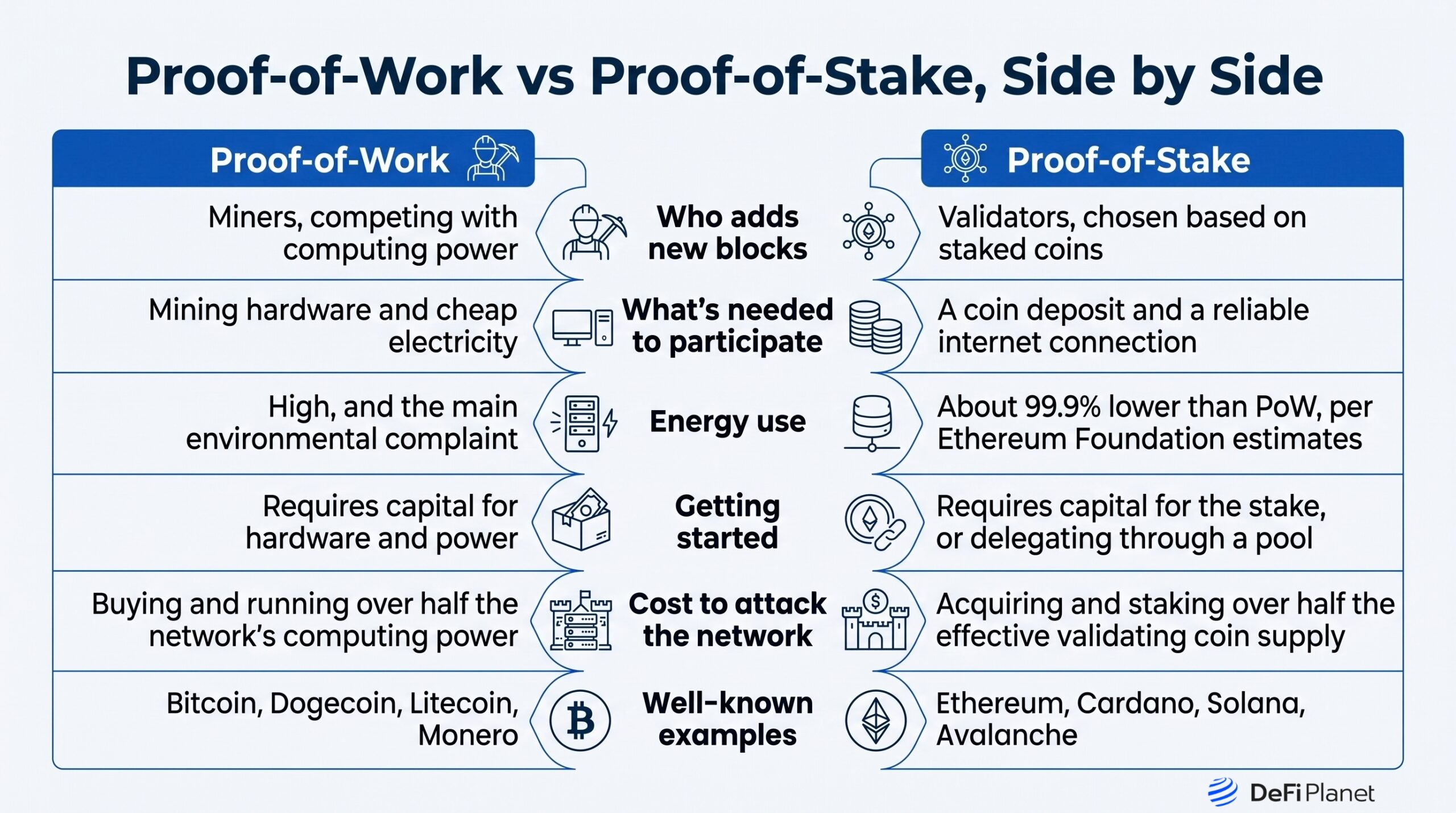
Proof-of-Work vs Proof-of-Stake, Side by Side
Why Did Ethereum Switch from Proof-of-Work to Proof-of-Stake?
Ethereum launched in 2015 running on Proof-of-Work, the same basic system as Bitcoin. In 2020, the Ethereum Foundation started laying the groundwork for a switch by launching something called the Beacon Chain, a separate Proof-of-Stake network that ran alongside the original Ethereum blockchain so validators and software could be tested safely before anything important depended on them.
The actual switch, known as the Merge, happened on September 15, 2022. On that day, Ethereum’s original chain merged with the Beacon Chain, and mining on Ethereum stopped for good. According to the Ethereum Foundation, this cut the network’s energy use by about 99.95%, and it also reduced how many new ETH coins get created by roughly 90%, since the network no longer needed to pay miners enough to cover expensive hardware and electricity. Staked ETH itself stayed locked up for several more months after the Merge, until an upgrade called Shapella arrived in April 2023 and finally let stakers withdraw their coins.
Ethereum co-founder Vitalik Buterin has described the move to Proof-of-Stake as a direct response to the environmental criticism aimed at Bitcoin, since it secures the network to a similar standard using a small fraction of the physical resources. Worth noting, the Merge on its own didn’t lower Ethereum’s transaction fees or speed up the network. Those improvements depend on separate upgrades, including expanded support for layer-2 networks, which the Merge made possible but didn’t deliver by itself.
A Few Other Consensus Mechanisms Worth Knowing
Proof-of-Work and Proof-of-Stake get most of the attention, but they aren’t the only options out there.
Delegated Proof-of-Stake hands more direct power to everyday coin holders, who vote for a smaller group of delegates to handle validation on their behalf. It tends to be faster than standard Proof-of-Stake, but with a smaller group of validators, there’s more risk of that group coordinating in ways that don’t serve everyone else.
Proof of Authority relies on a known, vetted set of validators rather than an open field. VeChain works this way. Before anyone can become a validator, the VeChain Foundation checks them out first. This trades away some decentralization in exchange for more accountability, since each validator’s real identity is tied to how they behave on the network.
Proof of Burn asks participants to permanently destroy some coins, usually by sending them to an address nobody can ever access again, in exchange for the right to validate. Slimcoin uses this approach. The logic is similar to Proof-of-Work in spirit. Burning coins is a real, verifiable cost, which discourages bad behaviour, just without an ongoing electricity bill.
Proof of Capacity hands out validating power based on how much spare hard drive space someone commits to the network. Burstcoin is a well-known example of a coin that used this method.
Then there’s Nano, which skips staking and mining entirely. Its Open Representative Voting system lets users pick representative nodes, which vote on individual transactions. Any node can independently confirm a transaction once enough of those votes come in, something Nano’s own documentation credits with settling transactions in under a second. Because only an account’s owner can ever sign new entries into that account’s own chain, most conflicts can only happen if that owner is acting maliciously or hits a software bug, which keeps Nano’s rulebook fairly simple.
Where Things Stand In the Market Today
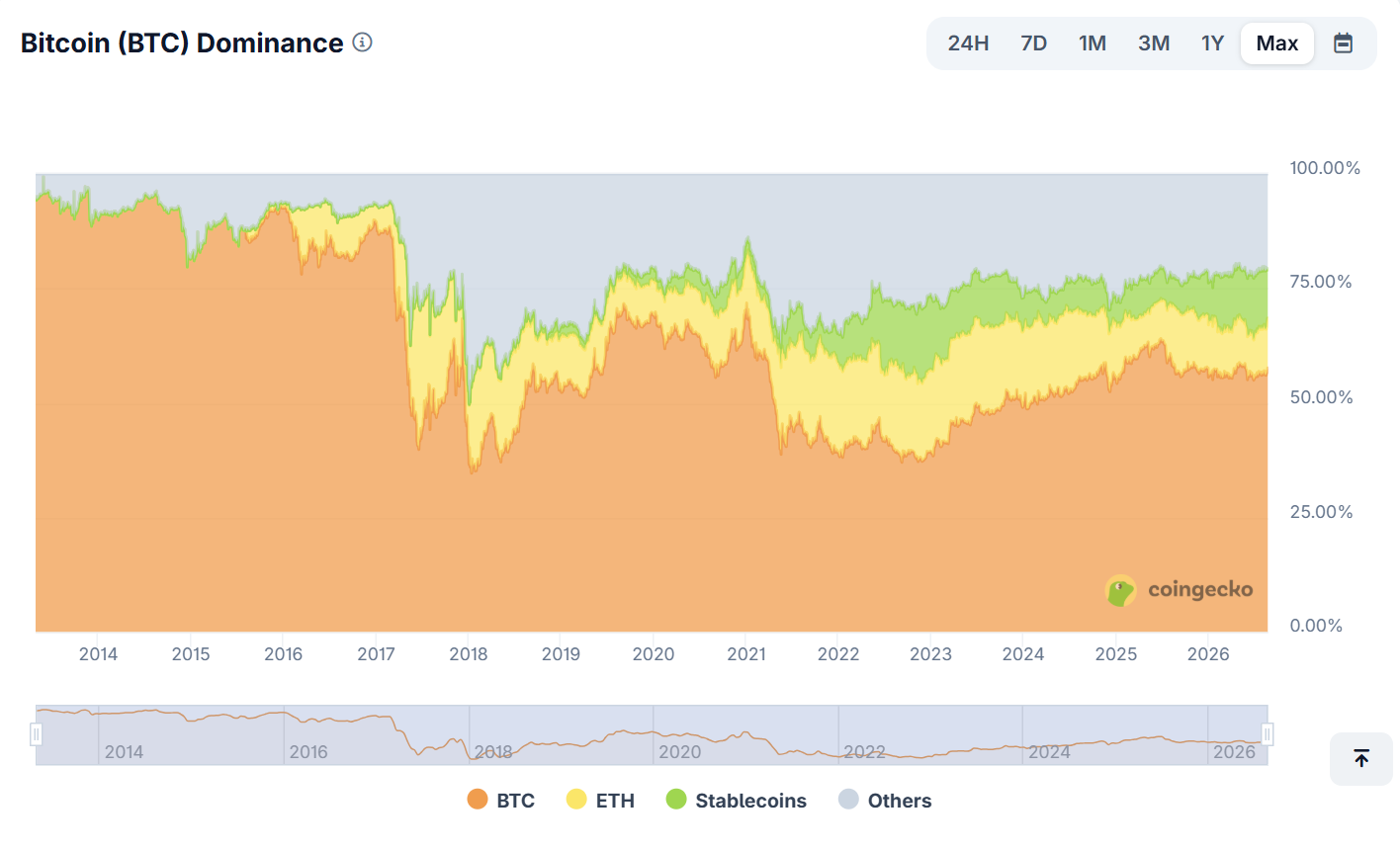
Proof-of-Work hasn’t disappeared, even though most new blockchains now launch on Proof-of-Stake. Bitcoin is still the dominant Proof-of-Work network by a wide margin, and it continues to make up more than half of the entire crypto market’s value, according to CoinGecko.
Dogecoin, which is mined alongside Litecoin using something called the Scrypt algorithm, is the only other top-ten coin by market cap still secured through mining rather than staking, based on market cap data from CoinGecko and mining firm OneMiners. Litecoin, Bitcoin Cash, Ethereum Classic, and Monero round out the more established mineable coins, per CoinGecko’s Proof-of-Work tracking.
On the staking side, CoinGecko’s Proof-of-Stake tracker puts that whole category above $500 billion in combined market value, with Ethereum, Solana, and Cardano holding some of the largest amounts of staked value. Ethereum’s share of that has grown alongside rising institutional staking activity and inflows into spot ETFs. Cardano and Solana also remain among the largest staked networks. Cardano’s staking returns typically run in the low single digits, while networks like Solana and Tezos tend to offer validators higher returns, according to staking data compiled by Koinly.
So, Which One Is Better?
Neither one wins outright, and getting an answer depends on what a network is trying to optimize for. Proof-of-Work has more than a decade of proven security behind Bitcoin specifically, but that comes at the cost of heavy energy use and a mining industry that rewards scale over individual participation.
Proof-of-Stake solves the energy problem and makes it easier for more people to participate, but it introduces its own risks around large coin holders gaining outsized influence, and it requires careful design to avoid problems like nothing-at-stake. Most new blockchains launched since 2020 have picked Proof-of-Stake, mainly for its lower energy footprint and easier scaling, while Bitcoin’s community has shown little interest in switching away from Proof-of-Work, partly because the security track record of a fourteen-year-old network is hard to replicate from scratch.
FAQs
Did Bitcoin ever consider switching to Proof-of-Stake?
No, not through any official development process. There’s no active proposal within Bitcoin’s core development community to change its consensus mechanism, and no roadmap for doing so. The idea does get discussed by outside commentators from time to time, but it isn’t something Bitcoin’s developers are working toward.
Can someone mine a Proof-of-Stake coin the same way Bitcoin gets mined?
No. Mining specifically means solving a Proof-of-Work puzzle using computing hardware. Proof-of-Stake coins are secured through staking instead, where a validator locks up coins as a deposit rather than doing any computational work, so there’s no mining process involved at all.
What happens if a validator on a Proof-of-Stake network breaks the rules?
Most Proof-of-Stake networks use something called slashing, an automatic penalty that takes away part or all of a validator’s staked coins when they’re caught doing something like approving two conflicting blocks at once. Going offline too often usually carries a smaller penalty than deliberately cheating.
Is staked Ethereum locked up forever?
No. Staked ETH had no way to be withdrawn between the Merge in September 2022 and an upgrade called Shapella in April 2023, which turned withdrawals on. Since then, stakers have been able to withdraw both their original stake and any rewards they’ve earned, though they may have to wait in a queue depending on how many other validators are exiting at the same time.
Why do some blockchains use Delegated Proof-of-Stake instead of regular Proof-of-Stake?
Delegated Proof-of-Stake gives everyday coin holders a more direct vote in choosing who validates transactions, and it usually produces new blocks faster because a smaller, elected group is doing the validating. The downside is that a smaller group means more trust is concentrated in fewer hands than a standard Proof-of-Stake setup would allow.
Disclaimer: This article is intended solely for informational purposes and should not be considered trading or investment advice. Nothing herein should be construed as financial, legal, or tax advice. Trading or investing in cryptocurrencies carries a considerable risk of financial loss. Always conduct due diligence.
Enjoyed this? Bookmark DeFi Planet, explore related topics, and follow us on Twitter, LinkedIn, Facebook, Instagram, Threads, and CoinMarketCap Community for seamless access to high-quality industry insights.
Take control of your crypto portfolio with DEFI PLANET PRO, DeFi Planet’s suite of analytics tools.