

























































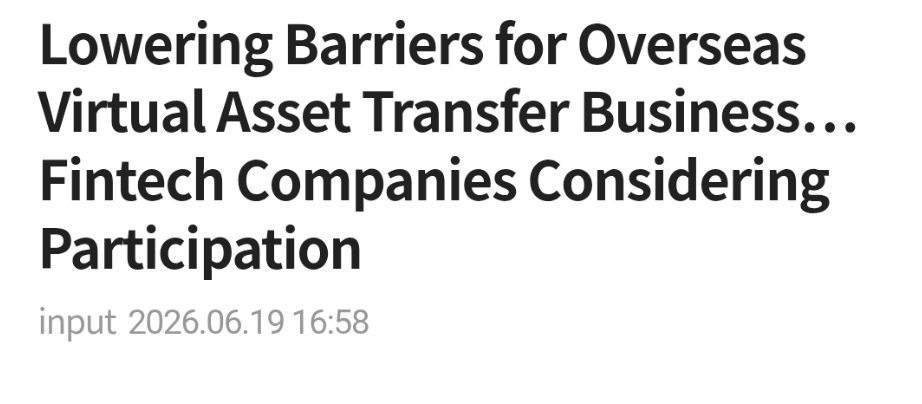
South Korea is considering expanding access to its upcoming crypto transfer licensing regime, a move that could allow fintech companies to compete alongside cryptocurrency exchanges in the growing cross-border digital asset payments market.

According to local reports, government agencies have begun drafting detailed enforcement rules for amendments to the Foreign Exchange Transactions Act, which will bring cross-border virtual asset transfers under formal regulatory oversight from December.
The revised law was officially promulgated on June 2, following cabinet approval, and includes a six-month transition period before taking effect.
New rules bring crypto transfers under foreign exchange oversight
Under the new framework, companies offering cross-border transfers involving digital assets will be required to register with the Ministry of Economy and Finance and report overseas transactions through the Bank of Korea’s foreign exchange reporting system.
South Korean authorities said the changes are aimed at closing regulatory gaps that previously allowed some cryptocurrency-related cross-border transactions to operate outside existing foreign exchange controls.
The government has also linked the reforms to efforts to strengthen anti-money laundering measures and improve oversight of international digital asset flows.
Businesses seeking licenses will be required to complete Virtual Asset Service Provider (VASP) registration and connect their systems to platforms that share foreign exchange and digital asset transaction data. Additional operational and staffing requirements will be outlined in a future presidential decree.
Fintech firms could gain access to crypto transfer Market
Until now, South Korea’s VASP framework has largely limited participation to cryptocurrency exchanges and approved custodial service providers registered with the Financial Intelligence Unit.
As a result, major domestic exchanges such as Upbit and Bithumb were widely expected to dominate the new licensing regime. However, officials are now reviewing whether fintech companies should also be allowed to obtain licenses for virtual asset transfer services.
A Bank of Korea official reportedly said authorities do not necessarily need to restrict the business to existing VASPs if other firms can safely provide transfer services, showing potential room for broader industry participation.
Meanwhile, South Korean financial regulators stepped back from a proposed rule that would have required cryptocurrency exchanges to automatically report large transfers involving overseas platforms and private wallets. The proposal would have classified any crypto transfer above 10 million won ($7,300) as a suspicious transaction, forcing exchanges to report it.
Industry awaits final licensing details
The Bank of Korea has been meeting with industry participants and guiding registration procedures and technical integration with the foreign exchange reporting network.
The final enforcement decree is expected to determine whether new entrants can access the market, a decision closely watched by fintech firms seeking opportunities in blockchain-based remittances and foreign exchange services.
The initiative forms part of South Korea’s broader effort to establish clearer rules for digital assets. Earlier this month, officials also said that tokenized stocks could be regulated and taxed under existing securities laws. In contrast, updated token securities guidelines are expected from the Financial Services Commission in July.
Enjoyed this? Bookmark DeFi Planet, explore related topics, and follow us on Twitter, LinkedIn, Facebook, Instagram, Threads and CoinMarketCap Community for seamless access to high-quality industry insights
Take control of your crypto portfolio with DEFI PLANET PRO, DeFi Planet’s suite of analytics.