




















































Quick Breakdown

- Canada’s Strong and Free Elections Act would prevent political parties and related groups from taking donations in crypto, money orders, or prepaid cards. This move is part of a wider global focus on how crypto is used in sensitive areas.
- The government cites transparency gaps, risks of foreign influence through anonymous transfers, and the need to protect electoral integrity and public trust as the main drivers behind restricting crypto donations.
- Similar trends are visible in the UK, US, and EU, with rules emphasizing accountability and traceability.
Canada’s federal government is moving to block cryptocurrency donations to political parties. The proposal, part of the Strong and Free Elections Act introduced on March 26, would update election laws to stop parties and affiliated groups from accepting contributions in crypto, as well as through money orders and prepaid cards.
Governments around the world are increasingly paying closer attention to how crypto is used in sensitive areas beyond finance, especially in politics and national security which raises the question of whether this is just a local policy decision, o early shape of a global consensus that crypto and democracy make uneasy bedfellows.
Why Canada is Targeting Crypto Donations
Steven MacKinnon, the bill’s sponsor and government House leader, noted that the measures are intended to block foreign interference and other threats to elections.
Lack of transparency in tracing the donor
Public blockchain-based cryptocurrencies offer some level of transparency due to transaction records being recorded on publicly accessible ledgers, however these transactions are not entirely transparent as wallet addresses may not be directly linked to the donor’s identity, and there could be multiple transactions done across different wallets.
In such cases, it becomes hard to trace who is funding a campaign. In a system where disclosure is critical, this gap creates room for hidden contributions, inaccurate reporting, or even deliberate attempts to bypass donation limits.
Possibility of foreign influence via anonymous transactions
Political contributions tend to be limited to nationals or sources sanctioned within the country; however, cryptocurrencies enable quick international transactions with relative ease. Since wallet owners could remain largely anonymous, there is a higher chance of contributions originating from foreign nationals.
There are several issues with this at a national security level because this means outside factors could influence the result of an election. While most election donations made with crypto would fairly be assumed to be legitimate, the possibility of not knowing for certain is a risk too great for any government to accept.
Electoral security and public faith
On a more general level, this ban has more to do with faith in the process of elections. Democratic elections only hold authority when the public believes the process is clean, that no outside hand has tipped the scales, and no hidden or dirty money has found its way into a campaign.
For context, during the 2022 US midterm elections, FTX, a crypto exchange that would later collapse in one of the most spectacular financial frauds in recent history made substantial donations to both Republican and Democratic campaigns. While the donations were legal and reported at the time, the exchange’s rapid and messy bankruptcy exposed just how opaque those funding sources actually were, raising serious questions about whether the true origins of those monies could ever be fully verified.
These types of cases put a name and a number to what regulators squirm about in the abstract. Another example, according to TRM Labs, all six high-profile election interference cases since 2016 have involved the use of cryptocurrency with Russia alleged to have repeatedly used digital assets to fund disinformation campaigns and interference operations across Western democracies.
Canada has not experienced a documented case of this kind. But that is precisely the point. Governments rarely act after the damage is done so the Strong and Free Elections Act is a pre-emptive move, a decision to close a door before someone walks through it because once they do, no legislation can undo what anonymous money already set in motion.
Global Regulatory Parallels
The United Kingdom has already taken a firmer stance by banning crypto political donations to political parties. UK Secretary of State Steve Reed noted that:
“This Government will do whatever is necessary to protect our democracy. Foreign interference and dirty money are menacing the integrity of our elections. A ban on cryptocurrency donations is vital. The UK will now be a world-leader in stamping out this growing threat to freedom, and we will stop hostile foreign states and others who want to weaken and exploit the UK by stoking division and hatred. It is our patriotic duty to safeguard the British people’s right to freely choose their own government.”
In the United States, crypto donations to political campaigns are permissible in certain states. However, these are heavily regulated. The relevant regulatory bodies, such as the Federal Election Commission, mandate that political campaigns disclose their crypto donations, exchange them into dollars, and verify the donor’s identity.
Although this demonstrates acceptance of cryptocurrency in the country, the strict compliance obligations reveal the issues surrounding transparency and accountability.
In contrast to the United States, the EU is moving towards a stricter regulatory framework for crypto assets within its legislative package, as demonstrated by the Markets in Crypto-Assets (MiCA).
Even though MiCA has nothing to do with political contributions, it imposes strict identity verification requirements and anti-money laundering regulations on all crypto transactions.
Thus, it becomes much harder to remain anonymous and use cryptocurrencies in political cases, revealing the government’s preference for control and transparency over full freedom of use.
The trend is quite apparent: the state is not afraid of cryptocurrencies; on the contrary, it limits their use. Political financing lies precisely at the intersection of these borders, which is why Canada’s legislation is just another step toward stricter regulation worldwide.
Impact on Adoption and Trust
Canada’s proposed crypto donation ban could reshape how the public perceives and uses cryptocurrency, both in politics and beyond.
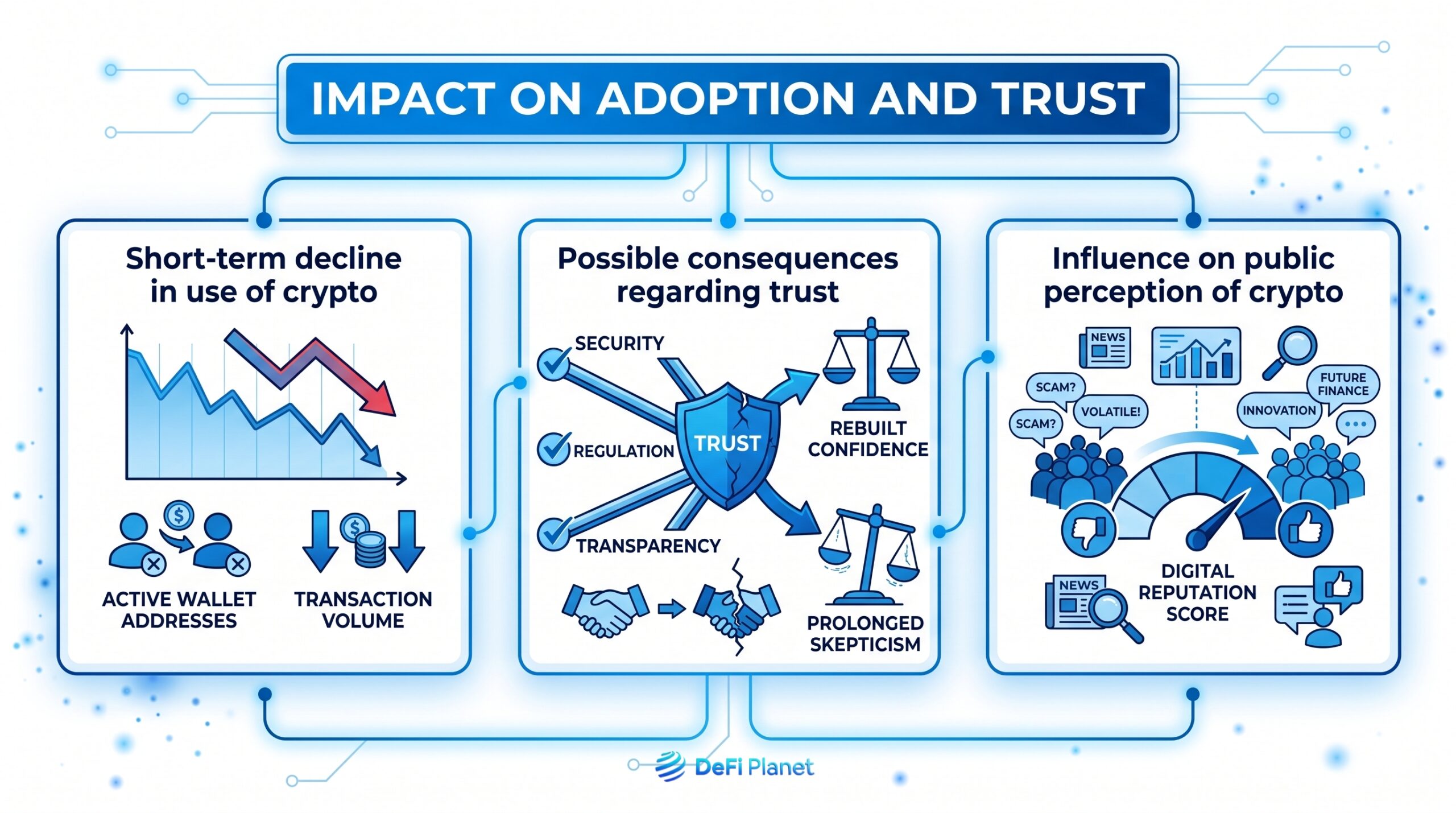
Short-term decline in use of crypto
This policy is expected to limit how digital assets are utilized within public and civic events. Organizers who may have considered using cryptocurrency for funding will be forced to turn to more conventional means, resulting in decreased use of cryptocurrencies in politically connected situations.
Possible consequences regarding trust
Such a policy can be both good and bad regarding trust:
- Good consequence: This policy would indicate that the authorities consider the matter to be important, which would increase the legitimacy of cryptocurrencies through regulation.
- Bad consequence: This policy could contribute to the view that the government controls the citizens’ money too much and, therefore, is not providing them enough freedom.
Influence on public perception of crypto
Aside from political matters, such action can also affect Canadians’ perception of cryptocurrency in general, contributing either to the notion of crypto as a highly risky investment instrument under strict observation or to its growth into a sophisticated financial instrument with clear regulations.
Market and Industry Implications
Canada’s crypto donation restrictions are likely to ripple across the broader crypto ecosystem, affecting exchanges, platforms, and service providers.

Cryptocurrency exchanges must adhere to compliance guidelines
Cryptocurrency exchanges that operate through charitable donations and/or political fundraising campaigns are encouraged to adopt more advanced technology infrastructure to ensure greater compliance with government crypto regulations. This will entail increased costs but will definitely help build reputations.
Anonymous cryptocurrencies may be regulated
There is the likelihood that anonymous cryptocurrencies will undergo more regulatory oversight as countries attempt to eradicate untraceable political donations and financing of illegal activities.
Higher demand for blockchain-based analytics and RegTech firms
Regulated institutions and government bodies will likely require more blockchain monitoring tools and services, creating business opportunities for companies providing such products.
Move towards regulated intermediaries
Politically sensitive transactions are expected to take place through regulated intermediaries, which include custodial wallets, regulated exchanges, or payment systems, reducing the possibility of direct use of crypto for P2P purposes in government or political circles.
An Emerging Trend?
The Canadian proposal to ban cryptocurrency donations is just the beginning of a new trend, in which cryptocurrencies may face regulations from governments when used in politically sensitive areas. This is because governments set rules to ensure crypto usage remains transparent and interference-free.
Moving forward, the big question lies in whether Canada will trigger a chain reaction throughout the world. Other nations’ actions in regulating cryptocurrencies and maintaining public confidence may answer that question.
Disclaimer: This article is intended solely for informational purposes and should not be considered trading or investment advice. Nothing herein should be construed as financial, legal, or tax advice. Trading or investing in cryptocurrencies carries a considerable risk of financial loss. Always conduct due diligence.
Enjoyed this piece? Bookmark DeFi Planet, explore related topics, and follow us on Twitter, LinkedIn, Facebook, Instagram, Threads, and CoinMarketCap Community for seamless access to high-quality industry insights.
Take control of your crypto portfolio with DEFI PLANET PRO, DeFi Planet’s suite of analytics tools.”