






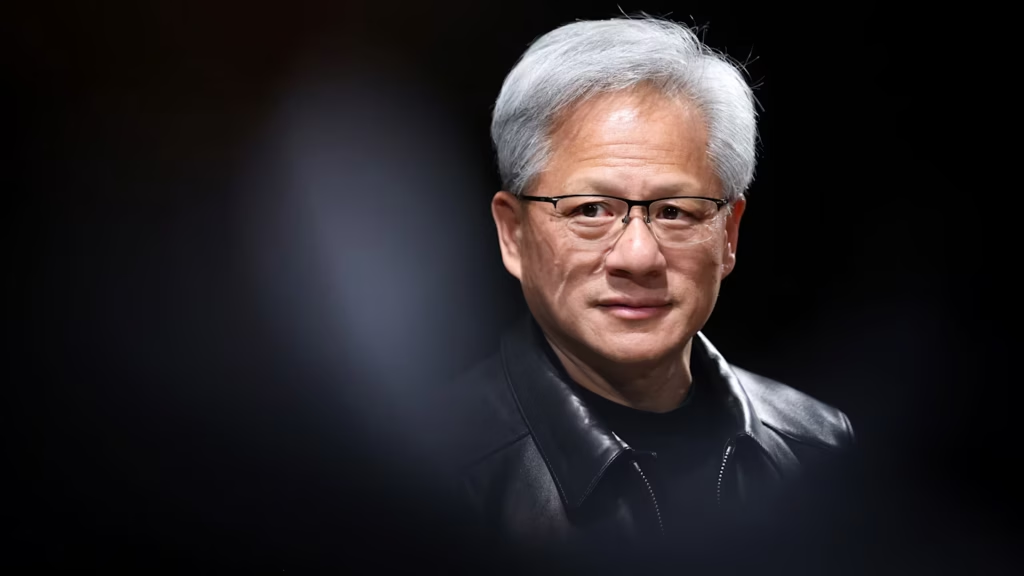
Jensen Huang resigned as president, chief executive and board member of Nvidia on November 12, effective immediately, four days after he acknowledged being unfaithful to his wife and the company’s board opened an investigation into whether a foreign intelligence effort had targeted him. Nvidia’s announcement gives no reason, names Chief Financial Officer Colette Kress as interim CEO and says the board will weigh internal and external candidates. Shares fell as much as 14% to $148.80 in early trading.


The departure removes the executive who has run Nvidia for 33 years at the moment the AI trade leans on the company most. It also reaches crypto through two channels, the Bitcoin miners that now sell computing power to AI customers and the tokenized Nvidia contracts that trade around the clock on crypto venues.
$NVDA analyst sentiment just hit -2.6σ, the most bearish on record.
Four weeks ago the narrative was “AI supercycle.” Now it’s “dot-com bubble.”
Bitcoin sells off with risk assets, but it bounces when liquidity comes back, usually before earnings do.
Extreme bearishness often signals the end of selling, not the start.
— Ki Young Ju (@ki_young_ju) November 9, 2026
Nvidia lost $190 billion in a day, then fell another 14% on the resignation
| Measure | Figure |
| Effective date | November 12, 2026, immediately |
| Interim CEO | Colette Kress, who stays CFO |
| Share price after the admission (November 9) | Down 4.27% to $178.67, about $190 billion in market value |
| Share price on resignation day | As low as $148.80, down as much as 14% |
| Huang’s stake | 3.56%, with no super-voting shares |
| Executives reporting to Huang | About 60, with no chief operating officer |
| Next test | Third-quarter results on November 17 |
Key moments
November 8: Huang acknowledges being unfaithful to his wife, and the board announces an investigation into reports that he was targeted by a foreign intelligence effort. The board says it has no reason to believe national security or Nvidia secrets were compromised.
November 9: Shares fall more than 4%, and shareholders file a proposed class action in San Jose, California, alleging Nvidia misled investors about the relationship. The suit’s claims are allegations and have not been tested in court.
November 12: Nvidia announces the resignation, and Harvey C. Jones becomes the first chair of the board in the company’s history.
November 17: Nvidia reports quarterly results as scheduled, the first under an interim CEO.
RELATED STORY: Nvidia Shareholders Sue Jensen Huang Over Alleged Chinese Spy Ties
Why the AI trade depends on one executive
Few formal structures stood between Nvidia’s chief executive and the market. Nvidia’s proxy statement lists Huang with 3.58% of the company and shows only common stock, so he held no super-voting shares and his influence rested on authority rather than control. Nvidia has no chief operating officer, and about 60 executives reported to Huang directly, so no single executive stood next in line when he resigned. The company has also operated without a chief compliance officer, relying instead on a committee made up of its chief financial officer, its head of operations and its head of human resources.
Nic Puckrin, CEO of the crypto research firm Coin Bureau, argued on X that pushing Huang out could hurt the wider AI industry, because Huang negotiated in person the financing deals that pay for much of the chip buildout.
Replacing Jensen as CEO of Nvidia could backfire on the ENTIRE AI boom.
Why?
Because of this chart.
Jensen has been one of the biggest architects of circular financing.
This has been propping up those valuations and nearly all of these deals were negotiated by him.
Would a successor be able to engineer similar structures?
And does uncertainty with Nvidia’s direction call into question this broader gambit?
Tenuous times.
— Nic (@puckrin) November 12, 2026
How crypto is exposed
Nvidia’s problems reached crypto through two routes, the on-chain products that track its share price and the Bitcoin miners that now sell computing power to AI customers. Nvidia perpetual futures on Hyperliquid trade around the clock, so they were already sliding on Sunday, November 8, while US exchanges were closed. The tokenized stock NVDAx, which tracks Nvidia’s share price on-chain, attracted money during the selloff.
DefiLlama showed $81.73 million in assets under management in the token on November 12, with net flows of $30.23 million over seven days and $41.25 million over 30 days, while the token traded at $165.35. The seven-day window began before the admission, so the inflows cannot be tied to the resignation alone.

That demand sits inside a fast-growing market. Stocks accounted for 43.1% of the $3.16 trillion in cumulative volume across 19 on-chain perpetual venues from late December to the end of August, and 62.3% of volume in August alone, according to the CoinMarketCap RWA Perps Quarterly Report.
The more lasting exposure sits with Bitcoin miners that rent computing power to AI customers. Fourteen public companies sold 108,247 BTC worth about $8.08 billion in 2026, according to Lookonchain data covered by DeFi Planet, to repay convertible debt and fund AI expansion. A prolonged slowdown in AI spending would weaken the business those sales are meant to build. Tokens tied to AI, including Bittensor, Render and the Artificial Superintelligence Alliance, carry the same sentiment risk, though no price moves for them have been confirmed since the resignation.
READ ALSO: Can Decentralized AI Really Compete With OpenAI, Google, and Meta?
How past CEOs fared after relationship scandals
| CEO and company | Year | What came out | How it ended |
| Harry Stonecipher, Boeing | 2005 | Board found a relationship with a female executive violated the code of conduct | Resigned |
| Mark Hurd, HP | 2010 | Inquiry into a contractor’s complaint found falsified expense reports | Resigned, then joined Oracle weeks later |
| Brian Krzanich, Intel | 2018 | Past consensual relationship with an employee broke the non-fraternization policy | Resigned |
| Steve Easterbrook, McDonald’s | 2019 | Consensual relationship with an employee violated policy | Terminated, then charged by the SEC in 2023 over misleading investors |
| Andy Byron, Astronomer | 2025 | Viral concert video with a colleague | Resigned within days |
| Laurent Freixe, Nestlé | 2025 | Undisclosed relationship with a direct subordinate | Dismissed after an investigation |
| Jeff Bezos, Amazon | 2019 | Tabloid exposed his relationship, and he accused the publisher of blackmail | Stayed CEO until 2021 |
Six of the seven left their jobs. In most cases the trigger was a breach of company policy, such as a relationship with a subordinate or falsified expenses, and not the affair itself. Bezos stayed because no policy was breached and because he was Amazon’s founder and largest shareholder. Huang’s case differs on both counts, since the allegations involve a possible national security risk and a shareholder suit, neither of which the cases in this table involved.
READ ALSO: Microsoft Urges Trump Administration to Drop Proposed Ban on Chinese AI Hardware
The Streets of social media have not been quiet
News of the resignation spread on X within minutes of Nvidia’s release. Technology analyst Sarbjeet Johal called it the “end of an era” and noted that Huang had resigned from every position, including CEO, president and board member, as the stock fell about 10%.
End of an era! @nvidia CEO Jensen Huang resigns, effective immediately. CFO is appointed as the interim CEO. Stock down by 10%. Jensen resigns from all positions, including CEO, president, and board role.
@dvellante @furrier https://t.co/mEil8EY55E
— Sarbjeet Johal (@sarbjeetjohal) November 12, 2026
Hugging Face CEO Clement Delangue, who leads one of the largest open-source AI platforms, wrote that “this whole thing sucks, and I wish none of it had happened.”
This whole thing sucks, and I wish none of it had happened. It’s a really sad day!
But I want to make one thing clear: we’ll keep fighting for open-source AI, harder than ever. This is too important to slow down now. Let’s go!
— clem 🤗 (@ClementDelangue) November 12, 2026
The political response was sharper. Senator Elizabeth Warren (D-MA) said in a post on X that Huang’s decision to resign “does not absolve him, other executives, or the company as a whole” and that “they still owe Congress answers.”
Warren’s post suggests the scrutiny that began when Senator Chris Coons (D-DE) called on November 9 for an investigation into whether national security was compromised will outlast the resignation. The post immediately drew reactions, including the ire of some users who deem the pressure on Nvidia and Huang from notable Democrat lawmakers unwarranted. A user on X (@daseinwelt), directly responding to Warren tweeted,
“People like you who created nothing, who have no meaningful contributions to the country but you suddenly care about national security by hunting the man who built the backbone of AI revolution. You should rename yourself to Elizabeth Karren.”
What to watch
The November 17 earnings call. Nvidia is due to report Q3 earnings five days after Huang’s exit, with Colette Kress presenting as interim chief executive and still serving as chief financial officer. Analysts will listen for any change to the product roadmap, and the stock’s reaction will show how much confidence investors place in a leadership team without its founder.
Succession. Nvidia’s Form 8-K says the board will search for a permanent chief executive while Kress serves on an interim basis. Chair Harvey C. Jones, 73, has sat on the board since 1993, so the choice between an internal candidate and an outsider will show how far the board wants to preserve continuity.
The investigations. Several processes are running simultaneously. A committee of independent directors, assisted by outside counsel, is reviewing reports that Huang was targeted by a foreign intelligence effort, according to the board’s November 8 statement. Shareholders have also filed a proposed class action in San Jose that alleges Nvidia misled investors, and those claims remain untested in court. In Congress, Senator Warren has said Huang and the Nvidia “still owe Congress answers”. In other news, The New York Times reports a second relationship Jensen Huang had, this time with Kimberly Powell, an Nvidia VP who reports to him. Neither of them has confirmed it.
Bitcoin and miners. Public miners sold 108,247 BTC in 2026 to repay debt and fund AI expansion, so a slowdown in AI spending after Huang’s exit would weaken the income those sales are meant to build. Further selling would also add supply to the Bitcoin market.
Huang’s resignation leaves Nvidia with an interim chief executive and an unfinished board investigation, five days before its first earnings report without him. Crypto’s exposure runs through the miners and tokenized Nvidia products described above, and both will follow the question the market is now asking about Nvidia, which is whether its AI customers stay committed without the founder who built the business.
FAQs
Why did Jensen Huang resign?
Nvidia’s announcement gives no reason. It followed Huang’s acknowledgment of infidelity on November 8 and the board’s investigation into reports that he was targeted by a foreign intelligence effort.
Who runs Nvidia now?
Colette Kress, the chief financial officer, is interim CEO while the board searches for a permanent successor.
Will the resignation crash crypto? >
Bitcoin fell toward $71,000 on the day, though part of the decline is tied to comments from a Federal Reserve official. The larger exposure sits in Bitcoin miners with AI contracts and in tokenized Nvidia products.
Enjoyed this? Bookmark DeFi Planet, explore related topics, and follow us on Twitter, LinkedIn, Facebook, Instagram, Threads, and CoinMarketCap Community for seamless access to high-quality industry insights.
Take control of your crypto portfolio with DEFI PLANET PRO, DeFi Planet’s suite of analytics tools.