










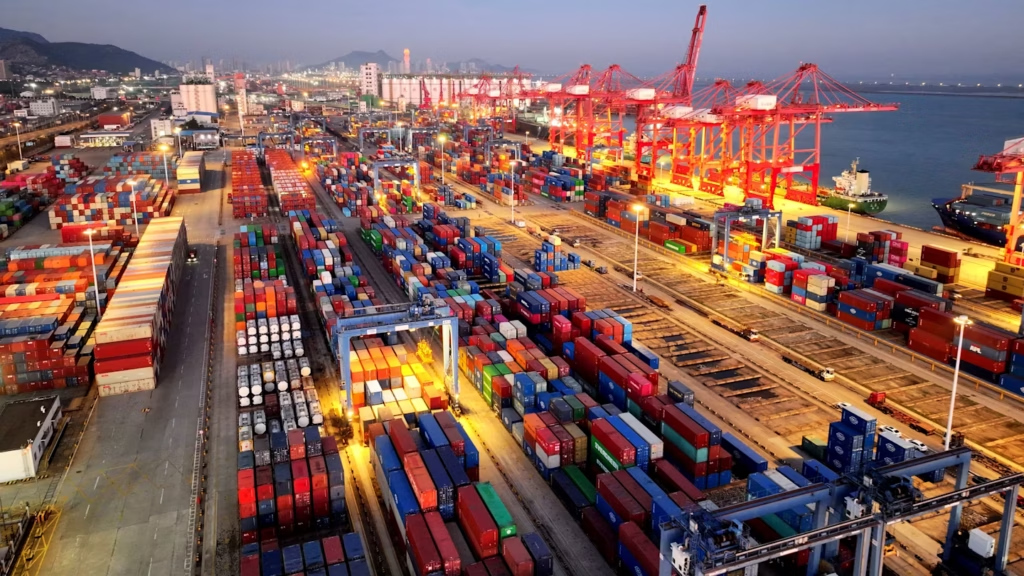
China’s trade surplus narrowed to $105.28 billion in October 2026, falling short of market expectations of approximately $126 billion. This was also a significant drop from September’s record surplus of $133.53 billion.

Despite the monthly decline, China’s trade surplus has exceeded $1.04 trillion year to date, putting the country on track to record a second consecutive annual high.
China’s latest trade numbers confirm that the country is on track to exceed its record 2025 trade surplus of $1.2 trillion.
Powered by a 35.2% annualized growth rate in exports, beating the consensus forecast of 33.5%, China recorded a monthly trade surplus of $105 million in October. This takes its cumulative year-to-date surplus to $1 trillion.
While these figures are impressive and reflect a critical engine for the broader economy, China is getting closer and closer to maximum export saturation in several key global markets, significantly increasing the risk of retaliatory protectionist measures.
#economy #markets #China #trade— Mohamed A. El-Erian (@elerianm) November 10, 2026
The main reason for the narrower surplus was a 41.6% year-over-year increase in imports, which reached $307.05 billion. The increase was largely driven by strong domestic demand for integrated circuits, memory hardware, and data center components needed to support artificial intelligence (AI) infrastructure.
Meanwhile, Chinese exports grew by 35.2% to $412.33 billion, supported mainly by electric vehicles and electronic components. However, a stronger Chinese yuan, which reached a four-year high, created additional pressure on the value of overseas sales.
Read also: Trump and Xi Meet in Washington as US-China Trade Deal Holds
China’s AI expansion raises concerns about global semiconductor supply
As Chinese manufacturers acquire more advanced computing components for domestic AI infrastructure, competition for semiconductor supplies is increasing. This could raise hardware costs for decentralized physical infrastructure networks (DePIN) and cryptocurrency miners outside China, which depend on many of the same semiconductor supply chains.
China’s reliance on imported computing hardware to support its export manufacturing sector also creates potential vulnerabilities.
On X, Enlightened Developers questioned how sustainable this strategy would be if Western governments suddenly restricted China’s exports of advanced technology. They also argued that declining domestic consumption has made China increasingly dependent on the money generated by its export industry.
Imagine what would happen if china’s exports r banned? Their domestic consumption has decreased and they r dependent on exports and more than a trillion dollars r coming through it. They r currently importing AI hardware more so they can manufacture more? This brings us back to the same question what if their exports get banned?
— Enlightened (@eidevelopers) November 10, 2026
If international tariffs or export restrictions disrupt the flow of AI-powered electronics from China, the country could be left with large amounts of unused, state-controlled computing infrastructure.
This situation could resemble the stranded assets left behind after China’s nationwide Bitcoin mining ban in 2021, which forced mining operations to shut down or relocate.
Read also: Singapore, China Eye AI and Green Economy for Next Growth Phase
The narrowing trade also brings global liquidity and crypto concerns
China’s changing trade balance could also affect global financial liquidity, an important factor influencing cryptocurrency prices.
Historically, China’s large trade surpluses generated substantial US dollar inflows. Some of these dollars were recycled into global financial markets, indirectly supporting risk-sensitive assets such as Bitcoin.
However, the latest figures suggest that this pattern could be changing. On X, Nari highlighted the changing market expectations, noting that a monthly trade surplus of $105 billion is no longer enough to impress Wall Street.
@WatcherGuru Even $105 billion isn’t enough to impress Wall Street anymore.
— Nari ต๊ะ (@iiws_ja) November 10, 2026
The October surplus fell more than $20 billion below market expectations, raising questions about whether the decline could affect global dollar circulation. Another commenter on X, Kumura, focused on the currency market implications, asking how the unexpected decline in China’s trade surplus could affect USD/CNH spot liquidity.
@WatcherGuru What impact are you seeing on the USD/CNH spot liquidity after that surprise drop in the surplus?
— クリプトトレイン / TAIKI KUMURA (@blt_s) November 10, 2026
At the same time, the People’s Bank of China is actively guiding the yuan higher, with the currency reaching a four-year high. These developments suggest that the amount of additional US dollars accumulating in China’s reserves could decline as trade dynamics change.
For the cryptocurrency market, which generally benefits from expanding global liquidity and expectations of dollar debasement, a sustained narrowing of China’s trade surplus could create an additional macroeconomic headwind.
Enjoyed this? Bookmark DeFi Planet, explore related topics, and follow us on Twitter, LinkedIn, Facebook, Instagram, Threads, and CoinMarketCap Community for seamless access to high-quality industry insights.
Take control of your crypto portfolio with DEFI PLANET PRO, DeFi Planet’s suite of analytics tools.