


























































Most new perp DEXs face the same problem after the mainnet: the market may be live, but the venue still has to prove that real flow, usable liquidity, and trading volume can stick.

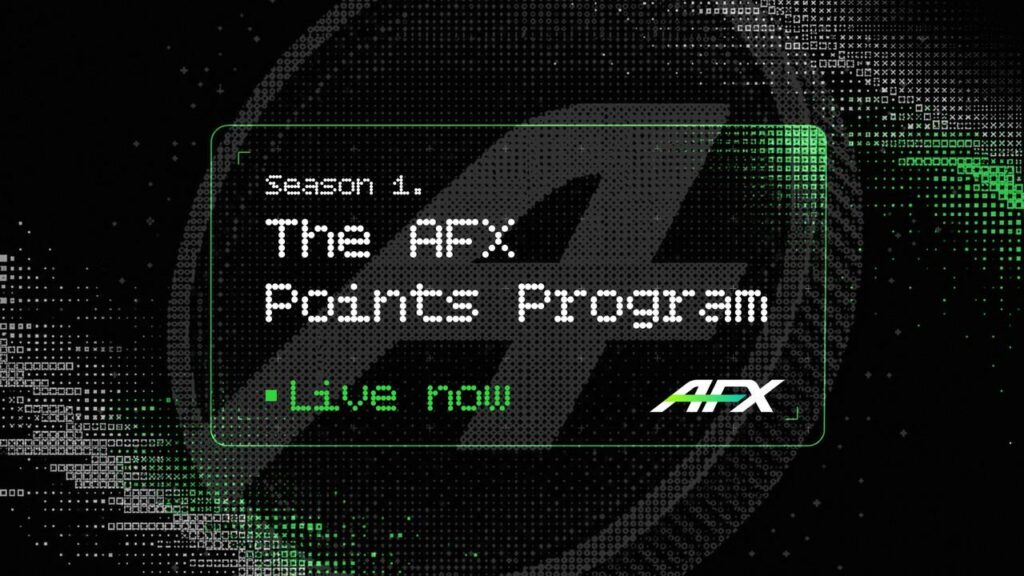
AFX, a high-performance sovereign L1 purpose-built for decentralized derivatives, is now entering its next phase with the launch of its Points Program, a season-based incentive system for traders, LPs, guilds, and trading communities. Positioned as an emerging challenger in the Hyperliquid category, AFX is using the program to support the early growth of an on-chain derivatives venue built around an orderbook model, self-custody, on-chain settlement, and low-latency execution.
Incentives in perp markets nowadays should go beyond rewarding early users. They actually influence where liquidity sits, how traders behave, whether API flow overwhelms manual users, and how much of the activity is real versus farmed. A poorly designed points program can make a new venue look active without improving the trading experience.
AFX’ s structure is built around that tradeoff. Instead of putting every participant into one large rewards bucket, the program separates trading, LP Vault deposits, guild competition, referrals, and API activity into different lanes. Season 1 runs from May 25 to July 20, 2026, with weekly settlement and a total allocation of 3.8 million points.
A Three-Season Program
The AFX Points Program will run across three seasons. Each season has its own points pool, but points do not reset when a season ends. Points from all seasons, together with retroactive testnet points, will accumulate and convert into native tokens at TGE.
Season 1 is split into two main pools:
Trading + AFX LP Vault Pool: 2,885,714 points in total, distributed at 360,714 points per week.
Guild Pool: 914,286 points in total, distributed at 114,286 points per week.
That split says something about the early priorities. AFX is not only trying to create volume. It is trying to seed market depth, recurring trading behavior, and community-led distribution at the same time.
Trading Points Are Not Only About Volume
AFX’ s trading points are not calculated purely by raw volume. The scoring model looks at trade
execution, position contribution, and market diversity.
In practice, taking and making orders, holding open positions, and trading across multiple markets can all matter. The program is trying to reward activity that improves the venue’s market structure, not just activity that prints a bigger volume number.
That distinction matters in perp DEXs. Volume is easy to incentivize and easy to distort. Open interest depth, market diversity, and consistent execution behavior are harder to fake at scale and more relevant to whether traders can actually use the venue.
AFX has not published the exact scoring weights, and the criteria may change over time. That is fairly standard for points programs, since full formula transparency can make the system easier to exploit.
LP Vault Incentives Focus on Early Depth
Season 1 also gives weight to the AFX LP Vault. Users who deposit into the vault earn points based on their contribution to liquidity depth.
The LP Vault shares the same combined pool as trading points, but the split between trading and LP rewards is adjusted dynamically each week. Users can trade and provide liquidity at the same time, with both activities counted separately.
This is one of the more relevant parts of the program for a new perp DEX. A derivatives venue can launch markets quickly, but execution quality depends on depth. Thin liquidity leads to worse fills, more fragile markets, and less confidence during volatility.
By including LP Vault deposits directly in Season 1, AFX is putting early liquidity depth on the same level as trading activity.
Retail and API Users Get Separate Lanes
AFX divides trading points into two independent sub-pools. Manual users trading through web or mobile sit in the Retail Pool. API users, including market makers, quant teams, and high-frequency traders, sit in a separate API Pool.
The two groups do not compete for the same points. API users may generate large volumes, but that activity does not reduce the points available to manual traders.
That is a practical distinction. API flow can support liquidity and tighter markets, but if API users share the same incentive pool with manual traders, rewards can quickly tilt toward automated strategies.
AFX’ s API allocation is adjusted dynamically based on API users’ contribution to total protocol volume. The API pool also includes caps to prevent a small number of accounts from absorbing too much of the allocation.
Manual traders and automated participants both matter, but they do not behave the same way. Treating them as separate cohorts makes the points system harder to dominate with one type of flow.
Guild League Adds Community Competition
AFX’ s Guild League adds a team-based layer to the program. Captains create guilds, invite
members, and compete on weekly trading volume.
Each week, the top 50 guilds share the Guild Pool through a five-tier structure. Each tier receives 20% of the weekly allocation, with more guilds included at lower tiers. Within each guild, points are split between the Captain and members, with the members’ portion distributed according to individual trading contributions.
The weekly reset is important. Rankings restart every week, so early winners do not carry a permanent advantage. Smaller or newly formed guilds still have a reason to compete in later weeks.
AFX also sets an activity threshold. A guild must have at least 10 active members, and each qualifying member must generate at least $1,000 in weekly trading volume. Inactive or placeholder accounts do not count.
That makes the guild system harder to pad with empty accounts and keeps the rewards linked to actual trading.
Referral Rewards Are Paid in Points and USDC
AFX also includes a referral commission layer distributed daily in USDC. The commission rate is based on the cumulative trading volume of the user’s referral network. As the network becomes more active, the commission tier increases. The maximum combined commission rate can reach 40%, including bonus commission from the next level of the referral network.
Referral rewards are issued as points and will convert at TGE alongside other mainnet points. AFX says referral activity is also subject to anti-abuse checks, including self-referral, wash trading, and coordinated manipulation.
Anti-Sybil Controls and Real Score
Points programs usually attract two types of activity: users who want to trade, and users who want to farm.
AFX says it uses a multi-layered behavioral analysis system to detect wash trading, self-trading, coordinated wallet clusters, abnormal trading patterns, and bot-driven activity.
The system applies a “Real Score” multiplier to raw points. Accounts showing genuine and diversified trading behavior may receive full or enhanced rewards. Accounts flagged as suspicious may see their allocations reduced or removed.
What Season 1 Tests
Season 1 is where AFX starts turning architecture into actual market behavior.
The design is not trying to win on one metric. Trading activity, LP depth, API flow, manual users, guilds, and referrals are all treated as separate parts of the same early market. That gives AFX a better chance of building liquidity that is not only visible on launch week, but useful once traders begin testing the venue more seriously.
The structure also leaves room for the market to find its shape. LPs can support depth, active traders can build flow, API users can strengthen the book, and guilds can bring in coordinated participation without crowding out individual users.
For a new perp DEX, that is a healthier starting point. Incentives alone will not create a durable venue, but they can help direct the first wave of activity toward the right behavior.
If Season 1 works as intended, AFX should enter its next phase with deeper liquidity, more consistent participation, and a clearer base of users who are there to trade rather than only farm.
Documentation lives at afx-docs.gitbook.io/afx.
Trade and deposit at app.afx.xyz/trade.
Join the Discord and follow @AFX_XYZ for weekly settlement updates.
Disclaimer
This is a sponsored post. The information provided in this article is for informational purposes only and does not constitute financial advice. DeFi Planet does not endorse or recommend any specific investment decisions and reminds readers to conduct their own research and due diligence before taking any financial actions. Digital assets are highly volatile and can lose some or all of their value. DeFi Planet is not responsible, directly or indirectly, for any damage or loss caused or alleged to be caused by or in connection with the use of or reliance on any content, goods, or services mentioned in the article.
Enjoyed this? Bookmark DeFi Planet, explore related topics, and follow us on Twitter, LinkedIn, Facebook, Instagram, Threads, and CoinMarketCap Community for seamless access to high-quality industry insights.
Take control of your crypto portfolio with DEFI PLANET PRO, DeFi Planet’s suite of analytics tools.